

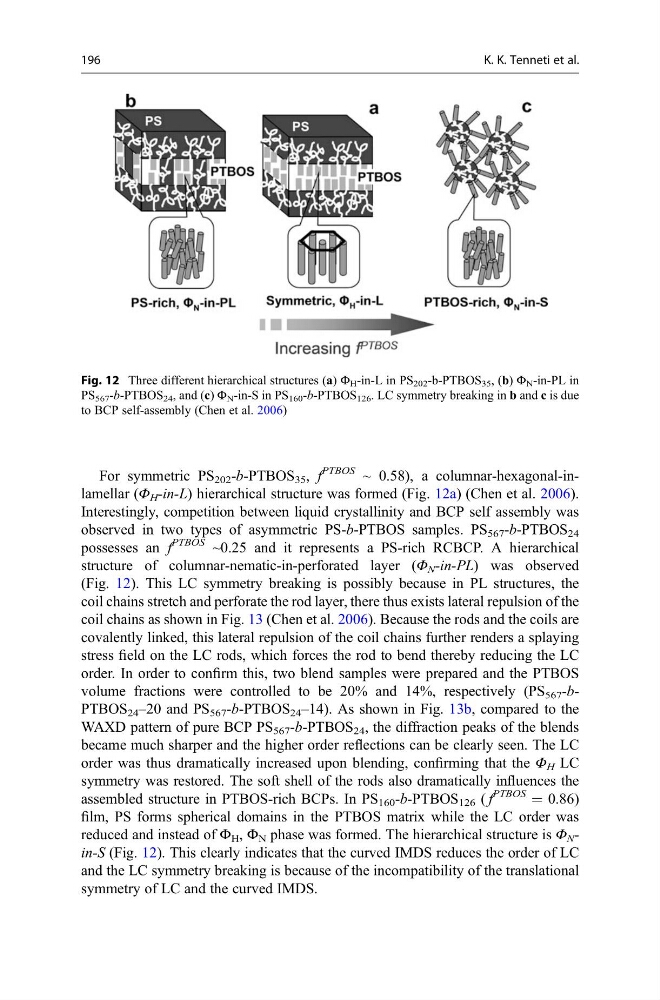
For symmetric PS 202 -b-PTBOS 35 , f
PTBOS ~ 0.58), a columnar-hexagonal-inlamellar (Φ H -in-L) hierarchical structure was formed (Fig. 12a) (Chen et al. 2006).
Interestingly, competition between liquid crystallinity and BCP self assembly was
observed in two types of asymmetric PS-b-PTBOS samples. PS 567 -b-PTBOS 24
possesses an f
PTBOS ~0.25 and it represents a PS-rich RCBCP. A hierarchical
structure of columnar-nematic-in-perforated layer (Φ N -in-PL) was observed
(Fig. 12). This LC symmetry breaking is possibly because in PL structures, the
coil chains stretch and perforate the rod layer, there thus exists lateral repulsion of the
coil chains as shown in Fig. 13 (Chen et al. 2006). Because the rods and the coils are
covalently linked, this lateral repulsion of the coil chains further renders a splaying
stress field on the LC rods, which forces the rod to bend thereby reducing the LC
order. In order to confirm this, two blend samples were prepared and the PTBOS
volume fractions were controlled to be 20% and 14%, respectively (PS 567 -bPTBOS 24 –20 and PS 567 -b-PTBOS 24 –14). As shown in Fig. 13b, compared to the
WAXD pattern of pure BCP PS 567 -b-PTBOS 24 , the diffraction peaks of the blends
became much sharper and the higher order reflections can be clearly seen. The LC
order was thus dramatically increased upon blending, confirming that the Φ H LC
symmetry was restored. The soft shell of the rods also dramatically influences the
assembled structure in PTBOS-rich BCPs. In PS 160 -b-PTBOS 126 ( f
PTBOS
= 0.86)
film, PS forms spherical domains in the PTBOS matrix while the LC order was
reduced and instead of Φ H , Φ N phase was formed. The hierarchical structure is Φ N -
in-S (Fig. 12). This clearly indicates that the curved IMDS reduces the order of LC
and the LC symmetry breaking is because of the incompatibility of the translational
symmetry of LC and the curved IMDS.
Fig. 12 Three different hierarchical structures (a) Φ H -in-L in PS 202 -b-PTBOS 35 , (b) Φ N -in-PL in
PS 567 -b-PTBOS 24 , and (c) Φ N -in-S in PS 160 -b-PTBOS 126 . LC symmetry breaking in b and c is due
to BCP self-assembly (Chen et al. 2006)
196
K. K. Tenneti et al.
PTBOS ~ 0.58), a columnar-hexagonal-inlamellar (Φ H -in-L) hierarchical structure was formed (Fig. 12a) (Chen et al. 2006).
Interestingly, competition between liquid crystallinity and BCP self assembly was
observed in two types of asymmetric PS-b-PTBOS samples. PS 567 -b-PTBOS 24
possesses an f
PTBOS ~0.25 and it represents a PS-rich RCBCP. A hierarchical
structure of columnar-nematic-in-perforated layer (Φ N -in-PL) was observed
(Fig. 12). This LC symmetry breaking is possibly because in PL structures, the
coil chains stretch and perforate the rod layer, there thus exists lateral repulsion of the
coil chains as shown in Fig. 13 (Chen et al. 2006). Because the rods and the coils are
covalently linked, this lateral repulsion of the coil chains further renders a splaying
stress field on the LC rods, which forces the rod to bend thereby reducing the LC
order. In order to confirm this, two blend samples were prepared and the PTBOS
volume fractions were controlled to be 20% and 14%, respectively (PS 567 -bPTBOS 24 –20 and PS 567 -b-PTBOS 24 –14). As shown in Fig. 13b, compared to the
WAXD pattern of pure BCP PS 567 -b-PTBOS 24 , the diffraction peaks of the blends
became much sharper and the higher order reflections can be clearly seen. The LC
order was thus dramatically increased upon blending, confirming that the Φ H LC
symmetry was restored. The soft shell of the rods also dramatically influences the
assembled structure in PTBOS-rich BCPs. In PS 160 -b-PTBOS 126 ( f
PTBOS
= 0.86)
film, PS forms spherical domains in the PTBOS matrix while the LC order was
reduced and instead of Φ H , Φ N phase was formed. The hierarchical structure is Φ N -
in-S (Fig. 12). This clearly indicates that the curved IMDS reduces the order of LC
and the LC symmetry breaking is because of the incompatibility of the translational
symmetry of LC and the curved IMDS.
Fig. 12 Three different hierarchical structures (a) Φ H -in-L in PS 202 -b-PTBOS 35 , (b) Φ N -in-PL in
PS 567 -b-PTBOS 24 , and (c) Φ N -in-S in PS 160 -b-PTBOS 126 . LC symmetry breaking in b and c is due
to BCP self-assembly (Chen et al. 2006)
196
K. K. Tenneti et al.