

An Introduction to Liquid Crystal Concept and Its Origin
Academic studies on liquid crystals have started more than 120 years ago, which
have now taken the interest of the scientific community for their possible vast
practical applications (Reinitzer 1989; Dunmur and Sluckin 2014). As the name
suggests, liquid crystal compounds can combine the properties of a solid crystalline
material and a liquid. Just like a liquid, they can flow and take the form of the
container where it holds; however, at the same time, they exhibit anisotropic
behavior similar to solids in an astonishing way. Hence, the physical characteristics
of these materials are expected to be different in different directions named as
anisotropic liquids sometimes. Thermodynamically, a liquid crystalline state of a
material is a stable phase, which is an intermediate of the amorphous and crystalline
state of a solid. Therefore, this phase of the materials is often named as the
mesomorphic state, also called the mesogens originally adapted from the Greek
word “mesos” meaning intermediate (Goodby et al. 2014).
Once again the origin of liquid crystals is way back to the year 1888 when
Austrian chemist Friedrich Reinitzer has observed a peculiar behavior of a solid
after subjecting it to the different temperatures (Reinitzer 1989). He has noticed that
at a particular temperature, cholesteryl benzoate solid becomes hazy liquid and again
is converted to a clear liquid once the material is heated to a higher temperature.
During cooling, he has observed that the liquid again passes through two different
colors before, finally, it achieves the white solid nature. This material also exhibits
different melting points, which is quite surprising. Later on, Lahmann analyzed the
material and found the presence of multiple small crystallites with improper boundaries indicating that the first intermediate fluid remains crystalline by nature and
expecting this to be a new state of a matter. After prolonged studies and analysis,
Lahmann named his finding as liquid crystals (Lehmann 1900). Later in 1850,
Heintz has also observed the fact that natural fats show two different melting points
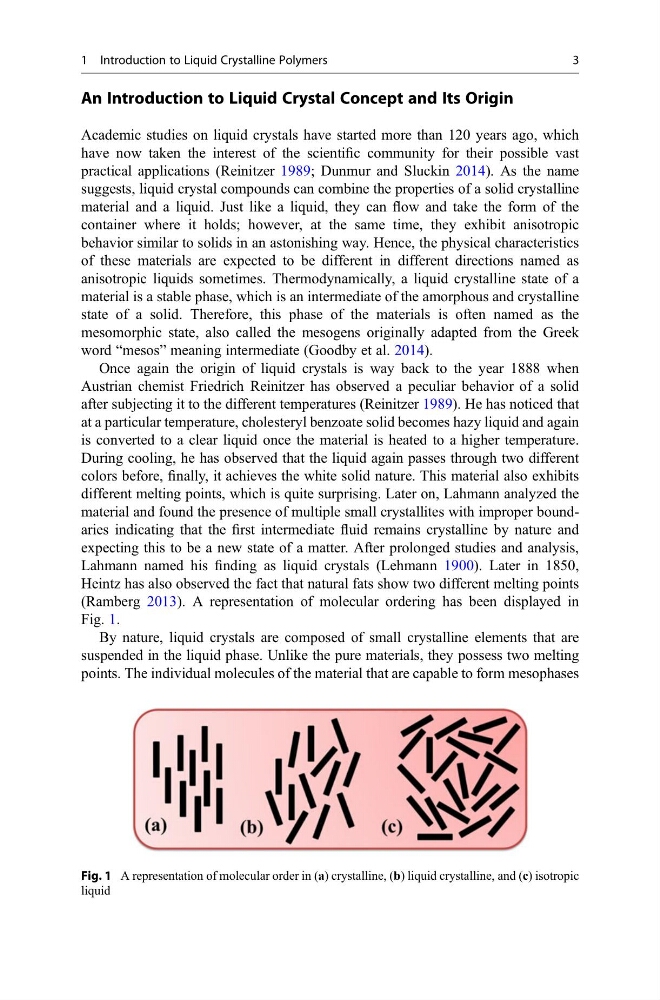
(Ramberg 2013). A representation of molecular ordering has been displayed in
Fig. 1.
By nature, liquid crystals are composed of small crystalline elements that are
suspended in the liquid phase. Unlike the pure materials, they possess two melting
points. The individual molecules of the material that are capable to form mesophases
Fig. 1 A representation of molecular order in (a) crystalline, (b) liquid crystalline, and (c) isotropic
liquid
1 Introduction to Liquid Crystalline Polymers
3
Academic studies on liquid crystals have started more than 120 years ago, which
have now taken the interest of the scientific community for their possible vast
practical applications (Reinitzer 1989; Dunmur and Sluckin 2014). As the name
suggests, liquid crystal compounds can combine the properties of a solid crystalline
material and a liquid. Just like a liquid, they can flow and take the form of the
container where it holds; however, at the same time, they exhibit anisotropic
behavior similar to solids in an astonishing way. Hence, the physical characteristics
of these materials are expected to be different in different directions named as
anisotropic liquids sometimes. Thermodynamically, a liquid crystalline state of a
material is a stable phase, which is an intermediate of the amorphous and crystalline
state of a solid. Therefore, this phase of the materials is often named as the
mesomorphic state, also called the mesogens originally adapted from the Greek
word “mesos” meaning intermediate (Goodby et al. 2014).
Once again the origin of liquid crystals is way back to the year 1888 when
Austrian chemist Friedrich Reinitzer has observed a peculiar behavior of a solid
after subjecting it to the different temperatures (Reinitzer 1989). He has noticed that
at a particular temperature, cholesteryl benzoate solid becomes hazy liquid and again
is converted to a clear liquid once the material is heated to a higher temperature.
During cooling, he has observed that the liquid again passes through two different
colors before, finally, it achieves the white solid nature. This material also exhibits
different melting points, which is quite surprising. Later on, Lahmann analyzed the
material and found the presence of multiple small crystallites with improper boundaries indicating that the first intermediate fluid remains crystalline by nature and
expecting this to be a new state of a matter. After prolonged studies and analysis,
Lahmann named his finding as liquid crystals (Lehmann 1900). Later in 1850,
Heintz has also observed the fact that natural fats show two different melting points
(Ramberg 2013). A representation of molecular ordering has been displayed in
Fig. 1.
By nature, liquid crystals are composed of small crystalline elements that are
suspended in the liquid phase. Unlike the pure materials, they possess two melting
points. The individual molecules of the material that are capable to form mesophases
Fig. 1 A representation of molecular order in (a) crystalline, (b) liquid crystalline, and (c) isotropic
liquid
1 Introduction to Liquid Crystalline Polymers
3