

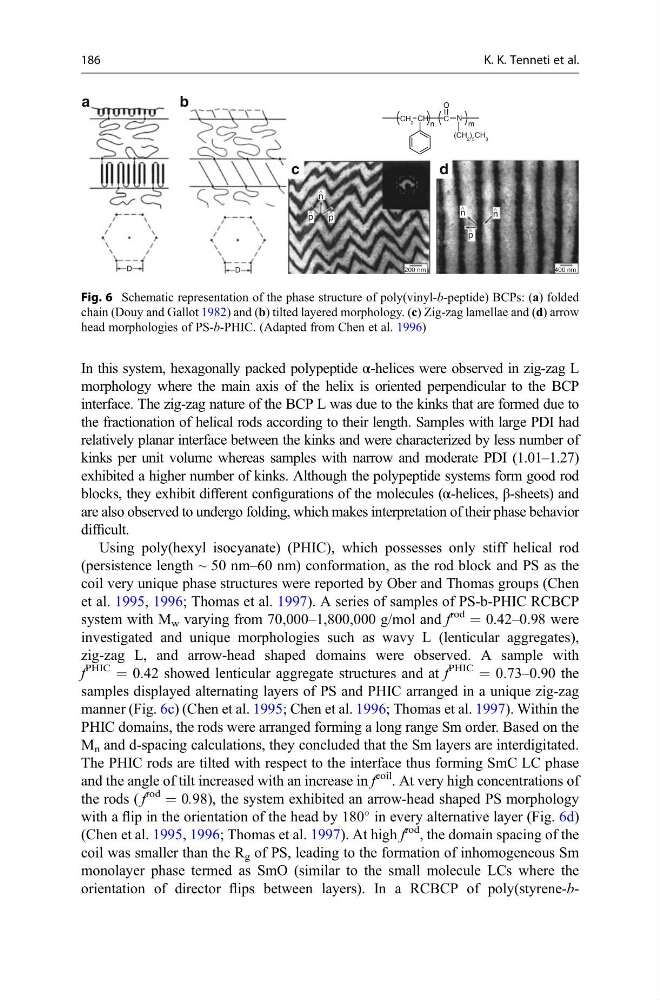
In this system, hexagonally packed polypeptide α-helices were observed in zig-zag L
morphology where the main axis of the helix is oriented perpendicular to the BCP
interface. The zig-zag nature of the BCP L was due to the kinks that are formed due to
the fractionation of helical rods according to their length. Samples with large PDI had
relatively planar interface between the kinks and were characterized by less number of
kinks per unit volume whereas samples with narrow and moderate PDI (1.01–1.27)
exhibited a higher number of kinks. Although the polypeptide systems form good rod
blocks, they exhibit different configurations of the molecules (α-helices, β-sheets) and
are also observed to undergo folding, which makes interpretation of their phase behavior
difficult.
Using poly(hexyl isocyanate) (PHIC), which possesses only stiff helical rod
(persistence length ~ 50 nm–60 nm) conformation, as the rod block and PS as the
coil very unique phase structures were reported by Ober and Thomas groups (Chen
et al. 1995, 1996; Thomas et al. 1997). A series of samples of PS-b-PHIC RCBCP
system with M w varying from 70,000–1,800,000 g/mol and f
rod
= 0.42–0.98 were
investigated and unique morphologies such as wavy L (lenticular aggregates),
zig-zag L, and arrow-head shaped domains were observed. A sample with
f
PHIC
= 0.42 showed lenticular aggregate structures and at f
PHIC
= 0.73–0.90 the
samples displayed alternating layers of PS and PHIC arranged in a unique zig-zag
manner (Fig. 6c) (Chen et al. 1995; Chen et al. 1996; Thomas et al. 1997). Within the
PHIC domains, the rods were arranged forming a long range Sm order. Based on the
M n and d-spacing calculations, they concluded that the Sm layers are interdigitated.
The PHIC rods are tilted with respect to the interface thus forming SmC LC phase
and the angle of tilt increased with an increase in f
coil . At very high concentrations of
the rods ( f
rod
= 0.98), the system exhibited an arrow-head shaped PS morphology
with a flip in the orientation of the head by 180
in every alternative layer (Fig. 6d)
(Chen et al. 1995, 1996; Thomas et al. 1997). At high f
rod , the domain spacing of the
coil was smaller than the R g of PS, leading to the formation of inhomogeneous Sm
monolayer phase termed as SmO (similar to the small molecule LCs where the
orientation of director flips between layers). In a RCBCP of poly(styrene-ba
b
c
d
CH 2
(CH 2 ) 5 CH 3
CH
C
m
n
N
O
D
D
n
∧
n
∧
n
∧
p
∧
p
∧
p
∧
200 nm
400 nm
Fig. 6 Schematic representation of the phase structure of poly(vinyl-b-peptide) BCPs: (a) folded
chain (Douy and Gallot 1982) and (b) tilted layered morphology. (c) Zig-zag lamellae and (d) arrow
head morphologies of PS-b-PHIC. (Adapted from Chen et al. 1996)
186
K. K. Tenneti et al.
morphology where the main axis of the helix is oriented perpendicular to the BCP
interface. The zig-zag nature of the BCP L was due to the kinks that are formed due to
the fractionation of helical rods according to their length. Samples with large PDI had
relatively planar interface between the kinks and were characterized by less number of
kinks per unit volume whereas samples with narrow and moderate PDI (1.01–1.27)
exhibited a higher number of kinks. Although the polypeptide systems form good rod
blocks, they exhibit different configurations of the molecules (α-helices, β-sheets) and
are also observed to undergo folding, which makes interpretation of their phase behavior
difficult.
Using poly(hexyl isocyanate) (PHIC), which possesses only stiff helical rod
(persistence length ~ 50 nm–60 nm) conformation, as the rod block and PS as the
coil very unique phase structures were reported by Ober and Thomas groups (Chen
et al. 1995, 1996; Thomas et al. 1997). A series of samples of PS-b-PHIC RCBCP
system with M w varying from 70,000–1,800,000 g/mol and f
rod
= 0.42–0.98 were
investigated and unique morphologies such as wavy L (lenticular aggregates),
zig-zag L, and arrow-head shaped domains were observed. A sample with
f
PHIC
= 0.42 showed lenticular aggregate structures and at f
PHIC
= 0.73–0.90 the
samples displayed alternating layers of PS and PHIC arranged in a unique zig-zag
manner (Fig. 6c) (Chen et al. 1995; Chen et al. 1996; Thomas et al. 1997). Within the
PHIC domains, the rods were arranged forming a long range Sm order. Based on the
M n and d-spacing calculations, they concluded that the Sm layers are interdigitated.
The PHIC rods are tilted with respect to the interface thus forming SmC LC phase
and the angle of tilt increased with an increase in f
coil . At very high concentrations of
the rods ( f
rod
= 0.98), the system exhibited an arrow-head shaped PS morphology
with a flip in the orientation of the head by 180
in every alternative layer (Fig. 6d)
(Chen et al. 1995, 1996; Thomas et al. 1997). At high f
rod , the domain spacing of the
coil was smaller than the R g of PS, leading to the formation of inhomogeneous Sm
monolayer phase termed as SmO (similar to the small molecule LCs where the
orientation of director flips between layers). In a RCBCP of poly(styrene-ba
b
c
d
CH 2
(CH 2 ) 5 CH 3
CH
C
m
n
N
O
D
D
n
∧
n
∧
n
∧
p
∧
p
∧
p
∧
200 nm
400 nm
Fig. 6 Schematic representation of the phase structure of poly(vinyl-b-peptide) BCPs: (a) folded
chain (Douy and Gallot 1982) and (b) tilted layered morphology. (c) Zig-zag lamellae and (d) arrow
head morphologies of PS-b-PHIC. (Adapted from Chen et al. 1996)
186
K. K. Tenneti et al.