

and oligo (γ-benzyl-L-glutamate) (OBLG) (DP = 10 and 20) (Klok et al. 2000; Klok
and Lecommandoux 2001). OBLG predominantly possesses α-helical conformation
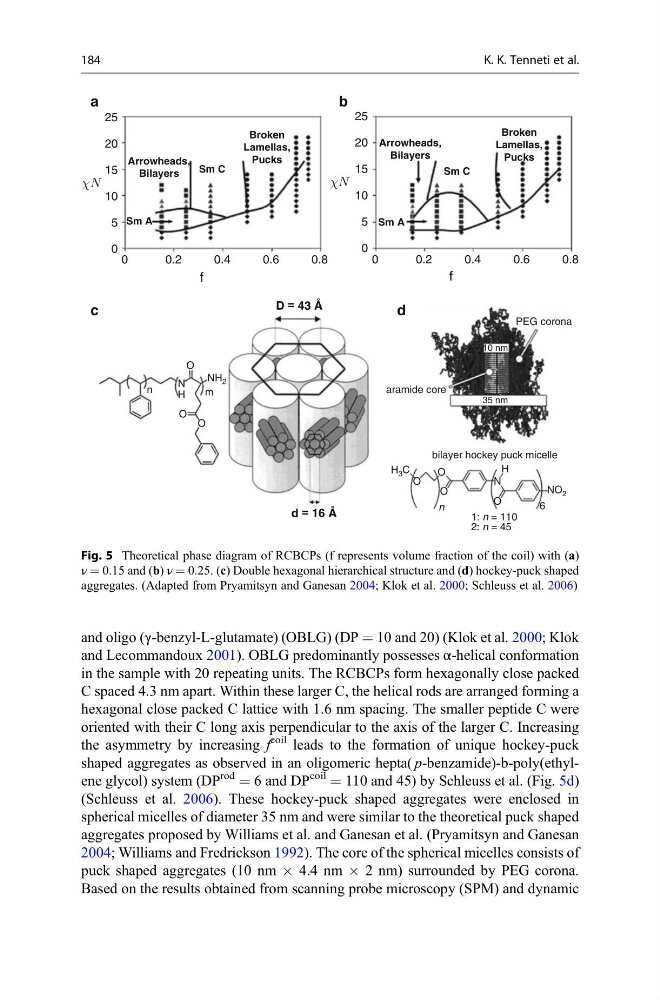
in the sample with 20 repeating units. The RCBCPs form hexagonally close packed
C spaced 4.3 nm apart. Within these larger C, the helical rods are arranged forming a
hexagonal close packed C lattice with 1.6 nm spacing. The smaller peptide C were
oriented with their C long axis perpendicular to the axis of the larger C. Increasing
the asymmetry by increasing f
coil leads to the formation of unique hockey-puck
shaped aggregates as observed in an oligomeric hepta( p-benzamide)-b-poly(ethylene glycol) system (DP
rod
= 6 and DP
coil
= 110 and 45) by Schleuss et al. (Fig. 5d)
(Schleuss et al. 2006). These hockey-puck shaped aggregates were enclosed in
spherical micelles of diameter 35 nm and were similar to the theoretical puck shaped
aggregates proposed by Williams et al. and Ganesan et al. (Pryamitsyn and Ganesan
2004; Williams and Fredrickson 1992). The core of the spherical micelles consists of
puck shaped aggregates (10 nm  4.4 nm  2 nm) surrounded by PEG corona.
Based on the results obtained from scanning probe microscopy (SPM) and dynamic
25
a
b
c
d
20
15
10
5
0
0
0.2
Arrowheads,
Bilayers
Arrowheads,
Bilayers
Broken
Lamellas,
Pucks
Broken
Lamellas,
Pucks
Sm C
Sm C
Sm A
Sm A
0.4
f
0.6
0.8
χN
25
20
15
10
5
0
0
0.2
0.4
f
0.6
0.8
χN
d = 16 Å
D = 43 Å
O
NH 2
m
n
O
O
O
O
O
O
6
H
H 3 C
N
n
1: n = 110
2: n = 45
N
H
bilayer hockey puck micelle
aramide core
PEG corona
35 nm
10 nm
NO 2
Fig. 5 Theoretical phase diagram of RCBCPs (f represents volume fraction of the coil) with (a)
ν = 0.15 and (b) ν = 0.25. (c) Double hexagonal hierarchical structure and (d) hockey-puck shaped
aggregates. (Adapted from Pryamitsyn and Ganesan 2004; Klok et al. 2000; Schleuss et al. 2006)
184
K. K. Tenneti et al.
and Lecommandoux 2001). OBLG predominantly possesses α-helical conformation
in the sample with 20 repeating units. The RCBCPs form hexagonally close packed
C spaced 4.3 nm apart. Within these larger C, the helical rods are arranged forming a
hexagonal close packed C lattice with 1.6 nm spacing. The smaller peptide C were
oriented with their C long axis perpendicular to the axis of the larger C. Increasing
the asymmetry by increasing f
coil leads to the formation of unique hockey-puck
shaped aggregates as observed in an oligomeric hepta( p-benzamide)-b-poly(ethylene glycol) system (DP
rod
= 6 and DP
coil
= 110 and 45) by Schleuss et al. (Fig. 5d)
(Schleuss et al. 2006). These hockey-puck shaped aggregates were enclosed in
spherical micelles of diameter 35 nm and were similar to the theoretical puck shaped
aggregates proposed by Williams et al. and Ganesan et al. (Pryamitsyn and Ganesan
2004; Williams and Fredrickson 1992). The core of the spherical micelles consists of
puck shaped aggregates (10 nm  4.4 nm  2 nm) surrounded by PEG corona.
Based on the results obtained from scanning probe microscopy (SPM) and dynamic
25
a
b
c
d
20
15
10
5
0
0
0.2
Arrowheads,
Bilayers
Arrowheads,
Bilayers
Broken
Lamellas,
Pucks
Broken
Lamellas,
Pucks
Sm C
Sm C
Sm A
Sm A
0.4
f
0.6
0.8
χN
25
20
15
10
5
0
0
0.2
0.4
f
0.6
0.8
χN
d = 16 Å
D = 43 Å
O
NH 2
m
n
O
O
O
O
O
O
6
H
H 3 C
N
n
1: n = 110
2: n = 45
N
H
bilayer hockey puck micelle
aramide core
PEG corona
35 nm
10 nm
NO 2
Fig. 5 Theoretical phase diagram of RCBCPs (f represents volume fraction of the coil) with (a)
ν = 0.15 and (b) ν = 0.25. (c) Double hexagonal hierarchical structure and (d) hockey-puck shaped
aggregates. (Adapted from Pryamitsyn and Ganesan 2004; Klok et al. 2000; Schleuss et al. 2006)
184
K. K. Tenneti et al.