

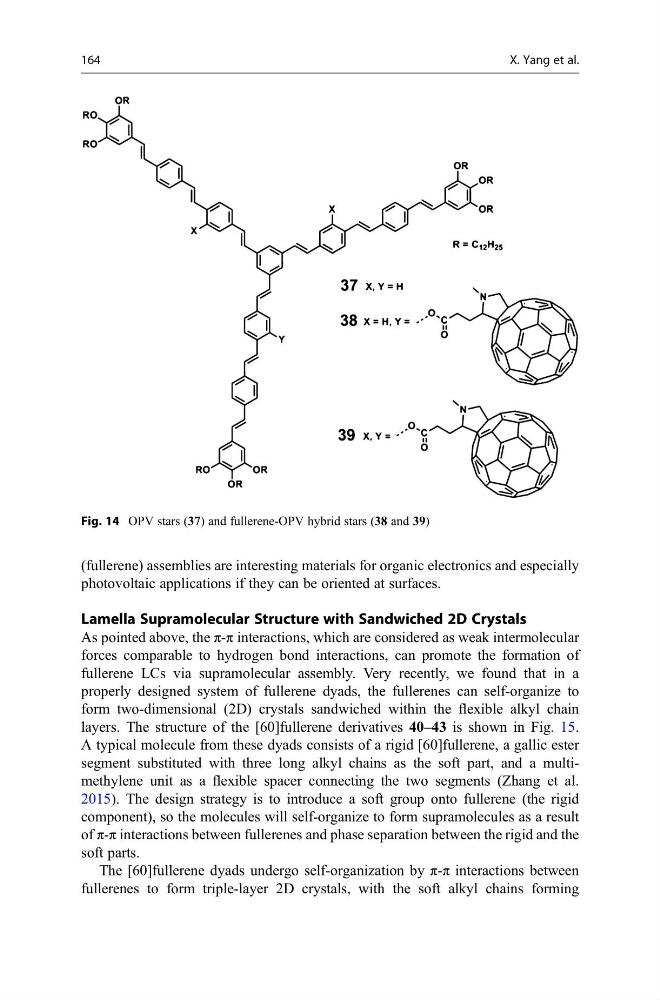
(fullerene) assemblies are interesting materials for organic electronics and especially
photovoltaic applications if they can be oriented at surfaces.
Lamella Supramolecular Structure with Sandwiched 2D Crystals
As pointed above, the π-π interactions, which are considered as weak intermolecular
forces comparable to hydrogen bond interactions, can promote the formation of
fullerene LCs via supramolecular assembly. Very recently, we found that in a
properly designed system of fullerene dyads, the fullerenes can self-organize to
form two-dimensional (2D) crystals sandwiched within the flexible alkyl chain
layers. The structure of the [60]fullerene derivatives 40–43 is shown in Fig. 15.
A typical molecule from these dyads consists of a rigid [60]fullerene, a gallic ester
segment substituted with three long alkyl chains as the soft part, and a multimethylene unit as a flexible spacer connecting the two segments (Zhang et al.
2015). The design strategy is to introduce a soft group onto fullerene (the rigid
component), so the molecules will self-organize to form supramolecules as a result
of π-π interactions between fullerenes and phase separation between the rigid and the
soft parts.
The [60]fullerene dyads undergo self-organization by π-π interactions between
fullerenes to form triple-layer 2D crystals, with the soft alkyl chains forming
Fig. 14 OPV stars (37) and fullerene-OPV hybrid stars (38 and 39)
164
X. Yang et al.
photovoltaic applications if they can be oriented at surfaces.
Lamella Supramolecular Structure with Sandwiched 2D Crystals
As pointed above, the π-π interactions, which are considered as weak intermolecular
forces comparable to hydrogen bond interactions, can promote the formation of
fullerene LCs via supramolecular assembly. Very recently, we found that in a
properly designed system of fullerene dyads, the fullerenes can self-organize to
form two-dimensional (2D) crystals sandwiched within the flexible alkyl chain
layers. The structure of the [60]fullerene derivatives 40–43 is shown in Fig. 15.
A typical molecule from these dyads consists of a rigid [60]fullerene, a gallic ester
segment substituted with three long alkyl chains as the soft part, and a multimethylene unit as a flexible spacer connecting the two segments (Zhang et al.
2015). The design strategy is to introduce a soft group onto fullerene (the rigid
component), so the molecules will self-organize to form supramolecules as a result
of π-π interactions between fullerenes and phase separation between the rigid and the
soft parts.
The [60]fullerene dyads undergo self-organization by π-π interactions between
fullerenes to form triple-layer 2D crystals, with the soft alkyl chains forming
Fig. 14 OPV stars (37) and fullerene-OPV hybrid stars (38 and 39)
164
X. Yang et al.