

containing thermotropic liquid crystals were obtained by addition of mesomorphic
malonates to C 60 following the Bingel reaction (Chuard et al. 2000). The smectic A
phase was observed in fullerene derivative 3.
Multiaddition of Mesogens on Fullerene
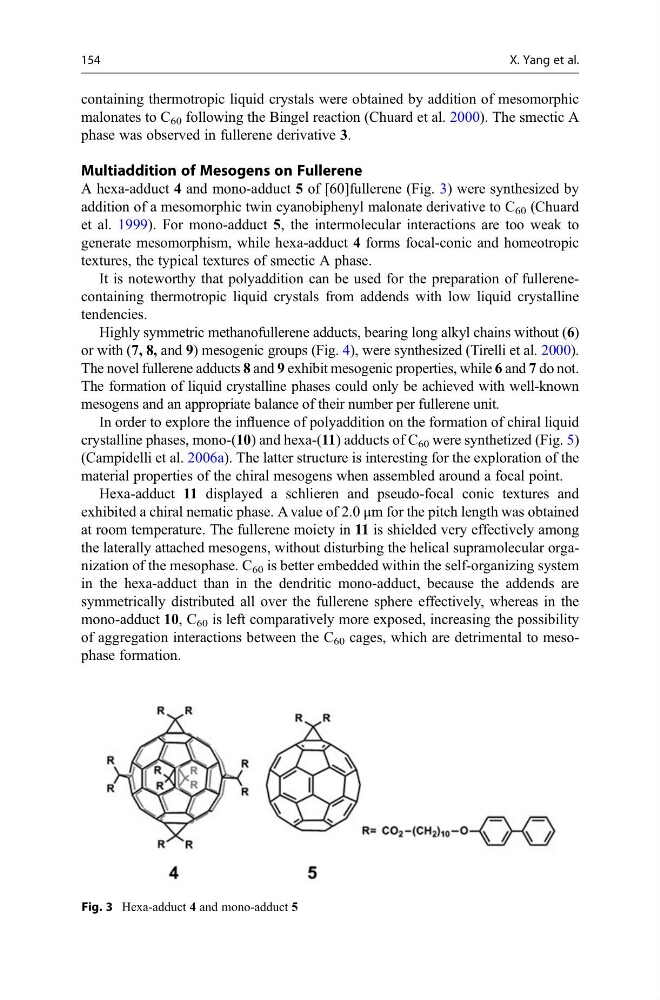
A hexa-adduct 4 and mono-adduct 5 of [60]fullerene (Fig. 3) were synthesized by
addition of a mesomorphic twin cyanobiphenyl malonate derivative to C 60 (Chuard
et al. 1999). For mono-adduct 5, the intermolecular interactions are too weak to
generate mesomorphism, while hexa-adduct 4 forms focal-conic and homeotropic
textures, the typical textures of smectic A phase.
It is noteworthy that polyaddition can be used for the preparation of fullerenecontaining thermotropic liquid crystals from addends with low liquid crystalline
tendencies.
Highly symmetric methanofullerene adducts, bearing long alkyl chains without (6)
or with (7, 8, and 9) mesogenic groups (Fig. 4), were synthesized (Tirelli et al. 2000).
The novel fullerene adducts 8 and 9 exhibit mesogenic properties, while 6 and 7 do not.
The formation of liquid crystalline phases could only be achieved with well-known
mesogens and an appropriate balance of their number per fullerene unit.
In order to explore the influence of polyaddition on the formation of chiral liquid
crystalline phases, mono-(10) and hexa-(11) adducts of C 60 were synthetized (Fig. 5)
(Campidelli et al. 2006a). The latter structure is interesting for the exploration of the
material properties of the chiral mesogens when assembled around a focal point.
Hexa-adduct 11 displayed a schlieren and pseudo-focal conic textures and
exhibited a chiral nematic phase. A value of 2.0 μm for the pitch length was obtained
at room temperature. The fullerene moiety in 11 is shielded very effectively among
the laterally attached mesogens, without disturbing the helical supramolecular organization of the mesophase. C 60 is better embedded within the self-organizing system
in the hexa-adduct than in the dendritic mono-adduct, because the addends are
symmetrically distributed all over the fullerene sphere effectively, whereas in the
mono-adduct 10, C 60 is left comparatively more exposed, increasing the possibility
of aggregation interactions between the C 60 cages, which are detrimental to mesophase formation.
Fig. 3 Hexa-adduct 4 and mono-adduct 5
154
X. Yang et al.
malonates to C 60 following the Bingel reaction (Chuard et al. 2000). The smectic A
phase was observed in fullerene derivative 3.
Multiaddition of Mesogens on Fullerene
A hexa-adduct 4 and mono-adduct 5 of [60]fullerene (Fig. 3) were synthesized by
addition of a mesomorphic twin cyanobiphenyl malonate derivative to C 60 (Chuard
et al. 1999). For mono-adduct 5, the intermolecular interactions are too weak to
generate mesomorphism, while hexa-adduct 4 forms focal-conic and homeotropic
textures, the typical textures of smectic A phase.
It is noteworthy that polyaddition can be used for the preparation of fullerenecontaining thermotropic liquid crystals from addends with low liquid crystalline
tendencies.
Highly symmetric methanofullerene adducts, bearing long alkyl chains without (6)
or with (7, 8, and 9) mesogenic groups (Fig. 4), were synthesized (Tirelli et al. 2000).
The novel fullerene adducts 8 and 9 exhibit mesogenic properties, while 6 and 7 do not.
The formation of liquid crystalline phases could only be achieved with well-known
mesogens and an appropriate balance of their number per fullerene unit.
In order to explore the influence of polyaddition on the formation of chiral liquid
crystalline phases, mono-(10) and hexa-(11) adducts of C 60 were synthetized (Fig. 5)
(Campidelli et al. 2006a). The latter structure is interesting for the exploration of the
material properties of the chiral mesogens when assembled around a focal point.
Hexa-adduct 11 displayed a schlieren and pseudo-focal conic textures and
exhibited a chiral nematic phase. A value of 2.0 μm for the pitch length was obtained
at room temperature. The fullerene moiety in 11 is shielded very effectively among
the laterally attached mesogens, without disturbing the helical supramolecular organization of the mesophase. C 60 is better embedded within the self-organizing system
in the hexa-adduct than in the dendritic mono-adduct, because the addends are
symmetrically distributed all over the fullerene sphere effectively, whereas in the
mono-adduct 10, C 60 is left comparatively more exposed, increasing the possibility
of aggregation interactions between the C 60 cages, which are detrimental to mesophase formation.
Fig. 3 Hexa-adduct 4 and mono-adduct 5
154
X. Yang et al.