

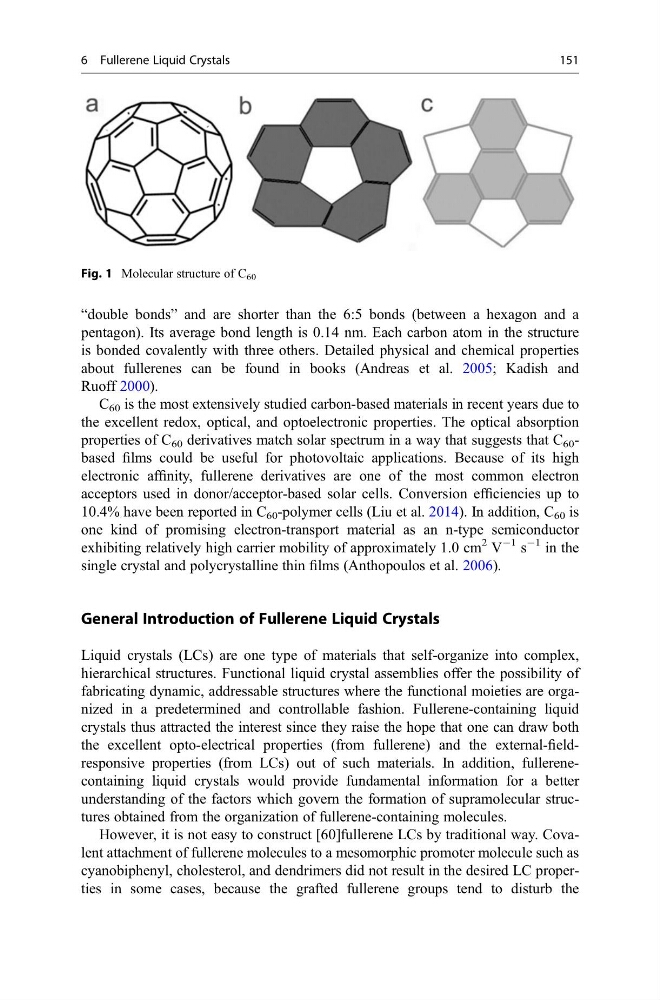
“double bonds” and are shorter than the 6:5 bonds (between a hexagon and a
pentagon). Its average bond length is 0.14 nm. Each carbon atom in the structure
is bonded covalently with three others. Detailed physical and chemical properties
about fullerenes can be found in books (Andreas et al. 2005; Kadish and
Ruoff 2000).
C 60 is the most extensively studied carbon-based materials in recent years due to
the excellent redox, optical, and optoelectronic properties. The optical absorption
properties of C 60 derivatives match solar spectrum in a way that suggests that C 60 -
based films could be useful for photovoltaic applications. Because of its high
electronic affinity, fullerene derivatives are one of the most common electron
acceptors used in donor/acceptor-based solar cells. Conversion efficiencies up to
10.4% have been reported in C 60 -polymer cells (Liu et al. 2014). In addition, C 60 is
one kind of promising electron-transport material as an n-type semiconductor
exhibiting relatively high carrier mobility of approximately 1.0 cm
2 V
À1 s
À1 in the
single crystal and polycrystalline thin films (Anthopoulos et al. 2006).
General Introduction of Fullerene Liquid Crystals
Liquid crystals (LCs) are one type of materials that self-organize into complex,
hierarchical structures. Functional liquid crystal assemblies offer the possibility of
fabricating dynamic, addressable structures where the functional moieties are organized in a predetermined and controllable fashion. Fullerene-containing liquid
crystals thus attracted the interest since they raise the hope that one can draw both
the excellent opto-electrical properties (from fullerene) and the external-fieldresponsive properties (from LCs) out of such materials. In addition, fullerenecontaining liquid crystals would provide fundamental information for a better
understanding of the factors which govern the formation of supramolecular structures obtained from the organization of fullerene-containing molecules.
However, it is not easy to construct [60]fullerene LCs by traditional way. Covalent attachment of fullerene molecules to a mesomorphic promoter molecule such as
cyanobiphenyl, cholesterol, and dendrimers did not result in the desired LC properties in some cases, because the grafted fullerene groups tend to disturb the
Fig. 1 Molecular structure of C 60
6 Fullerene Liquid Crystals
151
pentagon). Its average bond length is 0.14 nm. Each carbon atom in the structure
is bonded covalently with three others. Detailed physical and chemical properties
about fullerenes can be found in books (Andreas et al. 2005; Kadish and
Ruoff 2000).
C 60 is the most extensively studied carbon-based materials in recent years due to
the excellent redox, optical, and optoelectronic properties. The optical absorption
properties of C 60 derivatives match solar spectrum in a way that suggests that C 60 -
based films could be useful for photovoltaic applications. Because of its high
electronic affinity, fullerene derivatives are one of the most common electron
acceptors used in donor/acceptor-based solar cells. Conversion efficiencies up to
10.4% have been reported in C 60 -polymer cells (Liu et al. 2014). In addition, C 60 is
one kind of promising electron-transport material as an n-type semiconductor
exhibiting relatively high carrier mobility of approximately 1.0 cm
2 V
À1 s
À1 in the
single crystal and polycrystalline thin films (Anthopoulos et al. 2006).
General Introduction of Fullerene Liquid Crystals
Liquid crystals (LCs) are one type of materials that self-organize into complex,
hierarchical structures. Functional liquid crystal assemblies offer the possibility of
fabricating dynamic, addressable structures where the functional moieties are organized in a predetermined and controllable fashion. Fullerene-containing liquid
crystals thus attracted the interest since they raise the hope that one can draw both
the excellent opto-electrical properties (from fullerene) and the external-fieldresponsive properties (from LCs) out of such materials. In addition, fullerenecontaining liquid crystals would provide fundamental information for a better
understanding of the factors which govern the formation of supramolecular structures obtained from the organization of fullerene-containing molecules.
However, it is not easy to construct [60]fullerene LCs by traditional way. Covalent attachment of fullerene molecules to a mesomorphic promoter molecule such as
cyanobiphenyl, cholesterol, and dendrimers did not result in the desired LC properties in some cases, because the grafted fullerene groups tend to disturb the
Fig. 1 Molecular structure of C 60
6 Fullerene Liquid Crystals
151