

parameter, suggests that the phase formation is dominated by the minidendrons. This
is also supported by the fact that the change of the type of the minidendrons strongly
affects the stability of the Col h phase. The use of one-tailed or three-tailed minidendrons or even 3,5 two-tailed minidendrons destroys the ability of the polymer to
show a mesophase. It was suggested that most likely each polymer chain forms a
cylinder in the Col h phase, with tapered minidendrons radically surrounding the
helical main-chain.
PECH, poly(epichlorohydrin), randomly functionalized with a three-tailed
tapered minidendron (Chart 8), can exhibit a columnar LC phase when the degree
of substitution is 48% or higher (Ronda et al. 2003; Giamberini et al. 2005). The
isotropization temperature increases with the degree of substitution. X-ray diffraction results suggest that the benzene rings are tilted at 20–30
with respect to the
column axis in the mesophase. The same minidendron was also attached to the poly
(7-oxanorbornene) and polymaleimide main-chains (Percec and Schlueter 1997).
Both polymers exhibit a Col h phase, with the polymaleimide main-chain taking 7/2
helical conformation while poly(7-oxanorbornene) main-chain taking 3/1 helical
conformation.
A number of minidendrons with added rigid-rod units have been reported to induce a
columnar LC phase in polymers (Rosen et al. 2009). Chart 9 depicts some of such
polymers. While both 3,4-PS and 3,4,5-PS form a Col h phase, 3,5-PS is an amorphous
liquid, suggesting that the columnar mesophase is indeed dominated by the selfassembly of minidendrons (Percec et al. 1998b). The impact of the length and the
nature of the spacer connecting the minidendron substituent and the main-chain on the
columnar mesophase was investigated in BPMA-m, m = 1–4 (Percec et al. 1993). It was
observed that all polymers form a Col h phase, and the lattice of a minidendron-jacketed
polymethacrylate is slightly larger than that of the corresponding minidendron. An
increase of spacer length in a polymer increases the diameter of columns and reduces
the clearing point of the Col h phase. In addition, the incorporation of a larger periphery
aryl unit such as naphthalene or biphenyl into BPMA-4 leads to a similar Col h phase
with a slightly larger column (Percec et al. 1998c). More detailed X-ray analysis
suggested that in the Col h phase of BPMA-4, minidendrons organize around the
polymer main-chain in an 8 1 helical order (Rosen et al. 2009).
0
50
100 150 200
0
20
40
60
80
100
120
)
C
°
(
t
n
i
o
P
g
n
i
r
a
e
l
C
Degree of Polymerization
PEI-m, m = 8 - 13
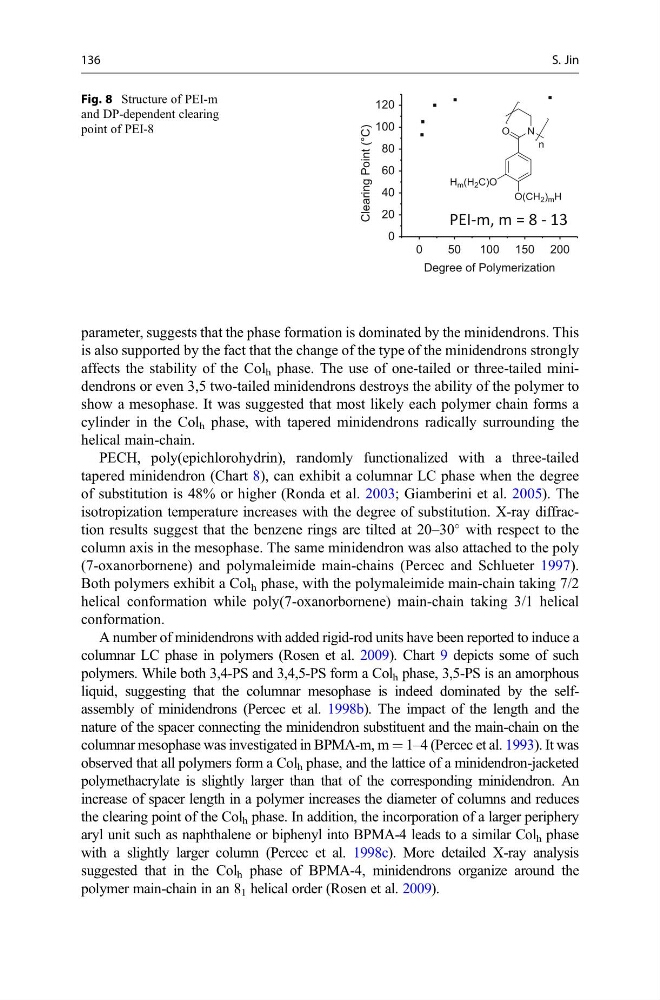
Fig. 8 Structure of PEI-m
and DP-dependent clearing
point of PEI-8
136
S. Jin
is also supported by the fact that the change of the type of the minidendrons strongly
affects the stability of the Col h phase. The use of one-tailed or three-tailed minidendrons or even 3,5 two-tailed minidendrons destroys the ability of the polymer to
show a mesophase. It was suggested that most likely each polymer chain forms a
cylinder in the Col h phase, with tapered minidendrons radically surrounding the
helical main-chain.
PECH, poly(epichlorohydrin), randomly functionalized with a three-tailed
tapered minidendron (Chart 8), can exhibit a columnar LC phase when the degree
of substitution is 48% or higher (Ronda et al. 2003; Giamberini et al. 2005). The
isotropization temperature increases with the degree of substitution. X-ray diffraction results suggest that the benzene rings are tilted at 20–30
with respect to the
column axis in the mesophase. The same minidendron was also attached to the poly
(7-oxanorbornene) and polymaleimide main-chains (Percec and Schlueter 1997).
Both polymers exhibit a Col h phase, with the polymaleimide main-chain taking 7/2
helical conformation while poly(7-oxanorbornene) main-chain taking 3/1 helical
conformation.
A number of minidendrons with added rigid-rod units have been reported to induce a
columnar LC phase in polymers (Rosen et al. 2009). Chart 9 depicts some of such
polymers. While both 3,4-PS and 3,4,5-PS form a Col h phase, 3,5-PS is an amorphous
liquid, suggesting that the columnar mesophase is indeed dominated by the selfassembly of minidendrons (Percec et al. 1998b). The impact of the length and the
nature of the spacer connecting the minidendron substituent and the main-chain on the
columnar mesophase was investigated in BPMA-m, m = 1–4 (Percec et al. 1993). It was
observed that all polymers form a Col h phase, and the lattice of a minidendron-jacketed
polymethacrylate is slightly larger than that of the corresponding minidendron. An
increase of spacer length in a polymer increases the diameter of columns and reduces
the clearing point of the Col h phase. In addition, the incorporation of a larger periphery
aryl unit such as naphthalene or biphenyl into BPMA-4 leads to a similar Col h phase
with a slightly larger column (Percec et al. 1998c). More detailed X-ray analysis
suggested that in the Col h phase of BPMA-4, minidendrons organize around the
polymer main-chain in an 8 1 helical order (Rosen et al. 2009).
0
50
100 150 200
0
20
40
60
80
100
120
)
C
°
(
t
n
i
o
P
g
n
i
r
a
e
l
C
Degree of Polymerization
PEI-m, m = 8 - 13
Fig. 8 Structure of PEI-m
and DP-dependent clearing
point of PEI-8
136
S. Jin