

0.5 kJmol
À1 per backbone atom (Papkov et al. 1984; Möller et al. 1990).
29 Si NMR
results have shown that there is significant conformational disordering at crystalCol h phase transition in the form of step-wise increase of gauche fraction, which
signals the gain of main-chain entropy when going to the mesophase from the
underlying crystalline phase (Möller 1985; Kögler et al. 1989). In contrast, there is
little change in backbone conformation at the Col h -isotropic transition. The rapid
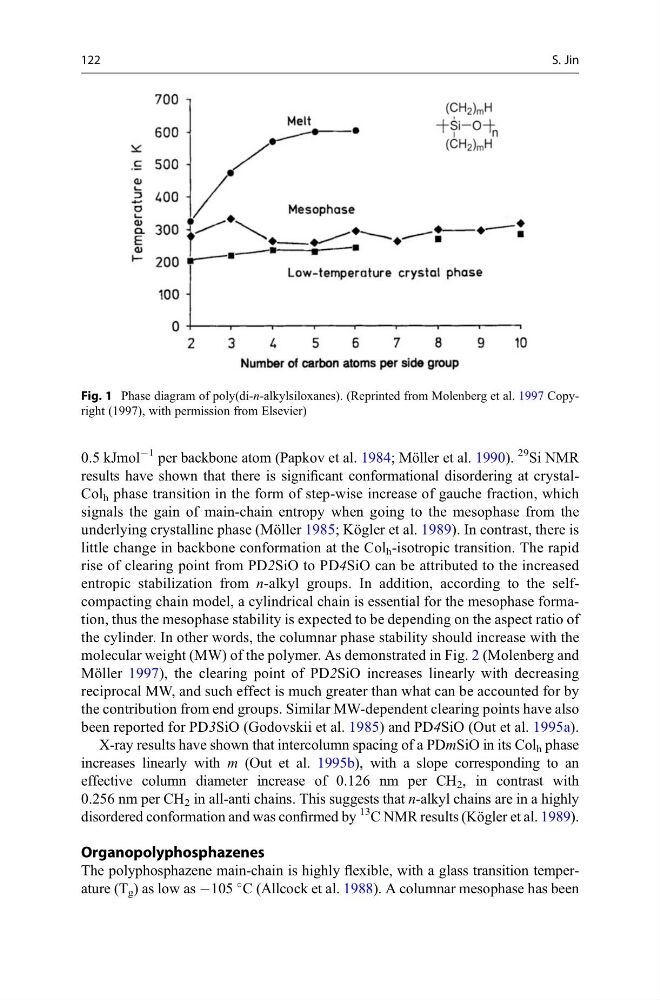
rise of clearing point from PD2SiO to PD4SiO can be attributed to the increased
entropic stabilization from n-alkyl groups. In addition, according to the selfcompacting chain model, a cylindrical chain is essential for the mesophase formation, thus the mesophase stability is expected to be depending on the aspect ratio of
the cylinder. In other words, the columnar phase stability should increase with the
molecular weight (MW) of the polymer. As demonstrated in Fig. 2 (Molenberg and
Möller 1997), the clearing point of PD2SiO increases linearly with decreasing
reciprocal MW, and such effect is much greater than what can be accounted for by
the contribution from end groups. Similar MW-dependent clearing points have also
been reported for PD3SiO (Godovskii et al. 1985) and PD4SiO (Out et al. 1995a).
X-ray results have shown that intercolumn spacing of a PDmSiO in its Col h phase
increases linearly with m (Out et al. 1995b), with a slope corresponding to an
effective column diameter increase of 0.126 nm per CH 2 , in contrast with
0.256 nm per CH 2 in all-anti chains. This suggests that n-alkyl chains are in a highly
disordered conformation and was confirmed by
13
C NMR results (Kögler et al. 1989).
Organopolyphosphazenes
The polyphosphazene main-chain is highly flexible, with a glass transition temperature (T g ) as low as À105
C (Allcock et al. 1988). A columnar mesophase has been
Fig. 1 Phase diagram of poly(di-n-alkylsiloxanes). (Reprinted from Molenberg et al. 1997 Copyright (1997), with permission from Elsevier)
122
S. Jin
À1 per backbone atom (Papkov et al. 1984; Möller et al. 1990).
29 Si NMR
results have shown that there is significant conformational disordering at crystalCol h phase transition in the form of step-wise increase of gauche fraction, which
signals the gain of main-chain entropy when going to the mesophase from the
underlying crystalline phase (Möller 1985; Kögler et al. 1989). In contrast, there is
little change in backbone conformation at the Col h -isotropic transition. The rapid
rise of clearing point from PD2SiO to PD4SiO can be attributed to the increased
entropic stabilization from n-alkyl groups. In addition, according to the selfcompacting chain model, a cylindrical chain is essential for the mesophase formation, thus the mesophase stability is expected to be depending on the aspect ratio of
the cylinder. In other words, the columnar phase stability should increase with the
molecular weight (MW) of the polymer. As demonstrated in Fig. 2 (Molenberg and
Möller 1997), the clearing point of PD2SiO increases linearly with decreasing
reciprocal MW, and such effect is much greater than what can be accounted for by
the contribution from end groups. Similar MW-dependent clearing points have also
been reported for PD3SiO (Godovskii et al. 1985) and PD4SiO (Out et al. 1995a).
X-ray results have shown that intercolumn spacing of a PDmSiO in its Col h phase
increases linearly with m (Out et al. 1995b), with a slope corresponding to an
effective column diameter increase of 0.126 nm per CH 2 , in contrast with
0.256 nm per CH 2 in all-anti chains. This suggests that n-alkyl chains are in a highly
disordered conformation and was confirmed by
13
C NMR results (Kögler et al. 1989).
Organopolyphosphazenes
The polyphosphazene main-chain is highly flexible, with a glass transition temperature (T g ) as low as À105
C (Allcock et al. 1988). A columnar mesophase has been
Fig. 1 Phase diagram of poly(di-n-alkylsiloxanes). (Reprinted from Molenberg et al. 1997 Copyright (1997), with permission from Elsevier)
122
S. Jin