

therefore the scattering (turbid) state turns to the transmission (homeotropic) state.
The high contrast between the transmission and scattering is preserved under the low
driving voltage conditions.
Surface Modifications
The striped walls are constructed by the photopolymerization of RM in the anisotropic LC solvents (Kang et al. 2015). The microscopic molecular orientations in the
hierarchical superstructures are well-organized with the aid of surface anchoring
forces. The LC networks with morphological gratings may render the directional
wettability. The shapes of water drop as well as the surface water contact angles are
finely tuned by the hierarchical superstructures and morphologies of the polymerized
networks (Fig. 13).
Homogeneous orientation of the polymer networks is induced by stepwise irradiation of linear-polarized light of 436 nm and 254 nm (Yamaoka et al. 2015). When
the polymerizable LC gel is coated on an elastomeric sheet, the anisotropic photopolymerization of the photo-aligned monomers leads to a uniformly aligned wrinkle
via polymerization shrinkage. Direction of the anisotropic shrinkage on the elastomer sheet follows the polymerization progresses, i.e., the face-to-face packing
direction of the mesogens. In the macroscopic point of view, the shrinkage gives
rise to the uniaxially aligned wrinkle (Fig. 14).
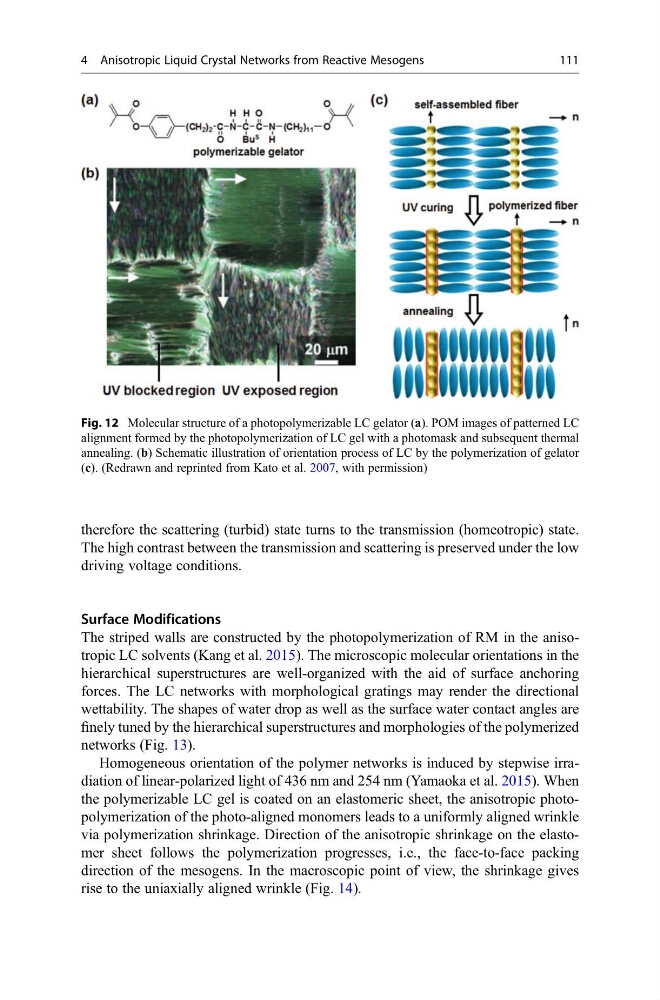
Fig. 12 Molecular structure of a photopolymerizable LC gelator (a). POM images of patterned LC
alignment formed by the photopolymerization of LC gel with a photomask and subsequent thermal
annealing. (b) Schematic illustration of orientation process of LC by the polymerization of gelator
(c). (Redrawn and reprinted from Kato et al. 2007, with permission)
4 Anisotropic Liquid Crystal Networks from Reactive Mesogens
111
The high contrast between the transmission and scattering is preserved under the low
driving voltage conditions.
Surface Modifications
The striped walls are constructed by the photopolymerization of RM in the anisotropic LC solvents (Kang et al. 2015). The microscopic molecular orientations in the
hierarchical superstructures are well-organized with the aid of surface anchoring
forces. The LC networks with morphological gratings may render the directional
wettability. The shapes of water drop as well as the surface water contact angles are
finely tuned by the hierarchical superstructures and morphologies of the polymerized
networks (Fig. 13).
Homogeneous orientation of the polymer networks is induced by stepwise irradiation of linear-polarized light of 436 nm and 254 nm (Yamaoka et al. 2015). When
the polymerizable LC gel is coated on an elastomeric sheet, the anisotropic photopolymerization of the photo-aligned monomers leads to a uniformly aligned wrinkle
via polymerization shrinkage. Direction of the anisotropic shrinkage on the elastomer sheet follows the polymerization progresses, i.e., the face-to-face packing
direction of the mesogens. In the macroscopic point of view, the shrinkage gives
rise to the uniaxially aligned wrinkle (Fig. 14).
Fig. 12 Molecular structure of a photopolymerizable LC gelator (a). POM images of patterned LC
alignment formed by the photopolymerization of LC gel with a photomask and subsequent thermal
annealing. (b) Schematic illustration of orientation process of LC by the polymerization of gelator
(c). (Redrawn and reprinted from Kato et al. 2007, with permission)
4 Anisotropic Liquid Crystal Networks from Reactive Mesogens
111