

structures. Organic light-emitting diodes exhibit brighter color, fast response time,
and wider viewing angle compared to the conventional LCD. Spontaneous selfassembly provides the charge-transporting mobility and polarized emission when
uniformly aligned. The orientation of luminescence LC polymers for polarized
alignment is easily achieved because of the ordered phases. The alignment direction
of luminescent RM is parallel to the polarization direction of UV light. The
organometal complexes containing palladium, platinum, nickel, and gold moieties
exhibit not only the light-emitting properties but also the mesophase behaviors. EL
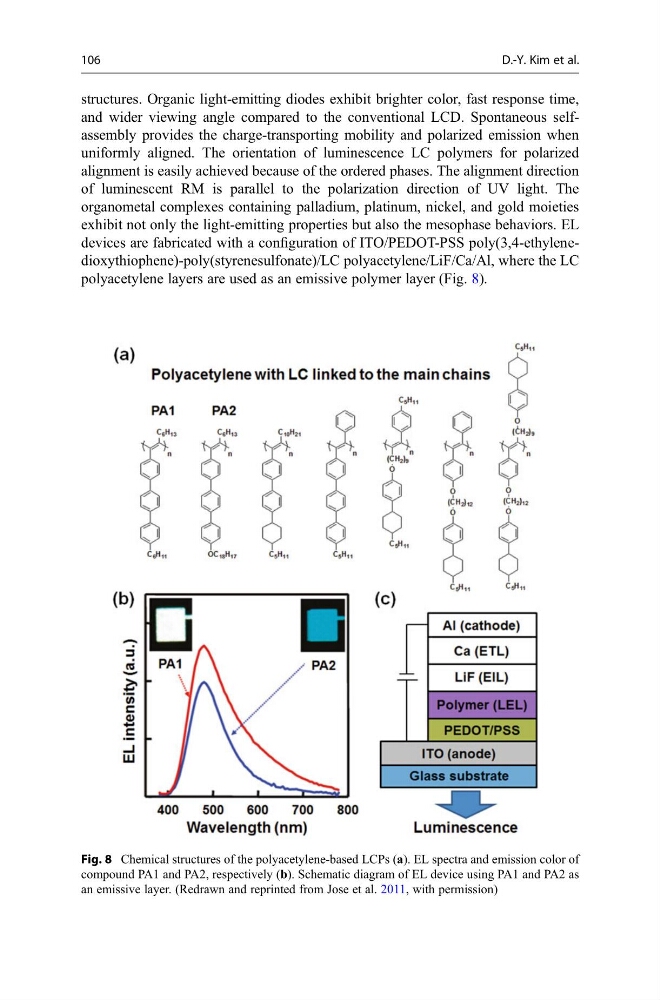
devices are fabricated with a configuration of ITO/PEDOT-PSS poly(3,4-ethylenedioxythiophene)-poly(styrenesulfonate)/LC polyacetylene/LiF/Ca/Al, where the LC
polyacetylene layers are used as an emissive polymer layer (Fig. 8).
Fig. 8 Chemical structures of the polyacetylene-based LCPs (a). EL spectra and emission color of
compound PA1 and PA2, respectively (b). Schematic diagram of EL device using PA1 and PA2 as
an emissive layer. (Redrawn and reprinted from Jose et al. 2011, with permission)
106
D.-Y. Kim et al.
and wider viewing angle compared to the conventional LCD. Spontaneous selfassembly provides the charge-transporting mobility and polarized emission when
uniformly aligned. The orientation of luminescence LC polymers for polarized
alignment is easily achieved because of the ordered phases. The alignment direction
of luminescent RM is parallel to the polarization direction of UV light. The
organometal complexes containing palladium, platinum, nickel, and gold moieties
exhibit not only the light-emitting properties but also the mesophase behaviors. EL
devices are fabricated with a configuration of ITO/PEDOT-PSS poly(3,4-ethylenedioxythiophene)-poly(styrenesulfonate)/LC polyacetylene/LiF/Ca/Al, where the LC
polyacetylene layers are used as an emissive polymer layer (Fig. 8).
Fig. 8 Chemical structures of the polyacetylene-based LCPs (a). EL spectra and emission color of
compound PA1 and PA2, respectively (b). Schematic diagram of EL device using PA1 and PA2 as
an emissive layer. (Redrawn and reprinted from Jose et al. 2011, with permission)
106
D.-Y. Kim et al.