

mobility. To maximize the physical properties of the anisotropic LC networks, the
programmed molecular building blocks should be specifically arranged in the threedimensional (3D) hierarchical superstructures.
Because the free movement of electrons is not possible in most organic materials,
phonons are considered to be the primary mechanism of heat conduction. Thermal
conductivity in organic materials is closely associated with their crystallinity, chemical constituent, and bond strength. The ordered structures exhibit higher thermal
energy transmissions, while the amorphous regions easily scatter the phonons.
Therefore, the phonon scattering can be effectively suppressed by increasing the
ordered portion of organic molecules. The orientational or positional order of LC
molecules may be effective to improve the transmission efficiency of the lattice
vibration. Thermal conductivity of the aligned polymers, such as the injectionmolded thermotropic LC and the lyotropic LC (LLC) polymers aligned by shear
coating, and the LC networks cured under an external field, has been fully examined.
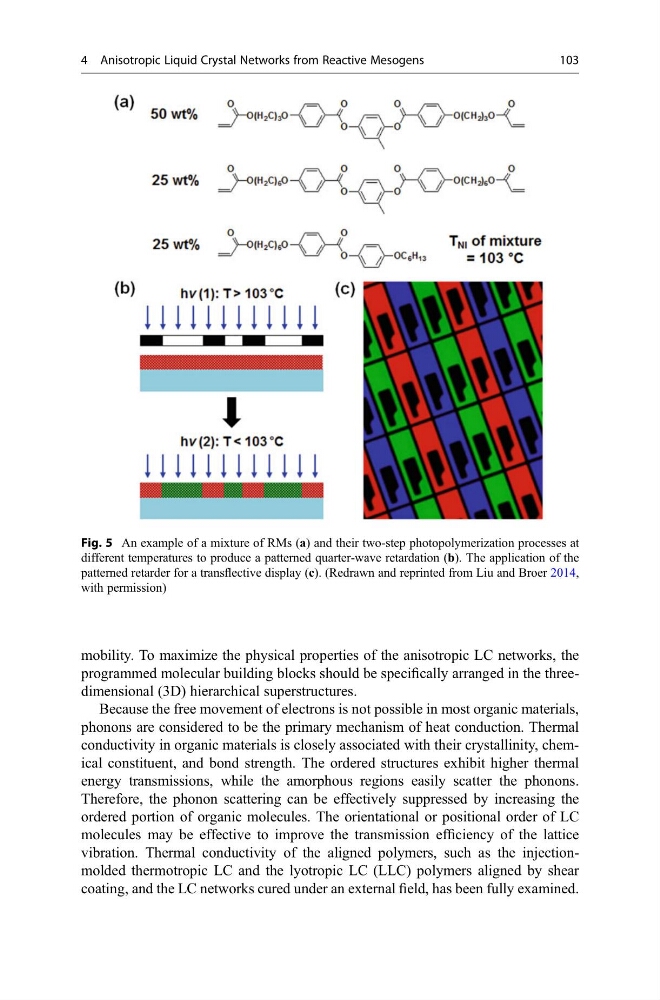
Fig. 5 An example of a mixture of RMs (a) and their two-step photopolymerization processes at
different temperatures to produce a patterned quarter-wave retardation (b). The application of the
patterned retarder for a transflective display (c). (Redrawn and reprinted from Liu and Broer 2014,
with permission)
4 Anisotropic Liquid Crystal Networks from Reactive Mesogens
103
programmed molecular building blocks should be specifically arranged in the threedimensional (3D) hierarchical superstructures.
Because the free movement of electrons is not possible in most organic materials,
phonons are considered to be the primary mechanism of heat conduction. Thermal
conductivity in organic materials is closely associated with their crystallinity, chemical constituent, and bond strength. The ordered structures exhibit higher thermal
energy transmissions, while the amorphous regions easily scatter the phonons.
Therefore, the phonon scattering can be effectively suppressed by increasing the
ordered portion of organic molecules. The orientational or positional order of LC
molecules may be effective to improve the transmission efficiency of the lattice
vibration. Thermal conductivity of the aligned polymers, such as the injectionmolded thermotropic LC and the lyotropic LC (LLC) polymers aligned by shear
coating, and the LC networks cured under an external field, has been fully examined.
Fig. 5 An example of a mixture of RMs (a) and their two-step photopolymerization processes at
different temperatures to produce a patterned quarter-wave retardation (b). The application of the
patterned retarder for a transflective display (c). (Redrawn and reprinted from Liu and Broer 2014,
with permission)
4 Anisotropic Liquid Crystal Networks from Reactive Mesogens
103