

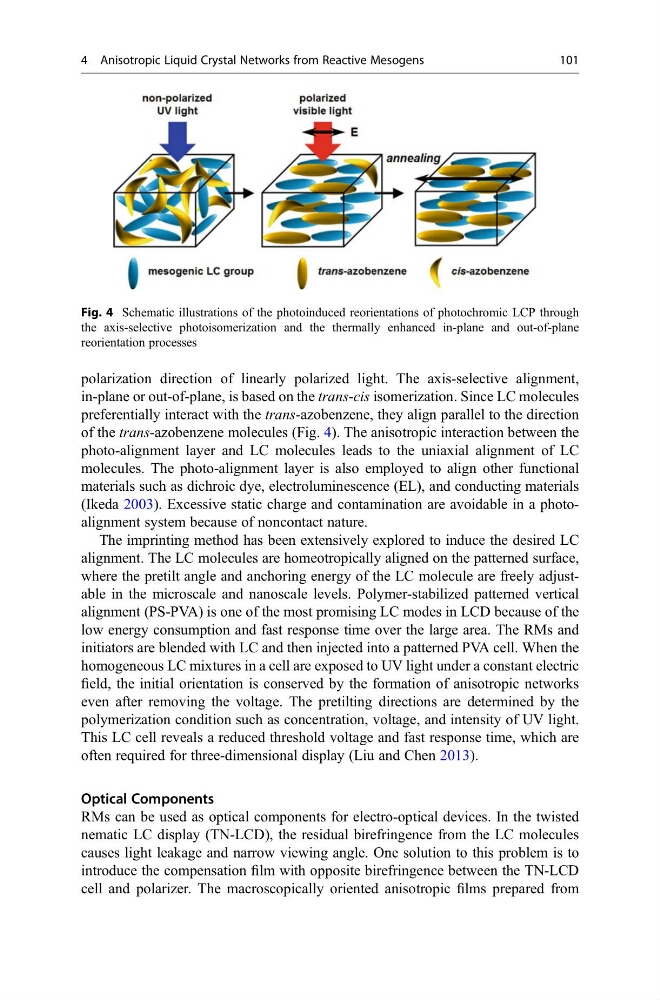
polarization direction of linearly polarized light. The axis-selective alignment,
in-plane or out-of-plane, is based on the trans-cis isomerization. Since LC molecules
preferentially interact with the trans-azobenzene, they align parallel to the direction
of the trans-azobenzene molecules (Fig. 4). The anisotropic interaction between the
photo-alignment layer and LC molecules leads to the uniaxial alignment of LC
molecules. The photo-alignment layer is also employed to align other functional
materials such as dichroic dye, electroluminescence (EL), and conducting materials
(Ikeda 2003). Excessive static charge and contamination are avoidable in a photoalignment system because of noncontact nature.
The imprinting method has been extensively explored to induce the desired LC
alignment. The LC molecules are homeotropically aligned on the patterned surface,
where the pretilt angle and anchoring energy of the LC molecule are freely adjustable in the microscale and nanoscale levels. Polymer-stabilized patterned vertical
alignment (PS-PVA) is one of the most promising LC modes in LCD because of the
low energy consumption and fast response time over the large area. The RMs and
initiators are blended with LC and then injected into a patterned PVA cell. When the
homogeneous LC mixtures in a cell are exposed to UV light under a constant electric
field, the initial orientation is conserved by the formation of anisotropic networks
even after removing the voltage. The pretilting directions are determined by the
polymerization condition such as concentration, voltage, and intensity of UV light.
This LC cell reveals a reduced threshold voltage and fast response time, which are
often required for three-dimensional display (Liu and Chen 2013).
Optical Components
RMs can be used as optical components for electro-optical devices. In the twisted
nematic LC display (TN-LCD), the residual birefringence from the LC molecules
causes light leakage and narrow viewing angle. One solution to this problem is to
introduce the compensation film with opposite birefringence between the TN-LCD
cell and polarizer. The macroscopically oriented anisotropic films prepared from
Fig. 4 Schematic illustrations of the photoinduced reorientations of photochromic LCP through
the axis-selective photoisomerization and the thermally enhanced in-plane and out-of-plane
reorientation processes
4 Anisotropic Liquid Crystal Networks from Reactive Mesogens
101
in-plane or out-of-plane, is based on the trans-cis isomerization. Since LC molecules
preferentially interact with the trans-azobenzene, they align parallel to the direction
of the trans-azobenzene molecules (Fig. 4). The anisotropic interaction between the
photo-alignment layer and LC molecules leads to the uniaxial alignment of LC
molecules. The photo-alignment layer is also employed to align other functional
materials such as dichroic dye, electroluminescence (EL), and conducting materials
(Ikeda 2003). Excessive static charge and contamination are avoidable in a photoalignment system because of noncontact nature.
The imprinting method has been extensively explored to induce the desired LC
alignment. The LC molecules are homeotropically aligned on the patterned surface,
where the pretilt angle and anchoring energy of the LC molecule are freely adjustable in the microscale and nanoscale levels. Polymer-stabilized patterned vertical
alignment (PS-PVA) is one of the most promising LC modes in LCD because of the
low energy consumption and fast response time over the large area. The RMs and
initiators are blended with LC and then injected into a patterned PVA cell. When the
homogeneous LC mixtures in a cell are exposed to UV light under a constant electric
field, the initial orientation is conserved by the formation of anisotropic networks
even after removing the voltage. The pretilting directions are determined by the
polymerization condition such as concentration, voltage, and intensity of UV light.
This LC cell reveals a reduced threshold voltage and fast response time, which are
often required for three-dimensional display (Liu and Chen 2013).
Optical Components
RMs can be used as optical components for electro-optical devices. In the twisted
nematic LC display (TN-LCD), the residual birefringence from the LC molecules
causes light leakage and narrow viewing angle. One solution to this problem is to
introduce the compensation film with opposite birefringence between the TN-LCD
cell and polarizer. The macroscopically oriented anisotropic films prepared from
Fig. 4 Schematic illustrations of the photoinduced reorientations of photochromic LCP through
the axis-selective photoisomerization and the thermally enhanced in-plane and out-of-plane
reorientation processes
4 Anisotropic Liquid Crystal Networks from Reactive Mesogens
101