

Polymers containing mesogenic units also reveal the partially ordered LC phases.
Anisotropic properties of LC polymers (LCP) are observed when oriented macroscopically. The film-forming nature provides the several potential advantages in the
optical storages, electro-optical displays, and electric sensors. The orientations of
LCP are accomplished by viscous flow in a melt or solution such as melt extrusion,
gel drawing, and spinning techniques. Although the degree of orientation is strongly
affected by temperature, the initial orientation state may be retained permanently at
room temperature when the glass transition temperature (T g ) is high enough (Kim
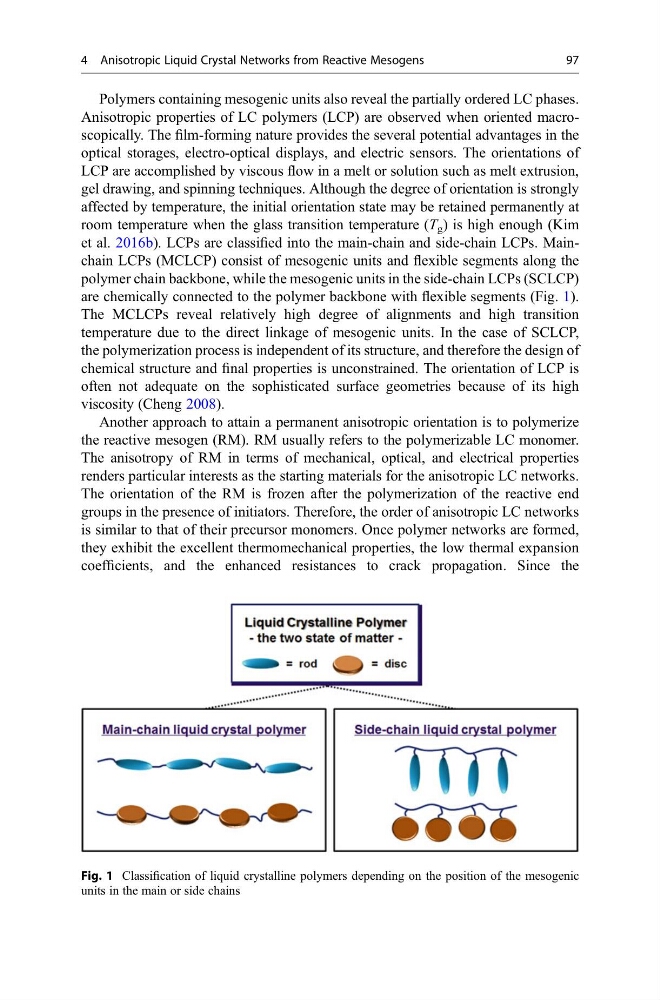
et al. 2016b). LCPs are classified into the main-chain and side-chain LCPs. Mainchain LCPs (MCLCP) consist of mesogenic units and flexible segments along the
polymer chain backbone, while the mesogenic units in the side-chain LCPs (SCLCP)
are chemically connected to the polymer backbone with flexible segments (Fig. 1).
The MCLCPs reveal relatively high degree of alignments and high transition
temperature due to the direct linkage of mesogenic units. In the case of SCLCP,
the polymerization process is independent of its structure, and therefore the design of
chemical structure and final properties is unconstrained. The orientation of LCP is
often not adequate on the sophisticated surface geometries because of its high
viscosity (Cheng 2008).
Another approach to attain a permanent anisotropic orientation is to polymerize
the reactive mesogen (RM). RM usually refers to the polymerizable LC monomer.
The anisotropy of RM in terms of mechanical, optical, and electrical properties
renders particular interests as the starting materials for the anisotropic LC networks.
The orientation of the RM is frozen after the polymerization of the reactive end
groups in the presence of initiators. Therefore, the order of anisotropic LC networks
is similar to that of their precursor monomers. Once polymer networks are formed,
they exhibit the excellent thermomechanical properties, the low thermal expansion
coefficients, and the enhanced resistances to crack propagation. Since the
Fig. 1 Classification of liquid crystalline polymers depending on the position of the mesogenic
units in the main or side chains
4 Anisotropic Liquid Crystal Networks from Reactive Mesogens
97
Anisotropic properties of LC polymers (LCP) are observed when oriented macroscopically. The film-forming nature provides the several potential advantages in the
optical storages, electro-optical displays, and electric sensors. The orientations of
LCP are accomplished by viscous flow in a melt or solution such as melt extrusion,
gel drawing, and spinning techniques. Although the degree of orientation is strongly
affected by temperature, the initial orientation state may be retained permanently at
room temperature when the glass transition temperature (T g ) is high enough (Kim
et al. 2016b). LCPs are classified into the main-chain and side-chain LCPs. Mainchain LCPs (MCLCP) consist of mesogenic units and flexible segments along the
polymer chain backbone, while the mesogenic units in the side-chain LCPs (SCLCP)
are chemically connected to the polymer backbone with flexible segments (Fig. 1).
The MCLCPs reveal relatively high degree of alignments and high transition
temperature due to the direct linkage of mesogenic units. In the case of SCLCP,
the polymerization process is independent of its structure, and therefore the design of
chemical structure and final properties is unconstrained. The orientation of LCP is
often not adequate on the sophisticated surface geometries because of its high
viscosity (Cheng 2008).
Another approach to attain a permanent anisotropic orientation is to polymerize
the reactive mesogen (RM). RM usually refers to the polymerizable LC monomer.
The anisotropy of RM in terms of mechanical, optical, and electrical properties
renders particular interests as the starting materials for the anisotropic LC networks.
The orientation of the RM is frozen after the polymerization of the reactive end
groups in the presence of initiators. Therefore, the order of anisotropic LC networks
is similar to that of their precursor monomers. Once polymer networks are formed,
they exhibit the excellent thermomechanical properties, the low thermal expansion
coefficients, and the enhanced resistances to crack propagation. Since the
Fig. 1 Classification of liquid crystalline polymers depending on the position of the mesogenic
units in the main or side chains
4 Anisotropic Liquid Crystal Networks from Reactive Mesogens
97