

82
4
Time-Dependent Fluids For these fluids, the apparent viscosity
does not only depend on the shear rate but also on time the shear
stress is applied. Time- dependent fluids may be divided into two distinct types.
5 Thixotropic Fluids—In these fluids, shear stress decreases with
time when the fluid is sheared at a constant rate. The structural
breakdown in these fluids is a function of the duration of shear
as well as shear rate. In thixotropic fluids, structures along with
secondary bonds and intermolecular attractions would be
progressively broken down, leading to the reduction of
apparent viscosity. For most thixotropic fluids, the viscosity
decreases with higher rates of shearing but only after the
threshold level of shear occurs. Mechanical shearing alters the
arrangement of the long chain of the molecular structure of
these fluids. Mayonnaise and yogurt are examples of thixotropic fluids where shearing causes the attraction of the long
chain of the molecular structure.
5 Rheopectic Fluids—These are the fluids in which structure
builds up from shearing with time. This phenomenon is the
reverse of thixotropy. In rheopectic fluids, viscosity increases
with time.
Time-Independent Fluids For these fluids, the shear rate is only a
function of shear stress. Time-dependent fluids may be divided into
three distinct types:
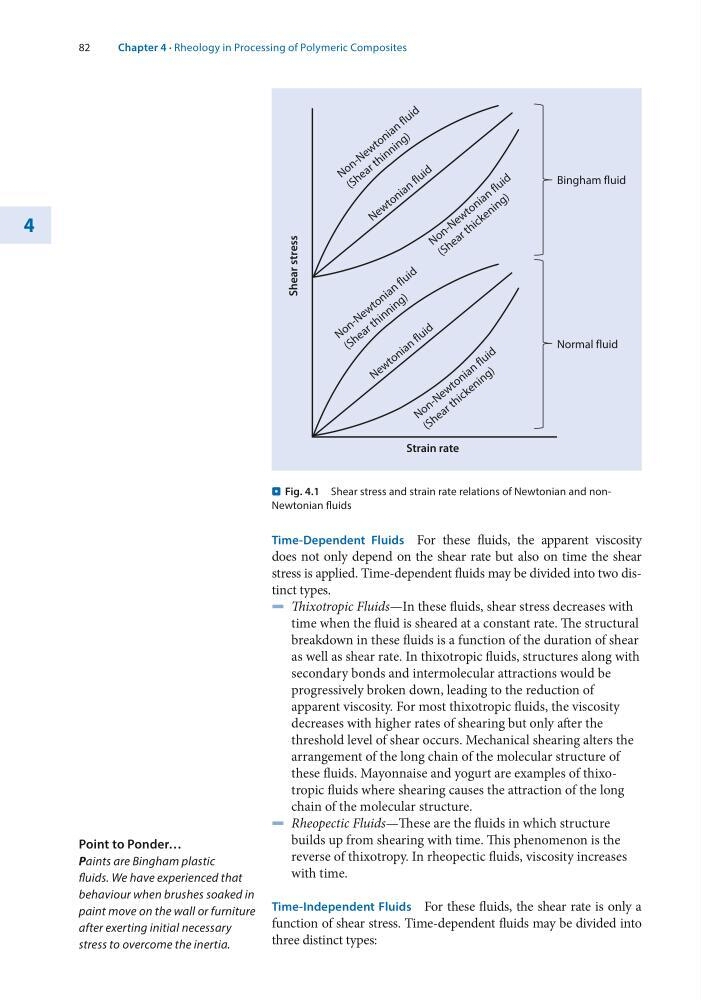
Point to Ponder…
Paints are Bingham plastic
fluids. We have experienced that
behaviour when brushes soaked in
paint move on the wall or furniture
after exerting initial necessary
stress to overcome the inertia.
Normal fluid
Strain rate
Shear stress
Bingham fluid
N o n - N e w t o n i a n f l u i d
( S h e a r t h i n n i n g )
N o n - N e w t o n i a n f l u i d
( S h e a r t h i n n i n g )
N o n - N e w t o n i a n f l u i d
( S h e a r t h i c k e n i n g )
N o n - N e w t o n i a n f l u i d
( S h e a r t h i c k e n i n g )
N e w t o n i a n f l u i d
N e w t o n i a n f l u i d
. Fig. 4.1 Shear stress and strain rate relations of Newtonian and nonNewtonian fluids
Chapter 4 · Rheology in Processing of Polymeric Composites
4
Time-Dependent Fluids For these fluids, the apparent viscosity
does not only depend on the shear rate but also on time the shear
stress is applied. Time- dependent fluids may be divided into two distinct types.
5 Thixotropic Fluids—In these fluids, shear stress decreases with
time when the fluid is sheared at a constant rate. The structural
breakdown in these fluids is a function of the duration of shear
as well as shear rate. In thixotropic fluids, structures along with
secondary bonds and intermolecular attractions would be
progressively broken down, leading to the reduction of
apparent viscosity. For most thixotropic fluids, the viscosity
decreases with higher rates of shearing but only after the
threshold level of shear occurs. Mechanical shearing alters the
arrangement of the long chain of the molecular structure of
these fluids. Mayonnaise and yogurt are examples of thixotropic fluids where shearing causes the attraction of the long
chain of the molecular structure.
5 Rheopectic Fluids—These are the fluids in which structure
builds up from shearing with time. This phenomenon is the
reverse of thixotropy. In rheopectic fluids, viscosity increases
with time.
Time-Independent Fluids For these fluids, the shear rate is only a
function of shear stress. Time-dependent fluids may be divided into
three distinct types:
Point to Ponder…
Paints are Bingham plastic
fluids. We have experienced that
behaviour when brushes soaked in
paint move on the wall or furniture
after exerting initial necessary
stress to overcome the inertia.
Normal fluid
Strain rate
Shear stress
Bingham fluid
N o n - N e w t o n i a n f l u i d
( S h e a r t h i n n i n g )
N o n - N e w t o n i a n f l u i d
( S h e a r t h i n n i n g )
N o n - N e w t o n i a n f l u i d
( S h e a r t h i c k e n i n g )
N o n - N e w t o n i a n f l u i d
( S h e a r t h i c k e n i n g )
N e w t o n i a n f l u i d
N e w t o n i a n f l u i d
. Fig. 4.1 Shear stress and strain rate relations of Newtonian and nonNewtonian fluids
Chapter 4 · Rheology in Processing of Polymeric Composites