

74
3
C
E
E
12
12 2
12 21
21
2
12 21
1
1
= −
= −
ν
ν ν
ν
ν ν
/
(3.39)
C
E
22
2
12 21
1
= −ν ν
(3.40)
C
G
66
12
=
(3.41)
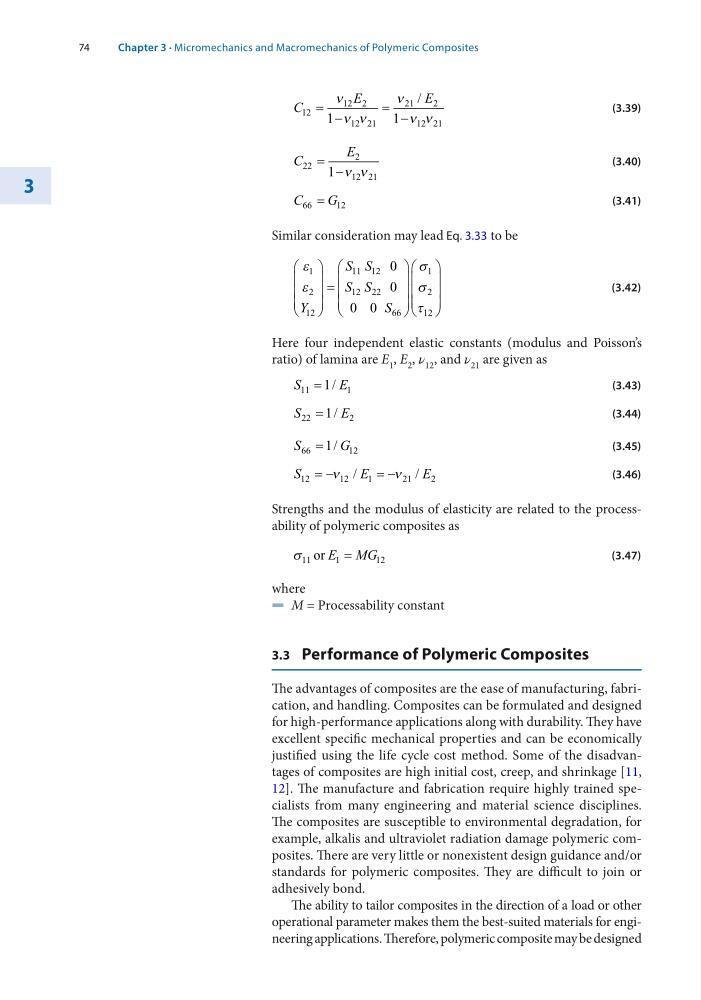
Similar consideration may lead Eq. 3.33 to be
ε
ε
σ
σ
τ
1
2
12
11
12
12
22
66
1
2
12
0 0
0
0
Y
S
S
S
S
S
=
(3.42)
Here four independent elastic constants (modulus and Poisson’s
ratio) of lamina are E 1 , E 2 , ν 12 , and ν 21 are given as
S
E
11
1
1
= /
(3.43)
S
E
22
2
1
= /
(3.44)
S
G
66
12
1
= /
(3.45)
S
E
E
12
12
1
2 1
2
= −
= −
ν
ν
/
/
(3.46)
Strengths and the modulus of elasticity are related to the processability of polymeric composites as
σ 11
1
1 2
or E MG
=
(3.47)
where
5 M = Processability constant
3.3 Performance of Polymeric Composites
The advantages of composites are the ease of manufacturing, fabrication, and handling. Composites can be formulated and designed
for high-performance applications along with durability. They have
excellent specific mechanical properties and can be economically
justified using the life cycle cost method. Some of the disadvantages of composites are high initial cost, creep, and shrinkage [11,
12]. The manufacture and fabrication require highly trained specialists from many engineering and material science disciplines.
The composites are susceptible to environmental degradation, for
example, alkalis and ultraviolet radiation damage polymeric composites. There are very little or nonexistent design guidance and/or
standards for polymeric composites. They are difficult to join or
adhesively bond.
The ability to tailor composites in the direction of a load or other
operational parameter makes them the best-suited materials for engineering applications. Therefore, polymeric composite may be designed
Chapter 3 · Micromechanics and Macromechanics of Polymeric Composites
3
C
E
E
12
12 2
12 21
21
2
12 21
1
1
= −
= −
ν
ν ν
ν
ν ν
/
(3.39)
C
E
22
2
12 21
1
= −ν ν
(3.40)
C
G
66
12
=
(3.41)
Similar consideration may lead Eq. 3.33 to be
ε
ε
σ
σ
τ
1
2
12
11
12
12
22
66
1
2
12
0 0
0
0
Y
S
S
S
S
S
=
(3.42)
Here four independent elastic constants (modulus and Poisson’s
ratio) of lamina are E 1 , E 2 , ν 12 , and ν 21 are given as
S
E
11
1
1
= /
(3.43)
S
E
22
2
1
= /
(3.44)
S
G
66
12
1
= /
(3.45)
S
E
E
12
12
1
2 1
2
= −
= −
ν
ν
/
/
(3.46)
Strengths and the modulus of elasticity are related to the processability of polymeric composites as
σ 11
1
1 2
or E MG
=
(3.47)
where
5 M = Processability constant
3.3 Performance of Polymeric Composites
The advantages of composites are the ease of manufacturing, fabrication, and handling. Composites can be formulated and designed
for high-performance applications along with durability. They have
excellent specific mechanical properties and can be economically
justified using the life cycle cost method. Some of the disadvantages of composites are high initial cost, creep, and shrinkage [11,
12]. The manufacture and fabrication require highly trained specialists from many engineering and material science disciplines.
The composites are susceptible to environmental degradation, for
example, alkalis and ultraviolet radiation damage polymeric composites. There are very little or nonexistent design guidance and/or
standards for polymeric composites. They are difficult to join or
adhesively bond.
The ability to tailor composites in the direction of a load or other
operational parameter makes them the best-suited materials for engineering applications. Therefore, polymeric composite may be designed
Chapter 3 · Micromechanics and Macromechanics of Polymeric Composites