

26
1
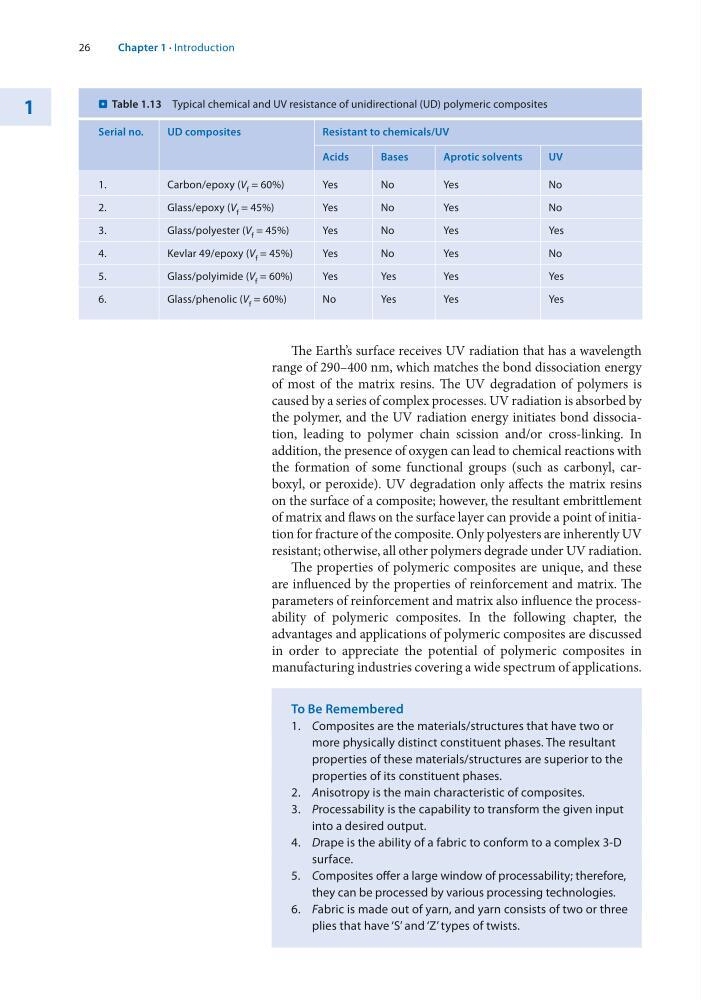
The Earth’s surface receives UV radiation that has a wavelength
range of 290–400 nm, which matches the bond dissociation energy
of most of the matrix resins. The UV degradation of polymers is
caused by a series of complex processes. UV radiation is absorbed by
the polymer, and the UV radiation energy initiates bond dissociation, leading to polymer chain scission and/or cross-linking. In
addition, the presence of oxygen can lead to chemical reactions with
the formation of some functional groups (such as carbonyl, carboxyl, or peroxide). UV degradation only affects the matrix resins
on the surface of a composite; however, the resultant embrittlement
of matrix and flaws on the surface layer can provide a point of initiation for fracture of the composite. Only polyesters are inherently UV
resistant; otherwise, all other polymers degrade under UV radiation.
The properties of polymeric composites are unique, and these
are influenced by the properties of reinforcement and matrix. The
parameters of reinforcement and matrix also influence the processability of polymeric composites. In the following chapter, the
advantages and applications of polymeric composites are discussed
in order to appreciate the potential of polymeric composites in
manufacturing industries covering a wide spectrum of applications.
To Be Remembered
1. Composites are the materials/structures that have two or
more physically distinct constituent phases. The resultant
properties of these materials/structures are superior to the
properties of its constituent phases.
2. Anisotropy is the main characteristic of composites.
3. Processability is the capability to transform the given input
into a desired output.
4. Drape is the ability of a fabric to conform to a complex 3-D
surface.
5. Composites offer a large window of processability; therefore,
they can be processed by various processing technologies.
6. Fabric is made out of yarn, and yarn consists of two or three
plies that have ‘S’ and ‘Z’ types of twists.
. Table 1.13 Typical chemical and UV resistance of unidirectional (UD) polymeric composites
Serial no.
UD composites
Resistant to chemicals/UV
Acids
Bases
Aprotic solvents
UV
1.
Carbon/epoxy (V f = 60%)
Yes
No
Yes
No
2.
Glass/epoxy (V f = 45%)
Yes
No
Yes
No
3.
Glass/polyester (V f = 45%)
Yes
No
Yes
Yes
4.
Kevlar 49/epoxy (V f = 45%)
Yes
No
Yes
No
5.
Glass/polyimide (V f = 60%)
Yes
Yes
Yes
Yes
6.
Glass/phenolic (V f = 60%)
No
Yes
Yes
Yes
Chapter 1 · Introduction
1
The Earth’s surface receives UV radiation that has a wavelength
range of 290–400 nm, which matches the bond dissociation energy
of most of the matrix resins. The UV degradation of polymers is
caused by a series of complex processes. UV radiation is absorbed by
the polymer, and the UV radiation energy initiates bond dissociation, leading to polymer chain scission and/or cross-linking. In
addition, the presence of oxygen can lead to chemical reactions with
the formation of some functional groups (such as carbonyl, carboxyl, or peroxide). UV degradation only affects the matrix resins
on the surface of a composite; however, the resultant embrittlement
of matrix and flaws on the surface layer can provide a point of initiation for fracture of the composite. Only polyesters are inherently UV
resistant; otherwise, all other polymers degrade under UV radiation.
The properties of polymeric composites are unique, and these
are influenced by the properties of reinforcement and matrix. The
parameters of reinforcement and matrix also influence the processability of polymeric composites. In the following chapter, the
advantages and applications of polymeric composites are discussed
in order to appreciate the potential of polymeric composites in
manufacturing industries covering a wide spectrum of applications.
To Be Remembered
1. Composites are the materials/structures that have two or
more physically distinct constituent phases. The resultant
properties of these materials/structures are superior to the
properties of its constituent phases.
2. Anisotropy is the main characteristic of composites.
3. Processability is the capability to transform the given input
into a desired output.
4. Drape is the ability of a fabric to conform to a complex 3-D
surface.
5. Composites offer a large window of processability; therefore,
they can be processed by various processing technologies.
6. Fabric is made out of yarn, and yarn consists of two or three
plies that have ‘S’ and ‘Z’ types of twists.
. Table 1.13 Typical chemical and UV resistance of unidirectional (UD) polymeric composites
Serial no.
UD composites
Resistant to chemicals/UV
Acids
Bases
Aprotic solvents
UV
1.
Carbon/epoxy (V f = 60%)
Yes
No
Yes
No
2.
Glass/epoxy (V f = 45%)
Yes
No
Yes
No
3.
Glass/polyester (V f = 45%)
Yes
No
Yes
Yes
4.
Kevlar 49/epoxy (V f = 45%)
Yes
No
Yes
No
5.
Glass/polyimide (V f = 60%)
Yes
Yes
Yes
Yes
6.
Glass/phenolic (V f = 60%)
No
Yes
Yes
Yes
Chapter 1 · Introduction