

262
9
To Be Remembered
1. Characterization of any material establishes its character
based on its morphology and molecular structure.
2. Sample collection and preparation are key to the testing of
composites.
3. Smaller the size of the reinforcement, the more the physical
barrier is presented in the translational movement of the
polymeric chains.
4. Creep is a deformation under constant stress.
5. Stress relaxation is the reduction in stress on constant strain
to the composite material.
6. Relation of morphology or internal structure of material
with any property of a material is called a structure–property relationship.
7. DMA provides the viscoelastic response of composites.
8. Composites have viscoelastic behaviour due to the
presence of a polymeric matrix.
9. Viscous parts of composite are responsible for dampening
behaviour, whereas the elastic parts of composite give
strength.
10. Fatigue strength and damage tolerance of composites are
good.
11. Primary bond scission takes place in thermal degradation.
Thermal degradation in composites is an irreversible
process.
Exercises
1. Differentiate between DSC and DTA.
2. How will you measure the thermal stability of any composite?
3. How will you evaluate fibre volume fractions in carbon fibre-reinforced epoxy composite and glass fibre-reinforced PP composite?
4. What makes PEEK and PEI thermal resistant matrices?
5. What is the best process to evaluate the glass transition temperature?
6. Why is it difficult to detect the glass transition temperature in
thermosetting composites?
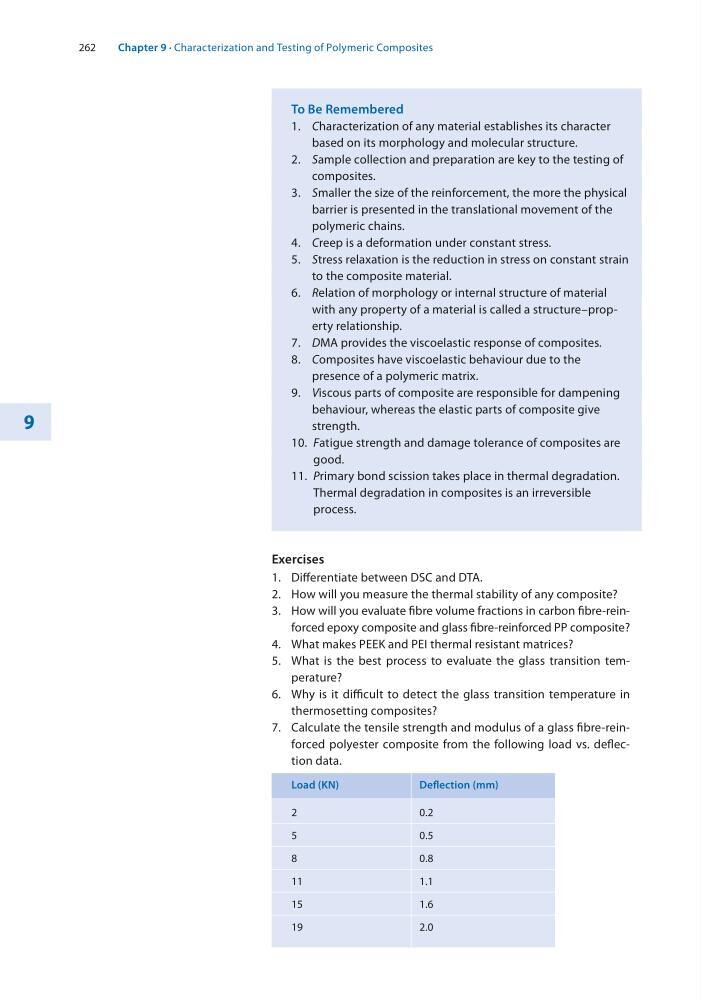
7. Calculate the tensile strength and modulus of a glass fibre-reinforced polyester composite from the following load vs. deflection data.
Load (KN)
Deflection (mm)
2
0.2
5
0.5
8
0.8
11
1.1
15
1.6
19
2.0
Chapter 9 · Characterization and Testing of Polymeric Composites
9
To Be Remembered
1. Characterization of any material establishes its character
based on its morphology and molecular structure.
2. Sample collection and preparation are key to the testing of
composites.
3. Smaller the size of the reinforcement, the more the physical
barrier is presented in the translational movement of the
polymeric chains.
4. Creep is a deformation under constant stress.
5. Stress relaxation is the reduction in stress on constant strain
to the composite material.
6. Relation of morphology or internal structure of material
with any property of a material is called a structure–property relationship.
7. DMA provides the viscoelastic response of composites.
8. Composites have viscoelastic behaviour due to the
presence of a polymeric matrix.
9. Viscous parts of composite are responsible for dampening
behaviour, whereas the elastic parts of composite give
strength.
10. Fatigue strength and damage tolerance of composites are
good.
11. Primary bond scission takes place in thermal degradation.
Thermal degradation in composites is an irreversible
process.
Exercises
1. Differentiate between DSC and DTA.
2. How will you measure the thermal stability of any composite?
3. How will you evaluate fibre volume fractions in carbon fibre-reinforced epoxy composite and glass fibre-reinforced PP composite?
4. What makes PEEK and PEI thermal resistant matrices?
5. What is the best process to evaluate the glass transition temperature?
6. Why is it difficult to detect the glass transition temperature in
thermosetting composites?
7. Calculate the tensile strength and modulus of a glass fibre-reinforced polyester composite from the following load vs. deflection data.
Load (KN)
Deflection (mm)
2
0.2
5
0.5
8
0.8
11
1.1
15
1.6
19
2.0
Chapter 9 · Characterization and Testing of Polymeric Composites