

243
9
4. Compressive Strength—Testing of the compressive strength of
composites is a complex phenomenon—right from the
fabrication of the test samples. The test samples used for
compressive strength are cylindrical in shape. They have
terminated internal plies that give rise to a large triangular
resin pocket. The plies above this resin pocket are misaligned
relative to the axial direction of the laminate. The test is carried
out on a UTM as per ASTM D6484. This test method determines the open-hole compressive strength of multidirectional
polymer matrix composite laminates [13].
5. Shear Strength—There are two types of shear strengths:
in-plane shear strength (IPSS) and interlaminar shear strength
(ILSS). The shear stress that distorts the lamina or layers in the
composite is the in-plane shear strength (IPSS), which is the
strength of the composite that resists distortion of lamina. The
shear stress that acts on interlaminar planes of the composites
is the interlaminar shear stress (ILSS). It measures the interlayer
strength in a fabric-reinforced composite. ILSS is very low in
comparison to IPSS. ILSS is an important material property for
design because laminated composites are made of several plies
and are bonded by polymeric materials. The ability of the
material to resist shearing when one portion is moved from a
stationary section is the shear strength.
Shear strength is expressed as the maximum load required
for shearing the specimen in such a manner that the moving
portion has completely cleared the stationary portion. It is
expressed in N/mm 2 based on the area of sheared edges. BS
4994 is the usual standard used for testing interlaminar shear
strength. This test is also carried out as per ASTM D2344 on a
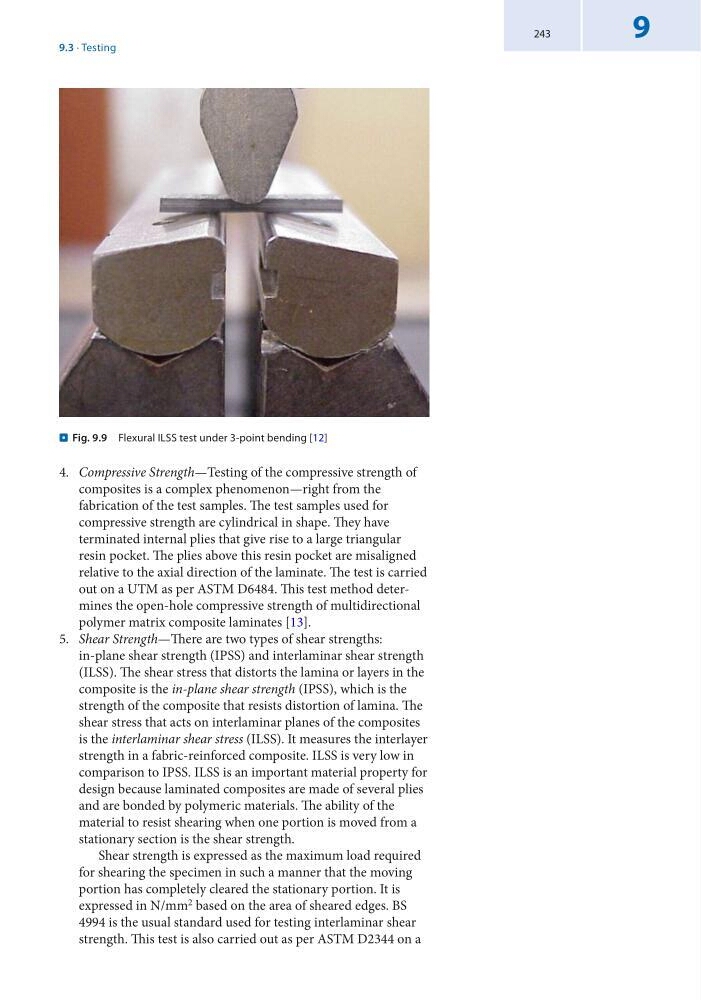
. Fig. 9.9 Flexural ILSS test under 3-point bending [12]
9.3 · Testing
9
4. Compressive Strength—Testing of the compressive strength of
composites is a complex phenomenon—right from the
fabrication of the test samples. The test samples used for
compressive strength are cylindrical in shape. They have
terminated internal plies that give rise to a large triangular
resin pocket. The plies above this resin pocket are misaligned
relative to the axial direction of the laminate. The test is carried
out on a UTM as per ASTM D6484. This test method determines the open-hole compressive strength of multidirectional
polymer matrix composite laminates [13].
5. Shear Strength—There are two types of shear strengths:
in-plane shear strength (IPSS) and interlaminar shear strength
(ILSS). The shear stress that distorts the lamina or layers in the
composite is the in-plane shear strength (IPSS), which is the
strength of the composite that resists distortion of lamina. The
shear stress that acts on interlaminar planes of the composites
is the interlaminar shear stress (ILSS). It measures the interlayer
strength in a fabric-reinforced composite. ILSS is very low in
comparison to IPSS. ILSS is an important material property for
design because laminated composites are made of several plies
and are bonded by polymeric materials. The ability of the
material to resist shearing when one portion is moved from a
stationary section is the shear strength.
Shear strength is expressed as the maximum load required
for shearing the specimen in such a manner that the moving
portion has completely cleared the stationary portion. It is
expressed in N/mm 2 based on the area of sheared edges. BS
4994 is the usual standard used for testing interlaminar shear
strength. This test is also carried out as per ASTM D2344 on a
. Fig. 9.9 Flexural ILSS test under 3-point bending [12]
9.3 · Testing