

221
8
ogy. The processability becomes complex through the resin
systems that release condensate or byproducts. The resins
that undergo cross-linking by addition polymerization are
good to process using VARTM technology.
5 Form of reinforcement—Only continuous reinforcements
(such as fabric, tapes, rovings, tows, and CSM) can be
processed in VARTM technology. Short fibres, whiskers, and
particles are not processable by this processing technology.
5 Mould preparation—In order to mould a composite using
VARTM, the mould must be cleaned before the layup of the
reinforcement and must be airtight after the layup so that
while under a high vacuum or pressure, no leak takes place.
5 Application of vacuum and pressure—The processability is
dependent on the evacuation of air from the reinforcement
placed in the closed mould so that during the resin transfer
no voids or air gaps are present. Also, the resin transfer at a
high pressure is an important parameter needed to wet the
reinforcement completely.
5 Evacuation of resin—Resin evacuation is needed for a
sufficient time to remove any entrapped air or gases. This
must be accomplished so that after curing these gases do
not form defects in the composite.
5 Viscosity of the resin—Viscosity of the resin needs to be low
so that it percolates the tightly stacked reinforcement in the
mould.
The basic arrangement for VARTM moulding uses a set of matched
die moulds and a resin injection machine. The disadvantage of
VARTM technologies is that the initial investment cost is much
higher, requiring a more expensive mould and a resin injection
machine, compared to open moulding. The higher investment cost
of VARTM means that the production rate is quite limited.
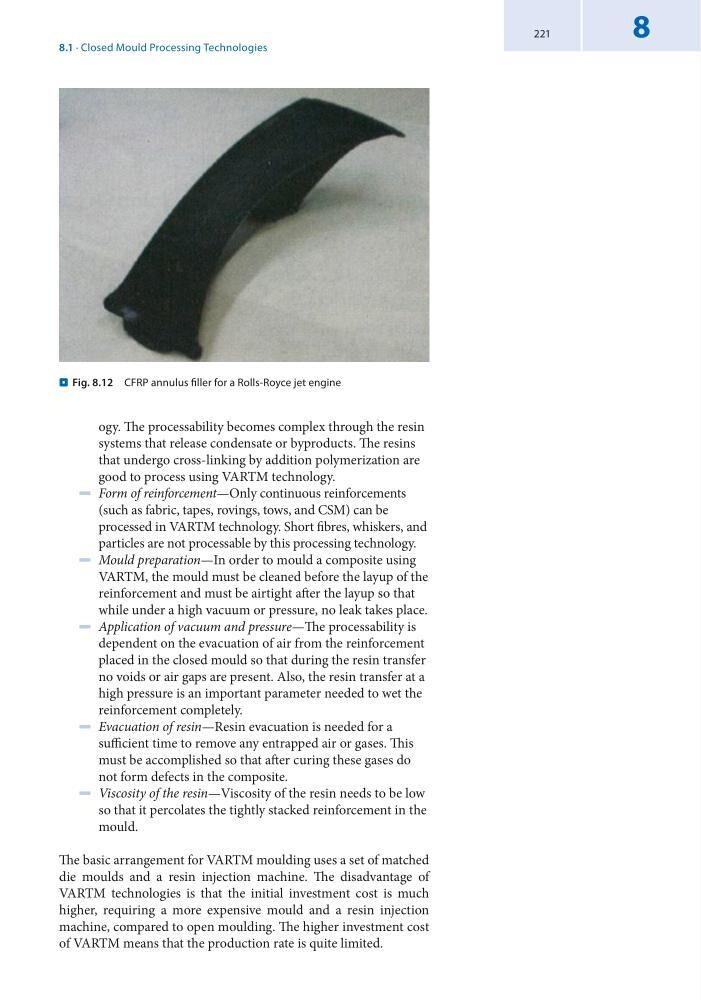
. Fig. 8.12 CFRP annulus filler for a Rolls-Royce jet engine
8.1 · Closed Mould Processing Technologies
8
ogy. The processability becomes complex through the resin
systems that release condensate or byproducts. The resins
that undergo cross-linking by addition polymerization are
good to process using VARTM technology.
5 Form of reinforcement—Only continuous reinforcements
(such as fabric, tapes, rovings, tows, and CSM) can be
processed in VARTM technology. Short fibres, whiskers, and
particles are not processable by this processing technology.
5 Mould preparation—In order to mould a composite using
VARTM, the mould must be cleaned before the layup of the
reinforcement and must be airtight after the layup so that
while under a high vacuum or pressure, no leak takes place.
5 Application of vacuum and pressure—The processability is
dependent on the evacuation of air from the reinforcement
placed in the closed mould so that during the resin transfer
no voids or air gaps are present. Also, the resin transfer at a
high pressure is an important parameter needed to wet the
reinforcement completely.
5 Evacuation of resin—Resin evacuation is needed for a
sufficient time to remove any entrapped air or gases. This
must be accomplished so that after curing these gases do
not form defects in the composite.
5 Viscosity of the resin—Viscosity of the resin needs to be low
so that it percolates the tightly stacked reinforcement in the
mould.
The basic arrangement for VARTM moulding uses a set of matched
die moulds and a resin injection machine. The disadvantage of
VARTM technologies is that the initial investment cost is much
higher, requiring a more expensive mould and a resin injection
machine, compared to open moulding. The higher investment cost
of VARTM means that the production rate is quite limited.
. Fig. 8.12 CFRP annulus filler for a Rolls-Royce jet engine
8.1 · Closed Mould Processing Technologies