

185
7
laminate more compact and devoid of air gaps. Additional
layers of chopped laminate are sprayed to achieve the required
thickness.
5 Processability Parameters—Similar to contact layup, this process
has the following processability parameters.
5 Viscosity of the resin (η)—The viscosity of the resin needs to
be low so that resin can be sprayed through nozzle. The
viscosity of the resin is preferred in the range of 500–5000
cps for this process. In order to reduce the viscosity of the
resin, diluents may be added in order to improve the
processability of the resin.
5 Gelation time—The gelation time of the resin needs to be
high in order to provide the processing window for the resin
and fibres to be placed in the required position on the
mould.
5 Form of reinforcement—In this process, only staples of fibres
are used as reinforcement. The length of the fibres is
controlled during the layup process. The processability of
reinforcement also is restricted to staples of fibres. This
process does not offer processability for reinforcing fabrics
and particles.
5 Shape and profile of the product—Sharp edges and undercuts
do not support the processability of composites using spray
layup technology. Although undercuts in the product can be
processed using split moulds, this makes the process
complicated and costly. Spray layup offers a good finish on
only the surface of the composite that is in contact of the
mould.
Contact layup and spray moulding are by far the most common
processes used to fabricate composite parts, accounting for over
40% of composites processed worldwide. These are relatively simple
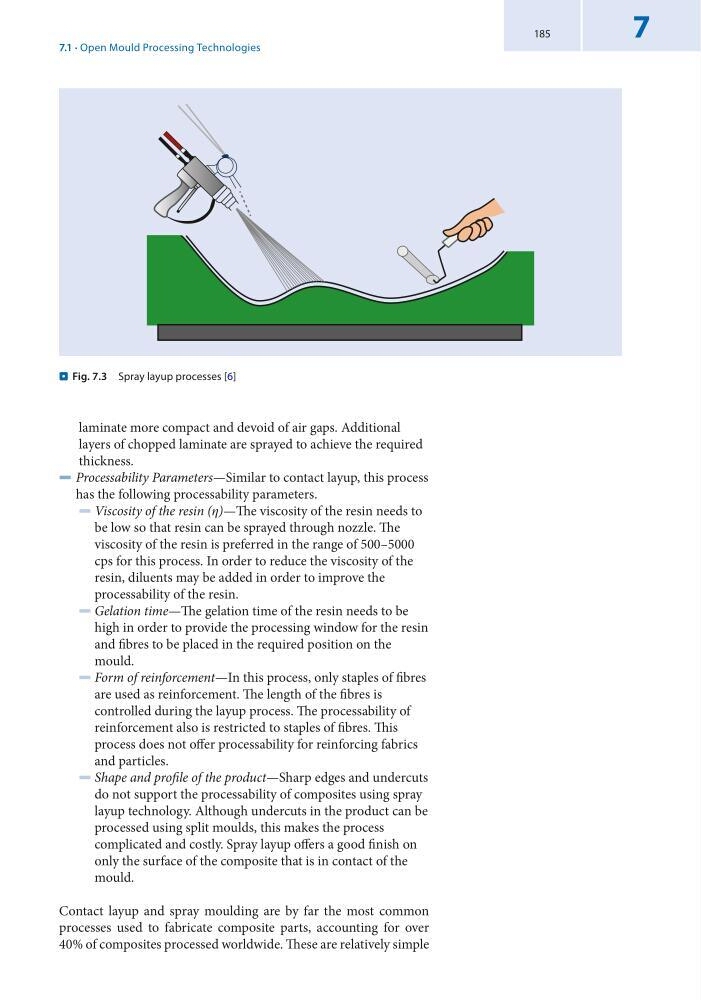
. Fig. 7.3 Spray layup processes [6]
7.1 · Open Mould Processing Technologies
7
laminate more compact and devoid of air gaps. Additional
layers of chopped laminate are sprayed to achieve the required
thickness.
5 Processability Parameters—Similar to contact layup, this process
has the following processability parameters.
5 Viscosity of the resin (η)—The viscosity of the resin needs to
be low so that resin can be sprayed through nozzle. The
viscosity of the resin is preferred in the range of 500–5000
cps for this process. In order to reduce the viscosity of the
resin, diluents may be added in order to improve the
processability of the resin.
5 Gelation time—The gelation time of the resin needs to be
high in order to provide the processing window for the resin
and fibres to be placed in the required position on the
mould.
5 Form of reinforcement—In this process, only staples of fibres
are used as reinforcement. The length of the fibres is
controlled during the layup process. The processability of
reinforcement also is restricted to staples of fibres. This
process does not offer processability for reinforcing fabrics
and particles.
5 Shape and profile of the product—Sharp edges and undercuts
do not support the processability of composites using spray
layup technology. Although undercuts in the product can be
processed using split moulds, this makes the process
complicated and costly. Spray layup offers a good finish on
only the surface of the composite that is in contact of the
mould.
Contact layup and spray moulding are by far the most common
processes used to fabricate composite parts, accounting for over
40% of composites processed worldwide. These are relatively simple
. Fig. 7.3 Spray layup processes [6]
7.1 · Open Mould Processing Technologies