

182
7
the composite is not very good because many flaws (voids,
uneven distribution of reinforcement and matrix, uneven
thickness, etc.) are present. The biggest advantage of this
process is the low cost of the mould with respect to the size of
the composite produced. Contact layup is used for the manufacture of large products where moulding in a closed mould is
not feasible or cost- effective. The composite products made by
this technology need to be designed with high factor of safety
(FoS) due to the high possibility of flaws in the composite. A
new variant of this technology is the use of pre-impregnated
reinforcement (prepregs) where the layup is carried out with
the use of semiautomatic rolling and pressing systems. The
quality of the product obtained is good, and the FoS can be
kept lower in comparison to the contact layup process carried
out with a manual impregnation process [7].
Contact layup technology is used for making boat hulls,
windmill blades, rail coaches, containers, front and rear
spoilers for automotives, etc. A blade for a windmill is made
using the manual or hand layup process with an open mould
and raw materials in the form of prepregs. The world’s largest
windmill rotor blade (B75) made by Siemens is shown in
. Fig. 7.2a, and the picture of a moulded blade is given in
. Fig. 7.2b. None other than this process—however automated
it may be—can replace this method for the production of a
composite blade of such a large size, usually >15 metres in
length, for a windmill.
5 Processability Parameters—The following are the processability
parameters for making polymeric composites using a contact
layup process.
5 Viscosity of the resin—Low viscosity of the resin facilitates the
processability of the composite in a contact layup technology.
The viscosity of the resin needs to be the minimum to enable
it to easily percolate into and completely wet the reinforcement. High viscosities of resin do not favour the processability of composites using contact layup technology.
Point to Ponder…
Windmills are the second most
important source of non conventional energy after solar energy. The
potential of wind energy from in
India and the world is 50,000 MW
and 500 GW, respectively.
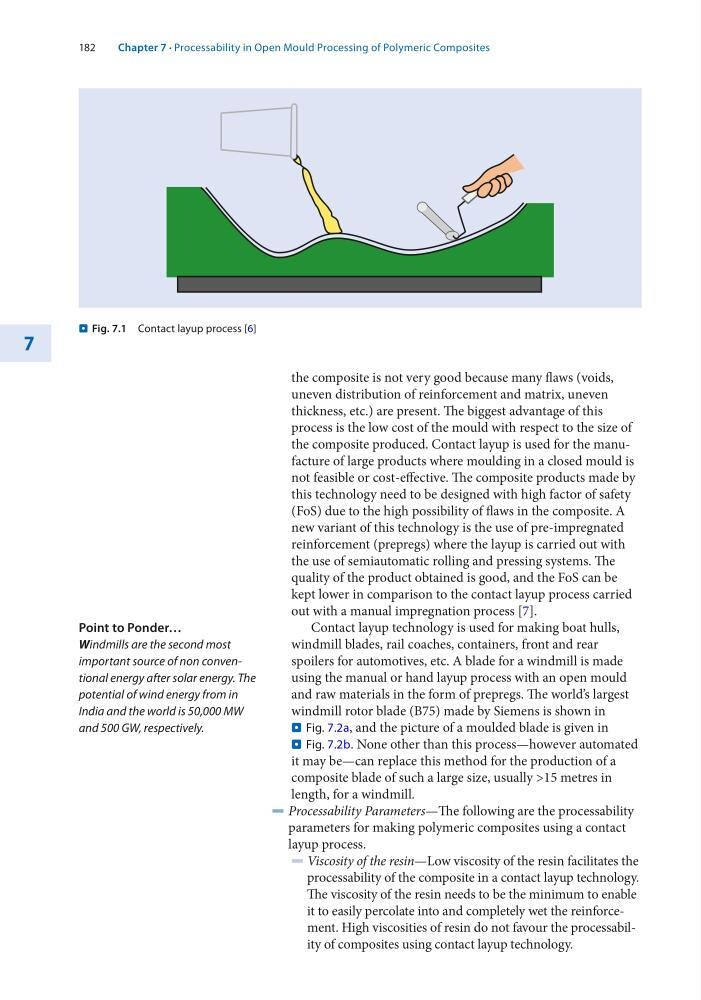
. Fig. 7.1 Contact layup process [6]
Chapter 7 · Processability in Open Mould Processing of Polymeric Composites
7
the composite is not very good because many flaws (voids,
uneven distribution of reinforcement and matrix, uneven
thickness, etc.) are present. The biggest advantage of this
process is the low cost of the mould with respect to the size of
the composite produced. Contact layup is used for the manufacture of large products where moulding in a closed mould is
not feasible or cost- effective. The composite products made by
this technology need to be designed with high factor of safety
(FoS) due to the high possibility of flaws in the composite. A
new variant of this technology is the use of pre-impregnated
reinforcement (prepregs) where the layup is carried out with
the use of semiautomatic rolling and pressing systems. The
quality of the product obtained is good, and the FoS can be
kept lower in comparison to the contact layup process carried
out with a manual impregnation process [7].
Contact layup technology is used for making boat hulls,
windmill blades, rail coaches, containers, front and rear
spoilers for automotives, etc. A blade for a windmill is made
using the manual or hand layup process with an open mould
and raw materials in the form of prepregs. The world’s largest
windmill rotor blade (B75) made by Siemens is shown in
. Fig. 7.2a, and the picture of a moulded blade is given in
. Fig. 7.2b. None other than this process—however automated
it may be—can replace this method for the production of a
composite blade of such a large size, usually >15 metres in
length, for a windmill.
5 Processability Parameters—The following are the processability
parameters for making polymeric composites using a contact
layup process.
5 Viscosity of the resin—Low viscosity of the resin facilitates the
processability of the composite in a contact layup technology.
The viscosity of the resin needs to be the minimum to enable
it to easily percolate into and completely wet the reinforcement. High viscosities of resin do not favour the processability of composites using contact layup technology.
Point to Ponder…
Windmills are the second most
important source of non conventional energy after solar energy. The
potential of wind energy from in
India and the world is 50,000 MW
and 500 GW, respectively.
. Fig. 7.1 Contact layup process [6]
Chapter 7 · Processability in Open Mould Processing of Polymeric Composites