

180
7
Polymeric composites offer the largest processing window among
all of the engineering materials due to their wide range of available
raw materials and vast horizons of processing technologies for the
production of specific composites. When put together, this provides
great flexibility in their processing. Advanced composites are also
amenable to post-fabrication processing, such as machining and
painting. The processing methods and parameters of polymeric
composites depend upon the type of raw materials to be processed.
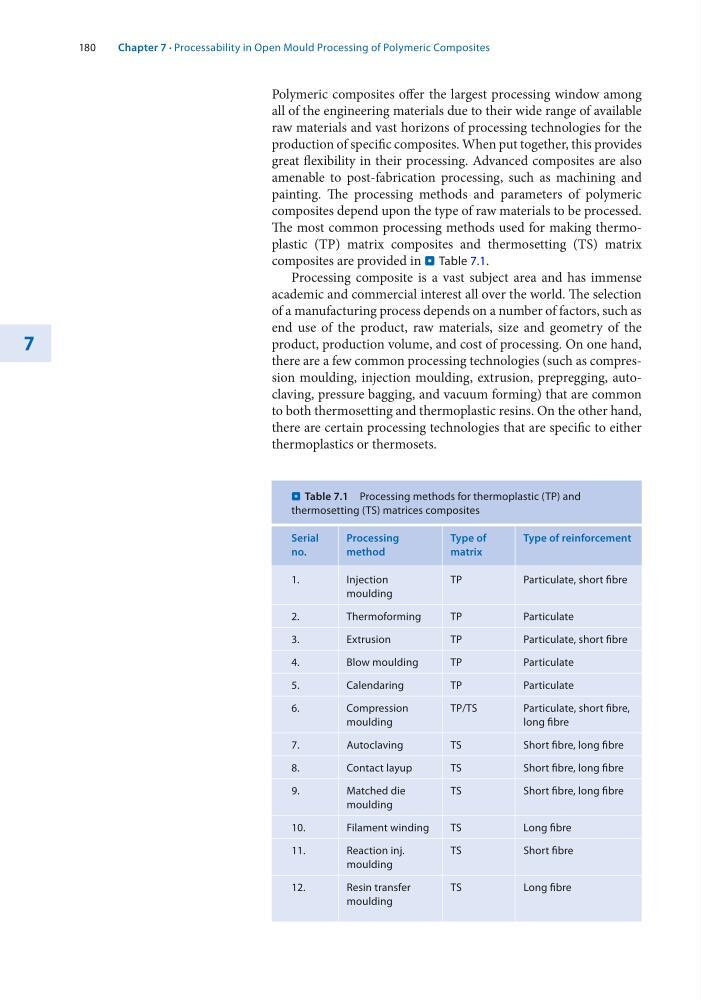
The most common processing methods used for making thermoplastic (TP) matrix composites and thermosetting (TS) matrix
composites are provided in . Table 7.1.
Processing composite is a vast subject area and has immense
academic and commercial interest all over the world. The selection
of a manufacturing process depends on a number of factors, such as
end use of the product, raw materials, size and geometry of the
product, production volume, and cost of processing. On one hand,
there are a few common processing technologies (such as compression moulding, injection moulding, extrusion, prepregging, autoclaving, pressure bagging, and vacuum forming) that are common
to both thermosetting and thermoplastic resins. On the other hand,
there are certain processing technologies that are specific to either
thermoplastics or thermosets.
. Table 7.1 Processing methods for thermoplastic (TP) and
thermosetting (TS) matrices composites
Serial
no.
Processing
method
Type of
matrix
Type of reinforcement
1.
Injection
moulding
TP
Particulate, short fibre
2.
Thermoforming
TP
Particulate
3.
Extrusion
TP
Particulate, short fibre
4.
Blow moulding
TP
Particulate
5.
Calendaring
TP
Particulate
6.
Compression
moulding
TP/TS
Particulate, short fibre,
long fibre
7.
Autoclaving
TS
Short fibre, long fibre
8.
Contact layup
TS
Short fibre, long fibre
9.
Matched die
moulding
TS
Short fibre, long fibre
10.
Filament winding
TS
Long fibre
11.
Reaction inj.
moulding
TS
Short fibre
12.
Resin transfer
moulding
TS
Long fibre
Chapter 7 · Processability in Open Mould Processing of Polymeric Composites
7
Polymeric composites offer the largest processing window among
all of the engineering materials due to their wide range of available
raw materials and vast horizons of processing technologies for the
production of specific composites. When put together, this provides
great flexibility in their processing. Advanced composites are also
amenable to post-fabrication processing, such as machining and
painting. The processing methods and parameters of polymeric
composites depend upon the type of raw materials to be processed.
The most common processing methods used for making thermoplastic (TP) matrix composites and thermosetting (TS) matrix
composites are provided in . Table 7.1.
Processing composite is a vast subject area and has immense
academic and commercial interest all over the world. The selection
of a manufacturing process depends on a number of factors, such as
end use of the product, raw materials, size and geometry of the
product, production volume, and cost of processing. On one hand,
there are a few common processing technologies (such as compression moulding, injection moulding, extrusion, prepregging, autoclaving, pressure bagging, and vacuum forming) that are common
to both thermosetting and thermoplastic resins. On the other hand,
there are certain processing technologies that are specific to either
thermoplastics or thermosets.
. Table 7.1 Processing methods for thermoplastic (TP) and
thermosetting (TS) matrices composites
Serial
no.
Processing
method
Type of
matrix
Type of reinforcement
1.
Injection
moulding
TP
Particulate, short fibre
2.
Thermoforming
TP
Particulate
3.
Extrusion
TP
Particulate, short fibre
4.
Blow moulding
TP
Particulate
5.
Calendaring
TP
Particulate
6.
Compression
moulding
TP/TS
Particulate, short fibre,
long fibre
7.
Autoclaving
TS
Short fibre, long fibre
8.
Contact layup
TS
Short fibre, long fibre
9.
Matched die
moulding
TS
Short fibre, long fibre
10.
Filament winding
TS
Long fibre
11.
Reaction inj.
moulding
TS
Short fibre
12.
Resin transfer
moulding
TS
Long fibre
Chapter 7 · Processability in Open Mould Processing of Polymeric Composites