

172
6
6.9 Processability of Thermoplastic Green
Composites
Thermoplastic composites offer more environmentally friendly
‘green composites’ due to one or more added advantage over thermosetting matrix composites in the form of their recyclability.
Green composites do not cause any harm to the environment during
their processing and their disposal after their useful life is over. In
this classification of composites, major composites are those that
use natural fibres as reinforcement and/or have biodegradable
matrices. Green composites have created interest worldwide due to
their environment friendliness. These composites are not new. In
fact, their knowledge has existed with mankind from time immemorial. In ancient times, straw- or bamboo-reinforced mud houses
were built (as mentioned in 7 Chap. 1), and natural fibres (such as
coir or jute) were used as reinforcement in the construction of
buildings. The densities of these fibres are in the range of 1.15–
1.55 g/cm 3 , which supports their processability using common processes and having matrices that are processable within the limit of
Resin crystal
Fibre
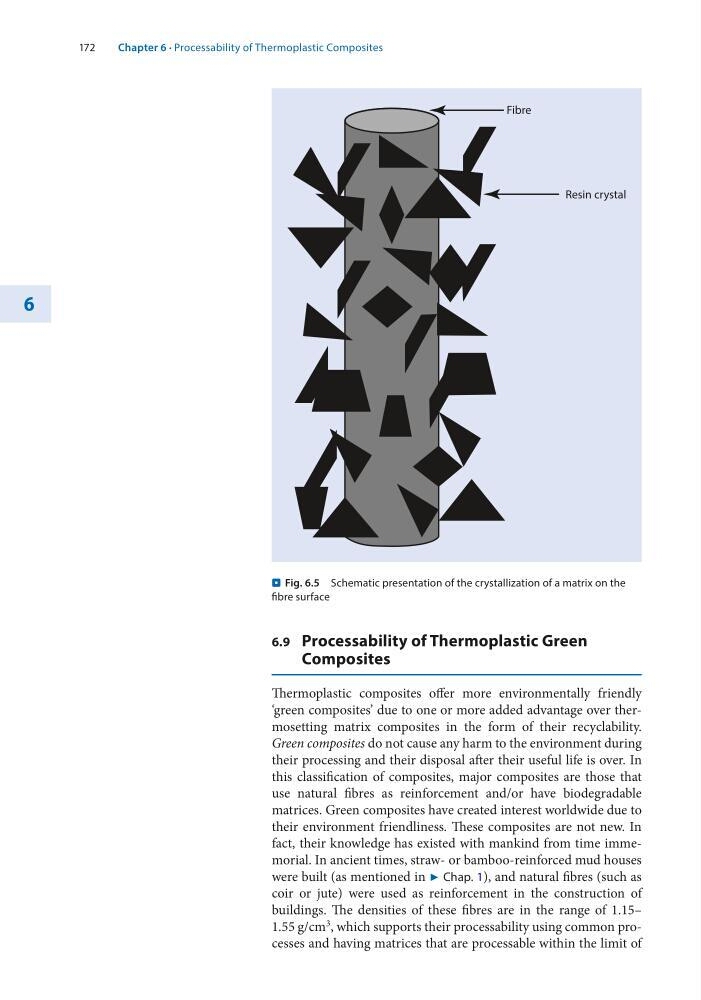
. Fig. 6.5 Schematic presentation of the crystallization of a matrix on the
fibre surface
Chapter 6 · Processability of Thermoplastic Composites
6
6.9 Processability of Thermoplastic Green
Composites
Thermoplastic composites offer more environmentally friendly
‘green composites’ due to one or more added advantage over thermosetting matrix composites in the form of their recyclability.
Green composites do not cause any harm to the environment during
their processing and their disposal after their useful life is over. In
this classification of composites, major composites are those that
use natural fibres as reinforcement and/or have biodegradable
matrices. Green composites have created interest worldwide due to
their environment friendliness. These composites are not new. In
fact, their knowledge has existed with mankind from time immemorial. In ancient times, straw- or bamboo-reinforced mud houses
were built (as mentioned in 7 Chap. 1), and natural fibres (such as
coir or jute) were used as reinforcement in the construction of
buildings. The densities of these fibres are in the range of 1.15–
1.55 g/cm 3 , which supports their processability using common processes and having matrices that are processable within the limit of
Resin crystal
Fibre
. Fig. 6.5 Schematic presentation of the crystallization of a matrix on the
fibre surface
Chapter 6 · Processability of Thermoplastic Composites