

138
5
thermosetting composites are dependent on the processability
factors of the reinforcement as well as the processing technology
[19–21]. The processability factors for reinforcement are detailed
here.
1. Properties Driven by Selection Criteria
5 Form of Reinforcement—In thermosetting composites, all
forms and shapes of reinforcements, as described in earlier
sections, are used. There are specific restrictions for the use
of any weave, staple, particles, etc. of the reinforcement for
the fabrication of composites.
5 Wettability of Reinforcement—The surface of the reinforcement must have a high surface energy to allow the resin to
wet its surface. The wettability of the reinforcement will
ensure a good interphase between the reinforcement and
the matrix. This will result in a good composite.
5 Chemical Interaction with Resin—The hydrophobic surface
of the reinforcement will allow the formation of a chemical
bond with an organic matrix. This will yield into a good
interphase. Reinforcement must be selected based on its
capability of having a good chemical interaction with the
matrix.
5 Fire Resistance—This is an important parameter from the
point of view of safety. Most synthetic-reinforcing fibres are
fire safe except UHMWPE, PP, and PEEK. Natural fibres
are susceptible to fire hazards, and care must be taken that
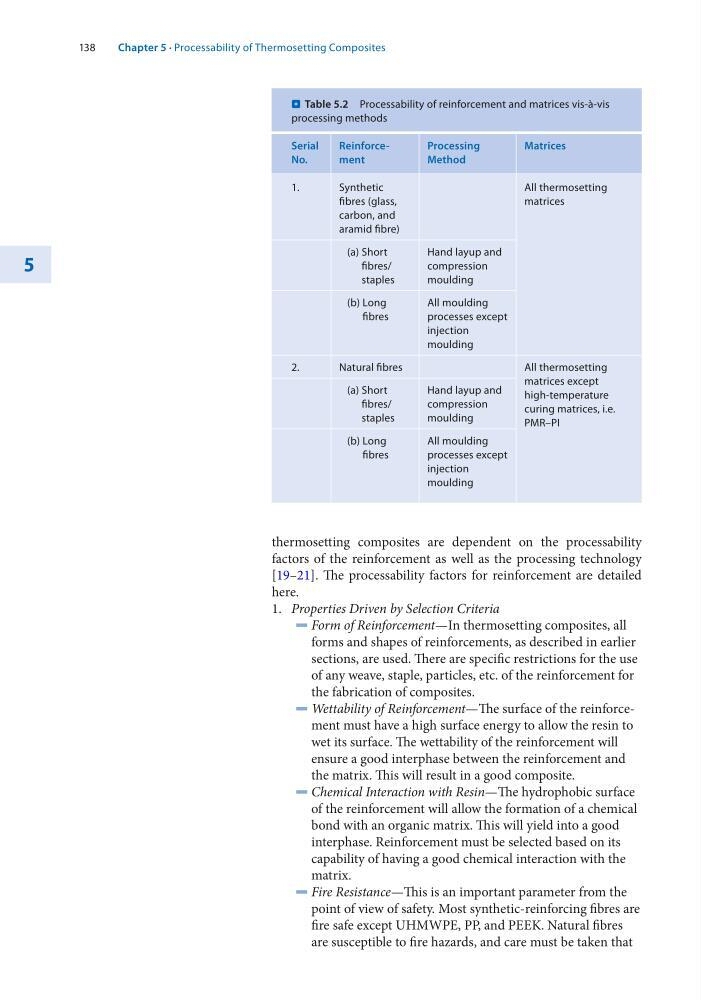
. Table 5.2 Processability of reinforcement and matrices vis-à-vis
processing methods
Serial
No.
Reinforcement
Processing
Method
Matrices
1.
Synthetic
fibres (glass,
carbon, and
aramid fibre)
All thermosetting
matrices
(a) Short
fibres/
staples
Hand layup and
compression
moulding
(b) Long
fibres
All moulding
processes except
injection
moulding
2.
Natural fibres
All thermosetting
matrices except
high-temperature
curing matrices, i.e.
PMR–PI
(a) Short
fibres/
staples
Hand layup and
compression
moulding
(b) Long
fibres
All moulding
processes except
injection
moulding
Chapter 5 · Processability of Thermosetting Composites
5
thermosetting composites are dependent on the processability
factors of the reinforcement as well as the processing technology
[19–21]. The processability factors for reinforcement are detailed
here.
1. Properties Driven by Selection Criteria
5 Form of Reinforcement—In thermosetting composites, all
forms and shapes of reinforcements, as described in earlier
sections, are used. There are specific restrictions for the use
of any weave, staple, particles, etc. of the reinforcement for
the fabrication of composites.
5 Wettability of Reinforcement—The surface of the reinforcement must have a high surface energy to allow the resin to
wet its surface. The wettability of the reinforcement will
ensure a good interphase between the reinforcement and
the matrix. This will result in a good composite.
5 Chemical Interaction with Resin—The hydrophobic surface
of the reinforcement will allow the formation of a chemical
bond with an organic matrix. This will yield into a good
interphase. Reinforcement must be selected based on its
capability of having a good chemical interaction with the
matrix.
5 Fire Resistance—This is an important parameter from the
point of view of safety. Most synthetic-reinforcing fibres are
fire safe except UHMWPE, PP, and PEEK. Natural fibres
are susceptible to fire hazards, and care must be taken that
. Table 5.2 Processability of reinforcement and matrices vis-à-vis
processing methods
Serial
No.
Reinforcement
Processing
Method
Matrices
1.
Synthetic
fibres (glass,
carbon, and
aramid fibre)
All thermosetting
matrices
(a) Short
fibres/
staples
Hand layup and
compression
moulding
(b) Long
fibres
All moulding
processes except
injection
moulding
2.
Natural fibres
All thermosetting
matrices except
high-temperature
curing matrices, i.e.
PMR–PI
(a) Short
fibres/
staples
Hand layup and
compression
moulding
(b) Long
fibres
All moulding
processes except
injection
moulding
Chapter 5 · Processability of Thermosetting Composites