

136
5
a condensate. BMI resins are prepared in two steps: first a
polyamic acid is formed and second a further condensation
reaction makes a bismaleimide prepolymer resin. This is cured
in the presence of an amine (such as DDM or DETA). Amines
are premixed and are used as one component system. The BMI
resin shelf life is short, and it must be stored under cool and
dry conditions. The mechanical properties of bismaleimide
resins have been mentioned in 7 Chap. 1. The major processability factors for epoxy resins are the following:
5 The viscosities of bismaleimide resins are low, and it is easy
to process them.
5 They are cured at a high temperature (190–230 °C).
5 Their T g is in the range of 190–230 °C.
5 Bismaleimide resins have low shrinkage (> 0.5%).
6. Polymeric Monomer Reactant–Polyimide (PMR–PI) Resins—
PMR–PI resins are the highest-temperature resins known to
date. Their service temperature is up to 367 °C. PMR–PI resins
are thermally stable at high temperatures due to the shifting of
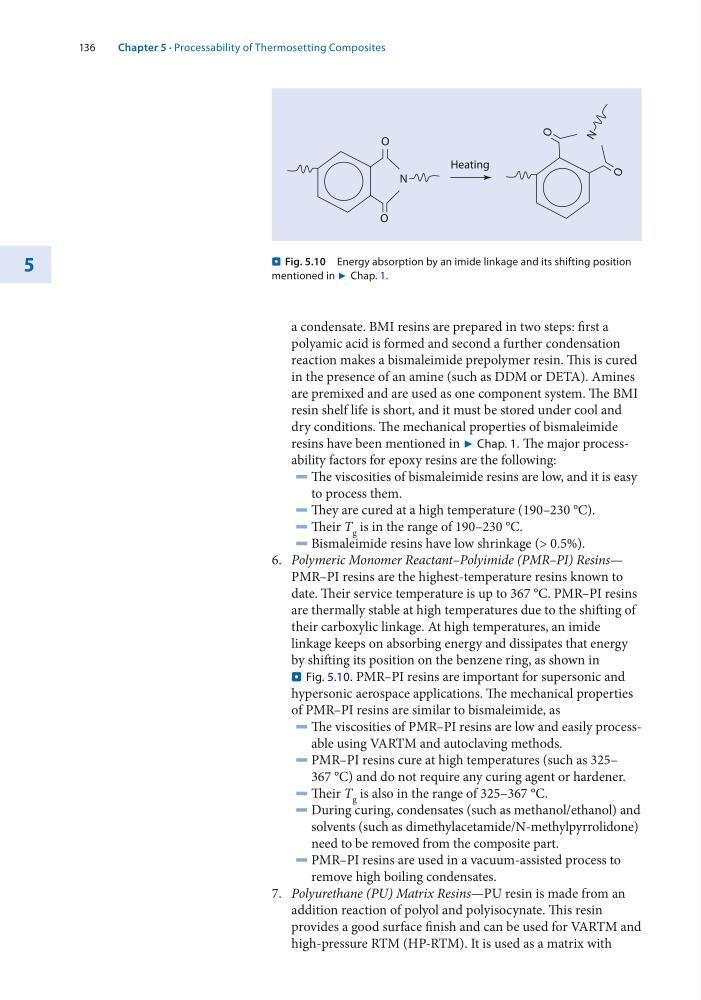
their carboxylic linkage. At high temperatures, an imide
linkage keeps on absorbing energy and dissipates that energy
by shifting its position on the benzene ring, as shown in
. Fig. 5.10. PMR–PI resins are important for supersonic and
hypersonic aerospace applications. The mechanical properties
of PMR–PI resins are similar to bismaleimide, as
5 The viscosities of PMR–PI resins are low and easily processable using VARTM and autoclaving methods.
5 PMR–PI resins cure at high temperatures (such as 325–
367 °C) and do not require any curing agent or hardener.
5 Their T g is also in the range of 325–367 °C.
5 During curing, condensates (such as methanol/ethanol) and
solvents (such as dimethylacetamide/N-methylpyrrolidone)
need to be removed from the composite part.
5 PMR–PI resins are used in a vacuum-assisted process to
remove high boiling condensates.
7. Polyurethane (PU) Matrix Resins—PU resin is made from an
addition reaction of polyol and polyisocynate. This resin
provides a good surface finish and can be used for VARTM and
high-pressure RTM (HP-RTM). It is used as a matrix with
O
O
N
O
O
N
Heating
. Fig. 5.10 Energy absorption by an imide linkage and its shifting position
mentioned in 7 Chap. 1.
Chapter 5 · Processability of Thermosetting Composites
5
a condensate. BMI resins are prepared in two steps: first a
polyamic acid is formed and second a further condensation
reaction makes a bismaleimide prepolymer resin. This is cured
in the presence of an amine (such as DDM or DETA). Amines
are premixed and are used as one component system. The BMI
resin shelf life is short, and it must be stored under cool and
dry conditions. The mechanical properties of bismaleimide
resins have been mentioned in 7 Chap. 1. The major processability factors for epoxy resins are the following:
5 The viscosities of bismaleimide resins are low, and it is easy
to process them.
5 They are cured at a high temperature (190–230 °C).
5 Their T g is in the range of 190–230 °C.
5 Bismaleimide resins have low shrinkage (> 0.5%).
6. Polymeric Monomer Reactant–Polyimide (PMR–PI) Resins—
PMR–PI resins are the highest-temperature resins known to
date. Their service temperature is up to 367 °C. PMR–PI resins
are thermally stable at high temperatures due to the shifting of
their carboxylic linkage. At high temperatures, an imide
linkage keeps on absorbing energy and dissipates that energy
by shifting its position on the benzene ring, as shown in
. Fig. 5.10. PMR–PI resins are important for supersonic and
hypersonic aerospace applications. The mechanical properties
of PMR–PI resins are similar to bismaleimide, as
5 The viscosities of PMR–PI resins are low and easily processable using VARTM and autoclaving methods.
5 PMR–PI resins cure at high temperatures (such as 325–
367 °C) and do not require any curing agent or hardener.
5 Their T g is also in the range of 325–367 °C.
5 During curing, condensates (such as methanol/ethanol) and
solvents (such as dimethylacetamide/N-methylpyrrolidone)
need to be removed from the composite part.
5 PMR–PI resins are used in a vacuum-assisted process to
remove high boiling condensates.
7. Polyurethane (PU) Matrix Resins—PU resin is made from an
addition reaction of polyol and polyisocynate. This resin
provides a good surface finish and can be used for VARTM and
high-pressure RTM (HP-RTM). It is used as a matrix with
O
O
N
O
O
N
Heating
. Fig. 5.10 Energy absorption by an imide linkage and its shifting position
mentioned in 7 Chap. 1.
Chapter 5 · Processability of Thermosetting Composites