

133
5
resin that has a high cost coupled with excellent mechanical
properties, very low shrinkage, and high transparency.
Depending upon the product and service requirement,
resin may be chosen.
5 Product Size and Shape—The shape and size of the
product limits the processability of composites. An
irregularly shaped product having undercuts on its profile
is difficult to mould using a filament winding process.
Similarly, large composite sheets are not processable by
injection moulding, resin transfer moulding, tape winding, or filament winding. The wrong selection of the
processing method leads to a poor-quality product with a
high overall cost of production. In order to process any
composite product, the processability of the product
depends upon the procedure selected with respect to the
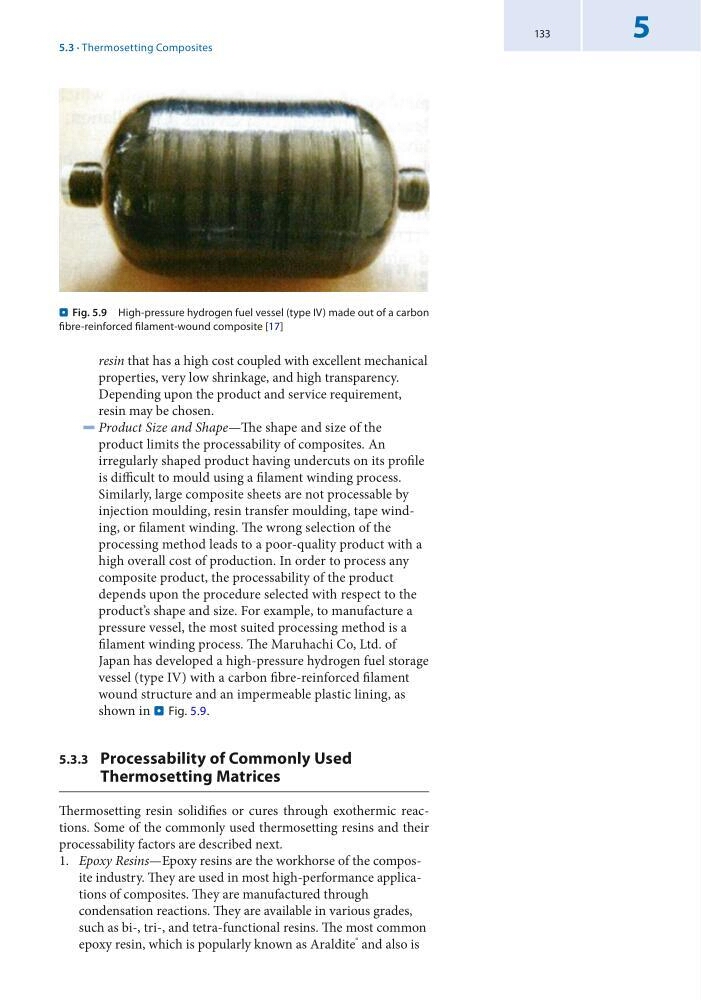
product’s shape and size. For example, to manufacture a
pressure vessel, the most suited processing method is a
filament winding process. The Maruhachi Co, Ltd. of
Japan has developed a high-pressure hydrogen fuel storage
vessel (type IV) with a carbon fibre-reinforced filament
wound structure and an impermeable plastic lining, as
shown in . Fig. 5.9.
5.3.3 Processability of Commonly Used
Thermosetting Matrices
Thermosetting resin solidifies or cures through exothermic reactions. Some of the commonly used thermosetting resins and their
processability factors are described next.
1. Epoxy Resins—Epoxy resins are the workhorse of the composite industry. They are used in most high-performance applications of composites. They are manufactured through
condensation reactions. They are available in various grades,
such as bi-, tri-, and tetra-functional resins. The most common
epoxy resin, which is popularly known as Araldite ® and also is
. Fig. 5.9 High-pressure hydrogen fuel vessel (type IV) made out of a carbon
fibre-reinforced filament-wound composite [17]
5.3 · Thermosetting Composites
5
resin that has a high cost coupled with excellent mechanical
properties, very low shrinkage, and high transparency.
Depending upon the product and service requirement,
resin may be chosen.
5 Product Size and Shape—The shape and size of the
product limits the processability of composites. An
irregularly shaped product having undercuts on its profile
is difficult to mould using a filament winding process.
Similarly, large composite sheets are not processable by
injection moulding, resin transfer moulding, tape winding, or filament winding. The wrong selection of the
processing method leads to a poor-quality product with a
high overall cost of production. In order to process any
composite product, the processability of the product
depends upon the procedure selected with respect to the
product’s shape and size. For example, to manufacture a
pressure vessel, the most suited processing method is a
filament winding process. The Maruhachi Co, Ltd. of
Japan has developed a high-pressure hydrogen fuel storage
vessel (type IV) with a carbon fibre-reinforced filament
wound structure and an impermeable plastic lining, as
shown in . Fig. 5.9.
5.3.3 Processability of Commonly Used
Thermosetting Matrices
Thermosetting resin solidifies or cures through exothermic reactions. Some of the commonly used thermosetting resins and their
processability factors are described next.
1. Epoxy Resins—Epoxy resins are the workhorse of the composite industry. They are used in most high-performance applications of composites. They are manufactured through
condensation reactions. They are available in various grades,
such as bi-, tri-, and tetra-functional resins. The most common
epoxy resin, which is popularly known as Araldite ® and also is
. Fig. 5.9 High-pressure hydrogen fuel vessel (type IV) made out of a carbon
fibre-reinforced filament-wound composite [17]
5.3 · Thermosetting Composites