

131
5
time (e.g. polyester and epoxy resins) are suitable for
using a hand layup process.
5 Thermal Stability—The thermal stability of a resin is another
criterion for its selection. The thermal stability of a resin
governs the life of the composite under the required service
conditions. The curing temperature of thermosetting resins
is usually close to their glass transition temperature (T g ).
Thermal degradation of thermosetting resin begins beyond
its T g .
5 Hygrothermal Stability—The hygrothermal stability of the
resin ensures its life under heat and in humid conditions.
The ester group of polyester gets hydrolysed under humid
and hot conditions. For example, polyester resins are not
suitable for a hygrothermal environment, whereas epoxy
and vinyl ester resins are more suitable.
5 Post-processing Operations—The role of the matrix and its
chemical activity is important for post-fabrication operations, such as metalizing, colouring, assembling, packaging,
etc. Resin plays a role in moulding surfaces; therefore,
processing technologies need to be chosen in order to
ensure minimum post-fabrication operations on moulded
composite products.
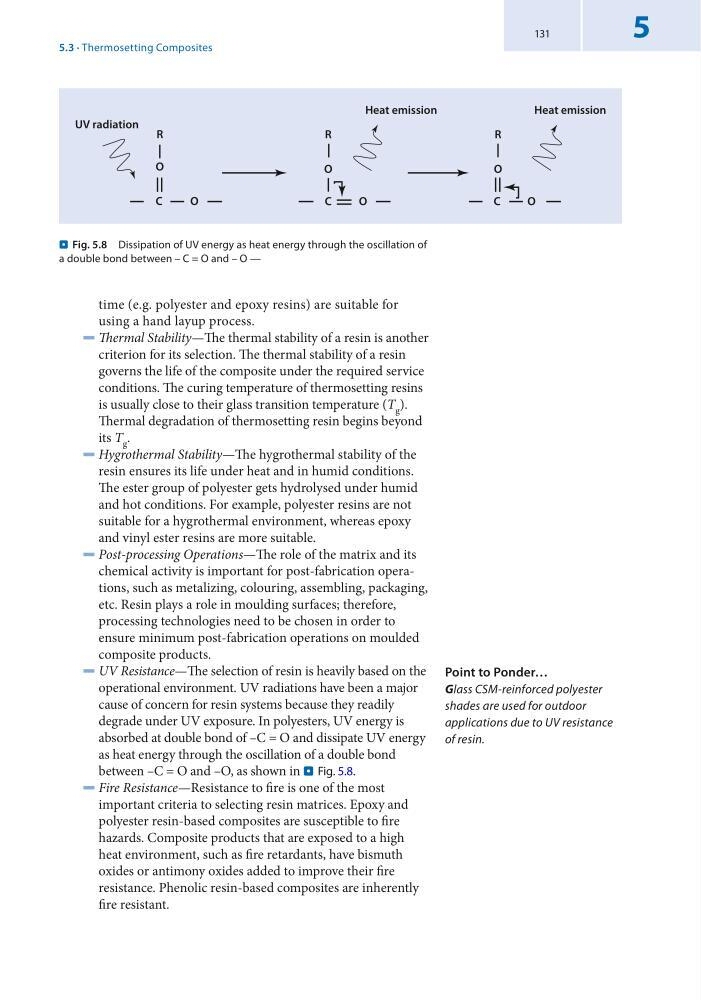
5 UV Resistance—The selection of resin is heavily based on the
operational environment. UV radiations have been a major
cause of concern for resin systems because they readily
degrade under UV exposure. In polyesters, UV energy is
absorbed at double bond of –C = O and dissipate UV energy
as heat energy through the oscillation of a double bond
between –C = O and –O, as shown in . Fig. 5.8.
5 Fire Resistance—Resistance to fire is one of the most
important criteria to selecting resin matrices. Epoxy and
polyester resin-based composites are susceptible to fire
hazards. Composite products that are exposed to a high
heat environment, such as fire retardants, have bismuth
oxides or antimony oxides added to improve their fire
resistance. Phenolic resin-based composites are inherently
fire resistant.
Point to Ponder…
Glass CSM-reinforced polyester
shades are used for outdoor
applications due to UV resistance
of resin.
R
UV radiation
Heat emission
Heat emission
O
R
O
C
O
C
O
R
O
C
O
. Fig. 5.8 Dissipation of UV energy as heat energy through the oscillation of
a double bond between – C = O and – O —
5.3 · Thermosetting Composites
5
time (e.g. polyester and epoxy resins) are suitable for
using a hand layup process.
5 Thermal Stability—The thermal stability of a resin is another
criterion for its selection. The thermal stability of a resin
governs the life of the composite under the required service
conditions. The curing temperature of thermosetting resins
is usually close to their glass transition temperature (T g ).
Thermal degradation of thermosetting resin begins beyond
its T g .
5 Hygrothermal Stability—The hygrothermal stability of the
resin ensures its life under heat and in humid conditions.
The ester group of polyester gets hydrolysed under humid
and hot conditions. For example, polyester resins are not
suitable for a hygrothermal environment, whereas epoxy
and vinyl ester resins are more suitable.
5 Post-processing Operations—The role of the matrix and its
chemical activity is important for post-fabrication operations, such as metalizing, colouring, assembling, packaging,
etc. Resin plays a role in moulding surfaces; therefore,
processing technologies need to be chosen in order to
ensure minimum post-fabrication operations on moulded
composite products.
5 UV Resistance—The selection of resin is heavily based on the
operational environment. UV radiations have been a major
cause of concern for resin systems because they readily
degrade under UV exposure. In polyesters, UV energy is
absorbed at double bond of –C = O and dissipate UV energy
as heat energy through the oscillation of a double bond
between –C = O and –O, as shown in . Fig. 5.8.
5 Fire Resistance—Resistance to fire is one of the most
important criteria to selecting resin matrices. Epoxy and
polyester resin-based composites are susceptible to fire
hazards. Composite products that are exposed to a high
heat environment, such as fire retardants, have bismuth
oxides or antimony oxides added to improve their fire
resistance. Phenolic resin-based composites are inherently
fire resistant.
Point to Ponder…
Glass CSM-reinforced polyester
shades are used for outdoor
applications due to UV resistance
of resin.
R
UV radiation
Heat emission
Heat emission
O
R
O
C
O
C
O
R
O
C
O
. Fig. 5.8 Dissipation of UV energy as heat energy through the oscillation of
a double bond between – C = O and – O —
5.3 · Thermosetting Composites