

119
5
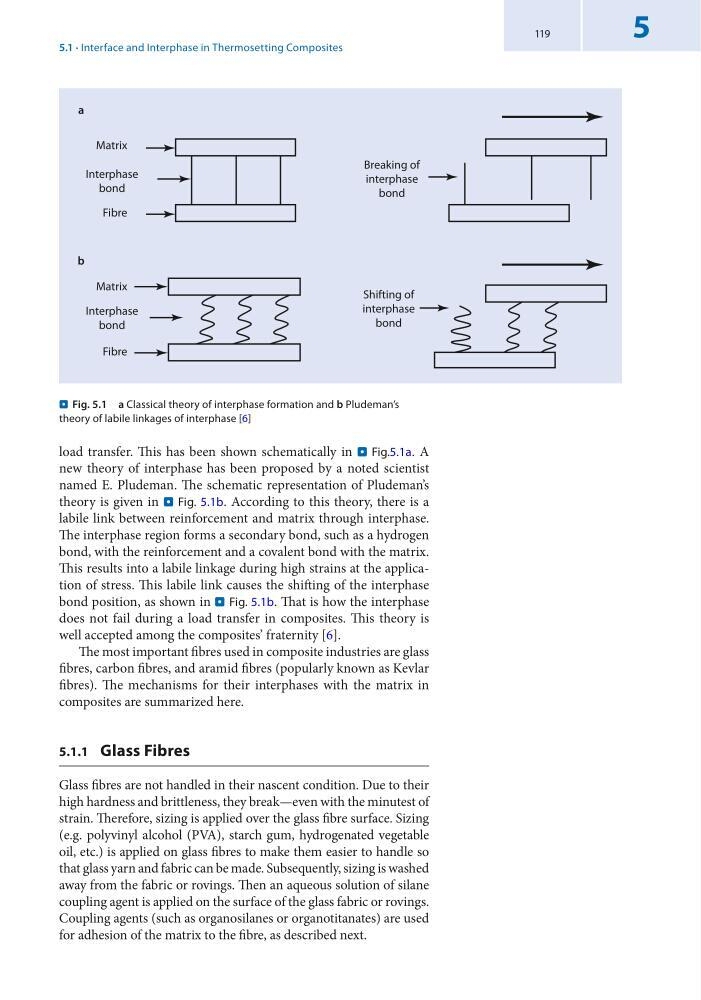
load transfer. This has been shown schematically in . Fig.5.1a. A
new theory of interphase has been proposed by a noted scientist
named E. Pludeman. The schematic representation of Pludeman’s
theory is given in . Fig. 5.1b. According to this theory, there is a
labile link between reinforcement and matrix through interphase.
The interphase region forms a secondary bond, such as a hydrogen
bond, with the reinforcement and a covalent bond with the matrix.
This results into a labile linkage during high strains at the application of stress. This labile link causes the shifting of the interphase
bond position, as shown in . Fig. 5.1b. That is how the interphase
does not fail during a load transfer in composites. This theory is
well accepted among the composites’ fraternity [6].
The most important fibres used in composite industries are glass
fibres, carbon fibres, and aramid fibres (popularly known as Kevlar
fibres). The mechanisms for their interphases with the matrix in
composites are summarized here.
5.1.1 Glass Fibres
Glass fibres are not handled in their nascent condition. Due to their
high hardness and brittleness, they break—even with the minutest of
strain. Therefore, sizing is applied over the glass fibre surface. Sizing
(e.g. polyvinyl alcohol (PVA), starch gum, hydrogenated vegetable
oil, etc.) is applied on glass fibres to make them easier to handle so
that glass yarn and fabric can be made. Subsequently, sizing is washed
away from the fabric or rovings. Then an aqueous solution of silane
coupling agent is applied on the surface of the glass fabric or rovings.
Coupling agents (such as organosilanes or organotitanates) are used
for adhesion of the matrix to the fibre, as described next.
Matrix
a
b
Interphase
bond
Fibre
Matrix
Breaking of
interphase
bond
Shifting of
interphase
bond
Interphase
bond
Fibre
. Fig. 5.1 a Classical theory of interphase formation and b Pludeman’s
theory of labile linkages of interphase [6]
5.1 · Interface and Interphase in Thermosetting Composites
5
load transfer. This has been shown schematically in . Fig.5.1a. A
new theory of interphase has been proposed by a noted scientist
named E. Pludeman. The schematic representation of Pludeman’s
theory is given in . Fig. 5.1b. According to this theory, there is a
labile link between reinforcement and matrix through interphase.
The interphase region forms a secondary bond, such as a hydrogen
bond, with the reinforcement and a covalent bond with the matrix.
This results into a labile linkage during high strains at the application of stress. This labile link causes the shifting of the interphase
bond position, as shown in . Fig. 5.1b. That is how the interphase
does not fail during a load transfer in composites. This theory is
well accepted among the composites’ fraternity [6].
The most important fibres used in composite industries are glass
fibres, carbon fibres, and aramid fibres (popularly known as Kevlar
fibres). The mechanisms for their interphases with the matrix in
composites are summarized here.
5.1.1 Glass Fibres
Glass fibres are not handled in their nascent condition. Due to their
high hardness and brittleness, they break—even with the minutest of
strain. Therefore, sizing is applied over the glass fibre surface. Sizing
(e.g. polyvinyl alcohol (PVA), starch gum, hydrogenated vegetable
oil, etc.) is applied on glass fibres to make them easier to handle so
that glass yarn and fabric can be made. Subsequently, sizing is washed
away from the fabric or rovings. Then an aqueous solution of silane
coupling agent is applied on the surface of the glass fabric or rovings.
Coupling agents (such as organosilanes or organotitanates) are used
for adhesion of the matrix to the fibre, as described next.
Matrix
a
b
Interphase
bond
Fibre
Matrix
Breaking of
interphase
bond
Shifting of
interphase
bond
Interphase
bond
Fibre
. Fig. 5.1 a Classical theory of interphase formation and b Pludeman’s
theory of labile linkages of interphase [6]
5.1 · Interface and Interphase in Thermosetting Composites