

102
4
ical bonds are expected in their composite. At best, only some
secondary bonds or van der Waals forces may occur.
4. Product Design—The rheology of matrix resin depends upon
its flow path, which is governed by the product design. Not
only is the processability of the composite product dependent
on the product design but also the quality. It can be said if the
product design is not conducive to the processing of the
composite product, the rate of production and quality of the
product are likely to suffer. The guiding factors for product
design are the following:
5 Functionality
5 Service environment
5 Cost
5 Assembly
5 Material properties
5 Service life
5 Life cycle cost and maintenance
5 Transportability
5 Government regulations
5 Surface finish, aesthetics, etc.
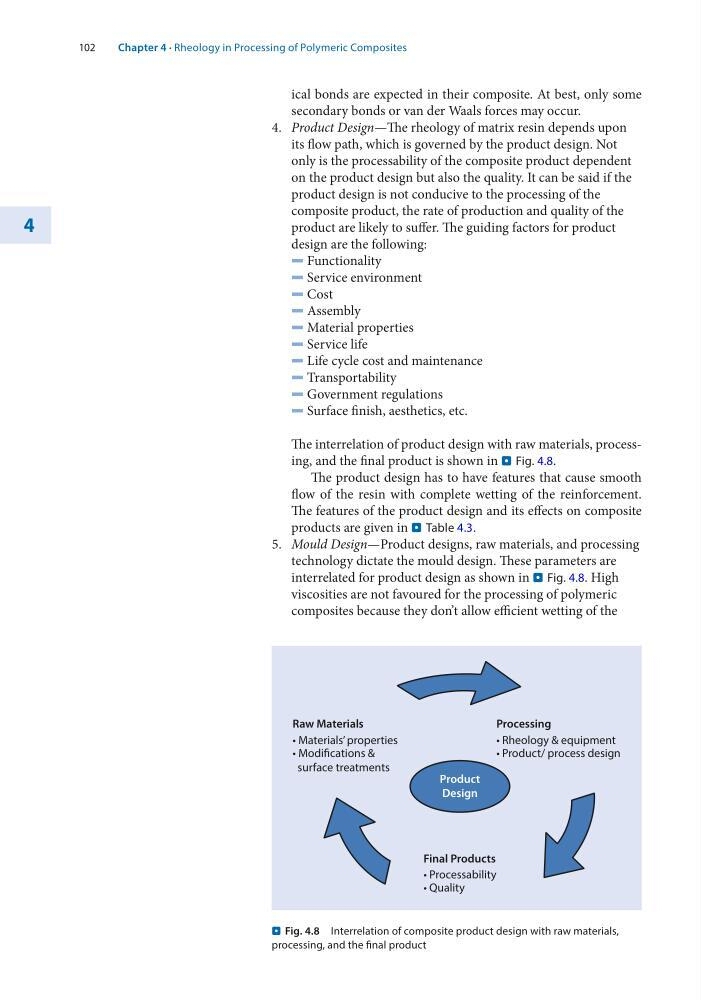
The interrelation of product design with raw materials, processing, and the final product is shown in . Fig. 4.8.
The product design has to have features that cause smooth
flow of the resin with complete wetting of the reinforcement.
The features of the product design and its effects on composite
products are given in . Table 4.3.
5. Mould Design—Product designs, raw materials, and processing
technology dictate the mould design. These parameters are
interrelated for product design as shown in . Fig. 4.8. High
viscosities are not favoured for the processing of polymeric
composites because they don’t allow efficient wetting of the
Processing
• Rheology & equipment
• Product/ process design
Product
Design
Raw Materials
• Materials’ properties
• Modiications &
surface treatments
Final Products
• Processability
• Quality
. Fig. 4.8 Interrelation of composite product design with raw materials,
processing, and the final product
Chapter 4 · Rheology in Processing of Polymeric Composites
4
ical bonds are expected in their composite. At best, only some
secondary bonds or van der Waals forces may occur.
4. Product Design—The rheology of matrix resin depends upon
its flow path, which is governed by the product design. Not
only is the processability of the composite product dependent
on the product design but also the quality. It can be said if the
product design is not conducive to the processing of the
composite product, the rate of production and quality of the
product are likely to suffer. The guiding factors for product
design are the following:
5 Functionality
5 Service environment
5 Cost
5 Assembly
5 Material properties
5 Service life
5 Life cycle cost and maintenance
5 Transportability
5 Government regulations
5 Surface finish, aesthetics, etc.
The interrelation of product design with raw materials, processing, and the final product is shown in . Fig. 4.8.
The product design has to have features that cause smooth
flow of the resin with complete wetting of the reinforcement.
The features of the product design and its effects on composite
products are given in . Table 4.3.
5. Mould Design—Product designs, raw materials, and processing
technology dictate the mould design. These parameters are
interrelated for product design as shown in . Fig. 4.8. High
viscosities are not favoured for the processing of polymeric
composites because they don’t allow efficient wetting of the
Processing
• Rheology & equipment
• Product/ process design
Product
Design
Raw Materials
• Materials’ properties
• Modiications &
surface treatments
Final Products
• Processability
• Quality
. Fig. 4.8 Interrelation of composite product design with raw materials,
processing, and the final product
Chapter 4 · Rheology in Processing of Polymeric Composites