

99
4
discussed here are within the limits of curing temperature, which
are well below the thermal degradation temperatures. Thermosetting
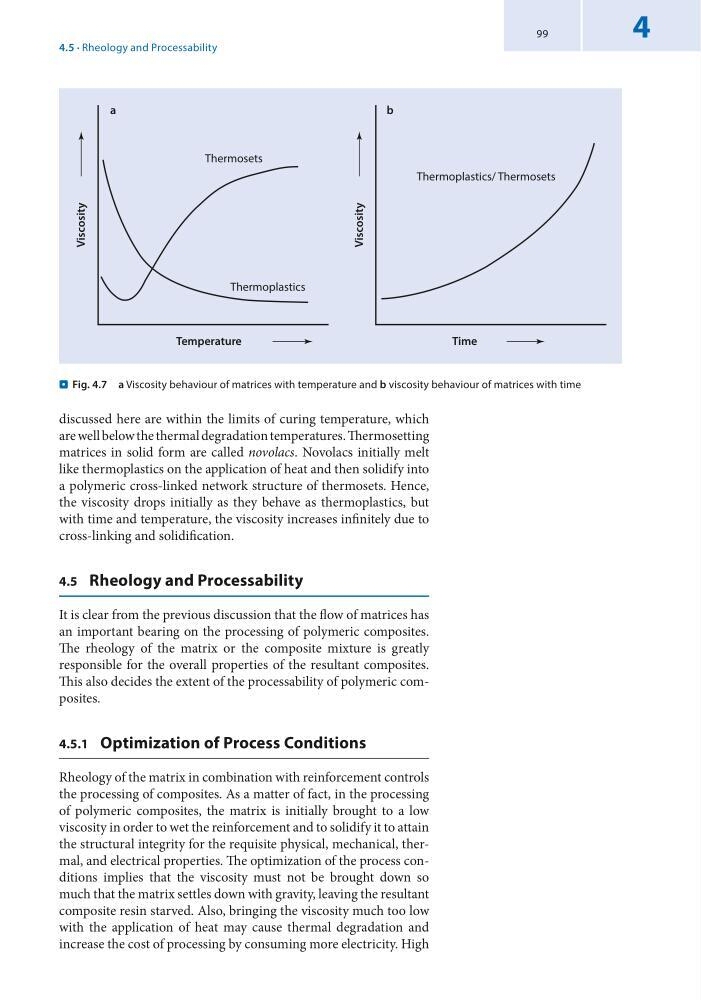
matrices in solid form are called novolacs. Novolacs initially melt
like thermoplastics on the application of heat and then solidify into
a polymeric cross-linked network structure of thermosets. Hence,
the viscosity drops initially as they behave as thermoplastics, but
with time and temperature, the viscosity increases infinitely due to
cross-linking and solidification.
4.5 Rheology and Processability
It is clear from the previous discussion that the flow of matrices has
an important bearing on the processing of polymeric composites.
The rheology of the matrix or the composite mixture is greatly
responsible for the overall properties of the resultant composites.
This also decides the extent of the processability of polymeric composites.
4.5.1 Optimization of Process Conditions
Rheology of the matrix in combination with reinforcement controls
the processing of composites. As a matter of fact, in the processing
of polymeric composites, the matrix is initially brought to a low
viscosity in order to wet the reinforcement and to solidify it to attain
the structural integrity for the requisite physical, mechanical, thermal, and electrical properties. The optimization of the process conditions implies that the viscosity must not be brought down so
much that the matrix settles down with gravity, leaving the resultant
composite resin starved. Also, bringing the viscosity much too low
with the application of heat may cause thermal degradation and
increase the cost of processing by consuming more electricity. High
Viscosity
Temperature
Thermoplastics
Thermoplastics/ Thermosets
Thermosets
a
b
Time
Viscosity
. Fig. 4.7 a Viscosity behaviour of matrices with temperature and b viscosity behaviour of matrices with time
4.5 · Rheology and Processability
4
discussed here are within the limits of curing temperature, which
are well below the thermal degradation temperatures. Thermosetting
matrices in solid form are called novolacs. Novolacs initially melt
like thermoplastics on the application of heat and then solidify into
a polymeric cross-linked network structure of thermosets. Hence,
the viscosity drops initially as they behave as thermoplastics, but
with time and temperature, the viscosity increases infinitely due to
cross-linking and solidification.
4.5 Rheology and Processability
It is clear from the previous discussion that the flow of matrices has
an important bearing on the processing of polymeric composites.
The rheology of the matrix or the composite mixture is greatly
responsible for the overall properties of the resultant composites.
This also decides the extent of the processability of polymeric composites.
4.5.1 Optimization of Process Conditions
Rheology of the matrix in combination with reinforcement controls
the processing of composites. As a matter of fact, in the processing
of polymeric composites, the matrix is initially brought to a low
viscosity in order to wet the reinforcement and to solidify it to attain
the structural integrity for the requisite physical, mechanical, thermal, and electrical properties. The optimization of the process conditions implies that the viscosity must not be brought down so
much that the matrix settles down with gravity, leaving the resultant
composite resin starved. Also, bringing the viscosity much too low
with the application of heat may cause thermal degradation and
increase the cost of processing by consuming more electricity. High
Viscosity
Temperature
Thermoplastics
Thermoplastics/ Thermosets
Thermosets
a
b
Time
Viscosity
. Fig. 4.7 a Viscosity behaviour of matrices with temperature and b viscosity behaviour of matrices with time
4.5 · Rheology and Processability