

97
4
fabric. This in turn assures the wetting of the fabric and results in a
good composite after moulding. All high-performance and highend applications in composites involve reinforcement in the form of
fabric, and thermosetting resins are largely used for their fabrication. Compression moulding and autoclaving are the processes
used for fabric-reinforced composites when external pressure is
applied to fabricate the thermoplastic composite parts.
The surface treatments used on hydrophilic fibres make them
hydrophobic; thereby, their wettability increases with hydrophobic
matrices. If the fibre treatment is not properly applied, either a small
fragment of fibres break out or scaling on the fibres comes out,
which is called fuzzing in the case of carbon fibres. This creates
resistance in the smooth flow of the matrix through microspaces
among the fibres and causes an increase in the viscosity of the composite mix. The reinforcement content in a matrix is denoted in
terms of the volume fraction of the composite. The volume fraction
of reinforcement is 0.50 (in an idealistic situation) in order to
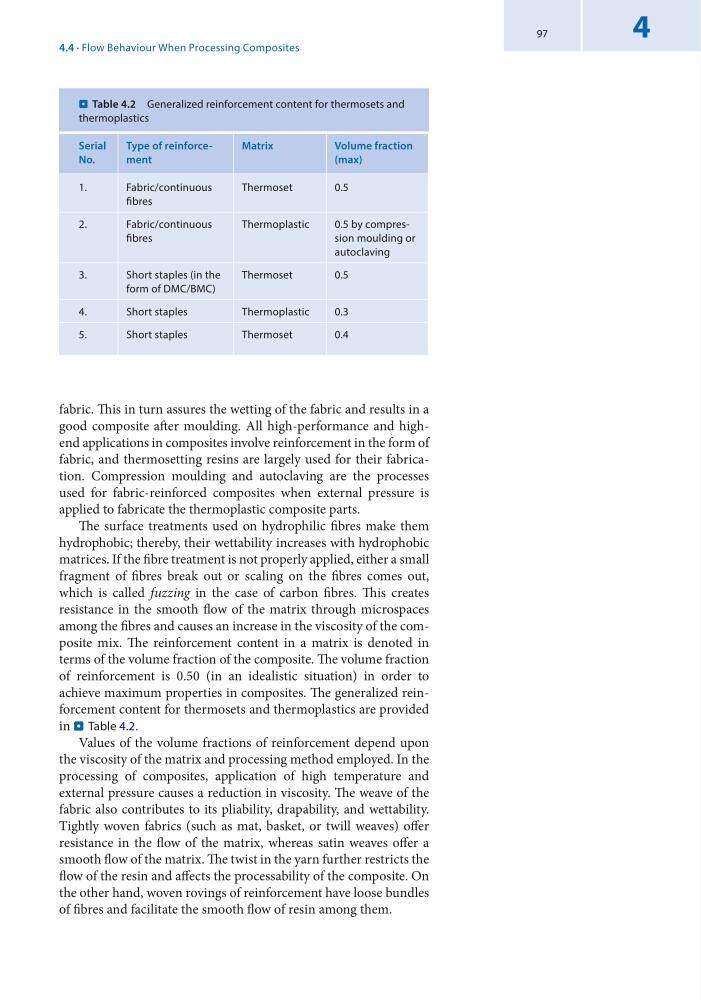
achieve maximum properties in composites. The generalized reinforcement content for thermosets and thermoplastics are provided
in . Table 4.2.
Values of the volume fractions of reinforcement depend upon
the viscosity of the matrix and processing method employed. In the
processing of composites, application of high temperature and
external pressure causes a reduction in viscosity. The weave of the
fabric also contributes to its pliability, drapability, and wettability.
Tightly woven fabrics (such as mat, basket, or twill weaves) offer
resistance in the flow of the matrix, whereas satin weaves offer a
smooth flow of the matrix. The twist in the yarn further restricts the
flow of the resin and affects the processability of the composite. On
the other hand, woven rovings of reinforcement have loose bundles
of fibres and facilitate the smooth flow of resin among them.
. Table 4.2 Generalized reinforcement content for thermosets and
thermoplastics
Serial
No.
Type of reinforcement
Matrix
Volume fraction
(max)
1.
Fabric/continuous
fibres
Thermoset
0.5
2.
Fabric/continuous
fibres
Thermoplastic
0.5 by compression moulding or
autoclaving
3.
Short staples (in the
form of DMC/BMC)
Thermoset
0.5
4.
Short staples
Thermoplastic
0.3
5.
Short staples
Thermoset
0.4
4.4 · Flow Behaviour When Processing Composites
4
fabric. This in turn assures the wetting of the fabric and results in a
good composite after moulding. All high-performance and highend applications in composites involve reinforcement in the form of
fabric, and thermosetting resins are largely used for their fabrication. Compression moulding and autoclaving are the processes
used for fabric-reinforced composites when external pressure is
applied to fabricate the thermoplastic composite parts.
The surface treatments used on hydrophilic fibres make them
hydrophobic; thereby, their wettability increases with hydrophobic
matrices. If the fibre treatment is not properly applied, either a small
fragment of fibres break out or scaling on the fibres comes out,
which is called fuzzing in the case of carbon fibres. This creates
resistance in the smooth flow of the matrix through microspaces
among the fibres and causes an increase in the viscosity of the composite mix. The reinforcement content in a matrix is denoted in
terms of the volume fraction of the composite. The volume fraction
of reinforcement is 0.50 (in an idealistic situation) in order to
achieve maximum properties in composites. The generalized reinforcement content for thermosets and thermoplastics are provided
in . Table 4.2.
Values of the volume fractions of reinforcement depend upon
the viscosity of the matrix and processing method employed. In the
processing of composites, application of high temperature and
external pressure causes a reduction in viscosity. The weave of the
fabric also contributes to its pliability, drapability, and wettability.
Tightly woven fabrics (such as mat, basket, or twill weaves) offer
resistance in the flow of the matrix, whereas satin weaves offer a
smooth flow of the matrix. The twist in the yarn further restricts the
flow of the resin and affects the processability of the composite. On
the other hand, woven rovings of reinforcement have loose bundles
of fibres and facilitate the smooth flow of resin among them.
. Table 4.2 Generalized reinforcement content for thermosets and
thermoplastics
Serial
No.
Type of reinforcement
Matrix
Volume fraction
(max)
1.
Fabric/continuous
fibres
Thermoset
0.5
2.
Fabric/continuous
fibres
Thermoplastic
0.5 by compression moulding or
autoclaving
3.
Short staples (in the
form of DMC/BMC)
Thermoset
0.5
4.
Short staples
Thermoplastic
0.3
5.
Short staples
Thermoset
0.4
4.4 · Flow Behaviour When Processing Composites