

1 3
Topics in Current Chemistry (2020) 378:29
During the rarefaction cycle, the degree of stretching of the liquid molecules is
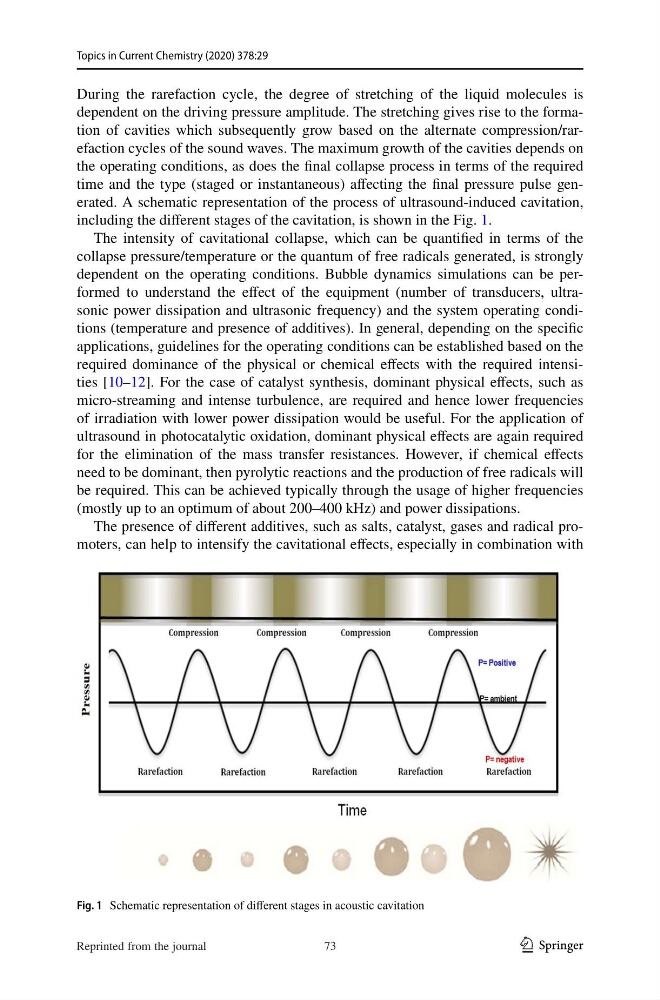
dependent on the driving pressure amplitude. The stretching gives rise to the formation of cavities which subsequently grow based on the alternate compression/rarefaction cycles of the sound waves. The maximum growth of the cavities depends on
the operating conditions, as does the final collapse process in terms of the required
time and the type (staged or instantaneous) affecting the final pressure pulse generated. A schematic representation of the process of ultrasound-induced cavitation,
including the different stages of the cavitation, is shown in the Fig. 1.
The intensity of cavitational collapse, which can be quantified in terms of the
collapse pressure/temperature or the quantum of free radicals generated, is strongly
dependent on the operating conditions. Bubble dynamics simulations can be performed to understand the effect of the equipment (number of transducers, ultrasonic power dissipation and ultrasonic frequency) and the system operating conditions (temperature and presence of additives). In general, depending on the specific
applications, guidelines for the operating conditions can be established based on the
required dominance of the physical or chemical effects with the required intensities [10–12]. For the case of catalyst synthesis, dominant physical effects, such as
micro-streaming and intense turbulence, are required and hence lower frequencies
of irradiation with lower power dissipation would be useful. For the application of
ultrasound in photocatalytic oxidation, dominant physical effects are again required
for the elimination of the mass transfer resistances. However, if chemical effects
need to be dominant, then pyrolytic reactions and the production of free radicals will
be required. This can be achieved typically through the usage of higher frequencies
(mostly up to an optimum of about 200–400 kHz) and power dissipations.
The presence of different additives, such as salts, catalyst, gases and radical promoters, can help to intensify the cavitational effects, especially in combination with
Fig. 1 Schematic representation of different stages in acoustic cavitation
73
Reprinted from the journal
Topics in Current Chemistry (2020) 378:29
During the rarefaction cycle, the degree of stretching of the liquid molecules is
dependent on the driving pressure amplitude. The stretching gives rise to the formation of cavities which subsequently grow based on the alternate compression/rarefaction cycles of the sound waves. The maximum growth of the cavities depends on
the operating conditions, as does the final collapse process in terms of the required
time and the type (staged or instantaneous) affecting the final pressure pulse generated. A schematic representation of the process of ultrasound-induced cavitation,
including the different stages of the cavitation, is shown in the Fig. 1.
The intensity of cavitational collapse, which can be quantified in terms of the
collapse pressure/temperature or the quantum of free radicals generated, is strongly
dependent on the operating conditions. Bubble dynamics simulations can be performed to understand the effect of the equipment (number of transducers, ultrasonic power dissipation and ultrasonic frequency) and the system operating conditions (temperature and presence of additives). In general, depending on the specific
applications, guidelines for the operating conditions can be established based on the
required dominance of the physical or chemical effects with the required intensities [10–12]. For the case of catalyst synthesis, dominant physical effects, such as
micro-streaming and intense turbulence, are required and hence lower frequencies
of irradiation with lower power dissipation would be useful. For the application of
ultrasound in photocatalytic oxidation, dominant physical effects are again required
for the elimination of the mass transfer resistances. However, if chemical effects
need to be dominant, then pyrolytic reactions and the production of free radicals will
be required. This can be achieved typically through the usage of higher frequencies
(mostly up to an optimum of about 200–400 kHz) and power dissipations.
The presence of different additives, such as salts, catalyst, gases and radical promoters, can help to intensify the cavitational effects, especially in combination with
Fig. 1 Schematic representation of different stages in acoustic cavitation
73
Reprinted from the journal