

1 3
Topics in Current Chemistry (2020) 378:2
promotes the peeling of the mineral’s particle even at a lower concentration of 10 M,
necessary for the hydrothermal peeling of TiO 2 particles.
The formation of the 1-D nanorods obtained from ilmenite sand and the necessity
of the metastable polymorphs formation was presented in 2008 and 2010 [132, 133].
It was revealed that for the formation of the nanorods, instead of other particle morphologies, the formation of the metastable phases like Ti 2 O 3 to Ti 3 O 5 is crucial. The
ilmenite mineral was ball-milled with the presence of activated carbon at a ratio 4:1
at room temperature and under vacuum. The role of the latter as mechanical activation agent was to trigger the initial reduction to TiO 2 . The obtained ultra-fine powder was annealed first at different high temperatures (900–1200 °C) in order to form
the metastable phases. The low and controlled heating rate (5–10 °C) in an argon
atmosphere with hydrogen flow was a critical step in order to obtain the desired
metastable phases. It was reported that the presence of nitrogen led to an alternative redox reaction and iron nitride was formed. At temperature less than 1100 °C,
the formed phase was rutile, which could remain in the same form after the second annealing step. The optimum duration of annealing was 8 h at 1200 °C, since
prolonged heat treatment led to the formation of FeTi alloys. The second step of
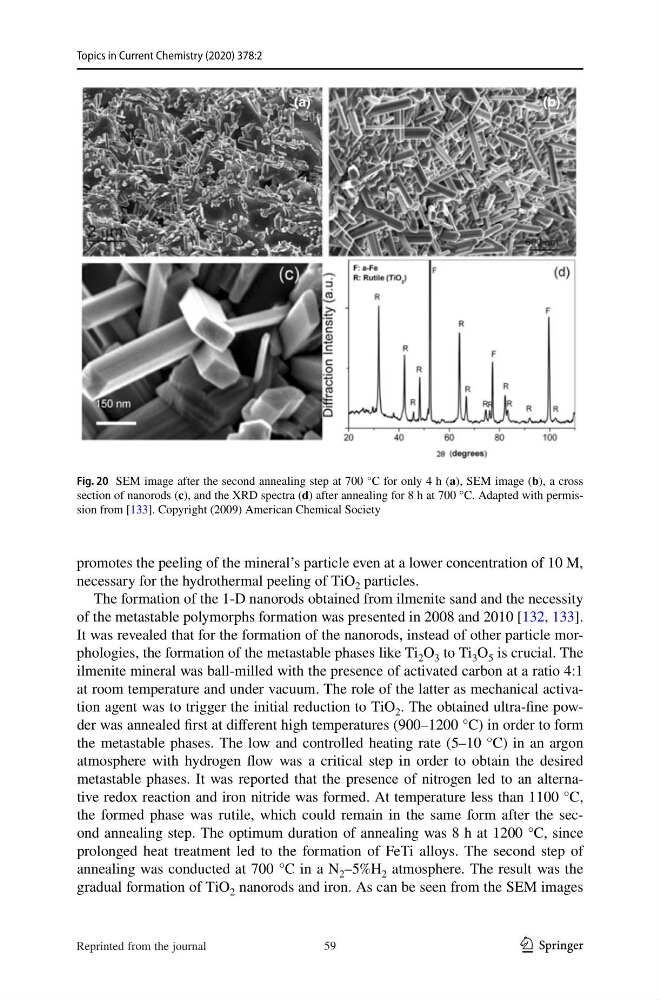
annealing was conducted at 700 °C in a N 2 –5%H 2 atmosphere. The result was the
gradual formation of TiO 2 nanorods and iron. As can be seen from the SEM images
Fig. 20 SEM image after the second annealing step at 700 °C for only 4 h (a), SEM image (b), a cross
section of nanorods (c), and the XRD spectra (d) after annealing for 8 h at 700 °C. Adapted with permission from [133]. Copyright (2009) American Chemical Society
59
Reprinted from the journal
Topics in Current Chemistry (2020) 378:2
promotes the peeling of the mineral’s particle even at a lower concentration of 10 M,
necessary for the hydrothermal peeling of TiO 2 particles.
The formation of the 1-D nanorods obtained from ilmenite sand and the necessity
of the metastable polymorphs formation was presented in 2008 and 2010 [132, 133].
It was revealed that for the formation of the nanorods, instead of other particle morphologies, the formation of the metastable phases like Ti 2 O 3 to Ti 3 O 5 is crucial. The
ilmenite mineral was ball-milled with the presence of activated carbon at a ratio 4:1
at room temperature and under vacuum. The role of the latter as mechanical activation agent was to trigger the initial reduction to TiO 2 . The obtained ultra-fine powder was annealed first at different high temperatures (900–1200 °C) in order to form
the metastable phases. The low and controlled heating rate (5–10 °C) in an argon
atmosphere with hydrogen flow was a critical step in order to obtain the desired
metastable phases. It was reported that the presence of nitrogen led to an alternative redox reaction and iron nitride was formed. At temperature less than 1100 °C,
the formed phase was rutile, which could remain in the same form after the second annealing step. The optimum duration of annealing was 8 h at 1200 °C, since
prolonged heat treatment led to the formation of FeTi alloys. The second step of
annealing was conducted at 700 °C in a N 2 –5%H 2 atmosphere. The result was the
gradual formation of TiO 2 nanorods and iron. As can be seen from the SEM images
Fig. 20 SEM image after the second annealing step at 700 °C for only 4 h (a), SEM image (b), a cross
section of nanorods (c), and the XRD spectra (d) after annealing for 8 h at 700 °C. Adapted with permission from [133]. Copyright (2009) American Chemical Society
59
Reprinted from the journal