

Topics in Current Chemistry (2020) 378:2
1 3
while modified forms of HP are the main compounds of human bones and teeth.
The increase of milling duration led to the decrease of the grain size, as well as to
an improvement on the homogenously distribution of nano-hydroxyapatite. Analogous composites were synthesized by ball milling the same year by Silva et al.
starting with Ca(H 2 PO 4 ) 2 and TiO 2 as the raw materials [122].
In 2000, Begin-Colin et al. studied in details the kinetics and mechanisms of
phase transformations induced by ball milling in air, starting with a commercial
anatase TiO 2 [123]. They concluded that the anatase is transformed by BM to
rutile via a TiO 2 II phase. The powder-to-balls ratio of weights (R) influenced the
transformation rate. Regarding the nature of ball-milling media, the transformation’s kinetics were found faster in the case of alumina compared to steel.
Yadav et al. showed in 2015 the synthesis of titanium oxide nanoparticles from
elemental powder of Ti (~ 0.5 mm) by ball milling for 10 h [124]. The size of
the spherically shaped particles was between 10 and 20 nm, while XRD analysis indicated a pure rutile phase. The estimated bandgap was 4.46 eV. They used
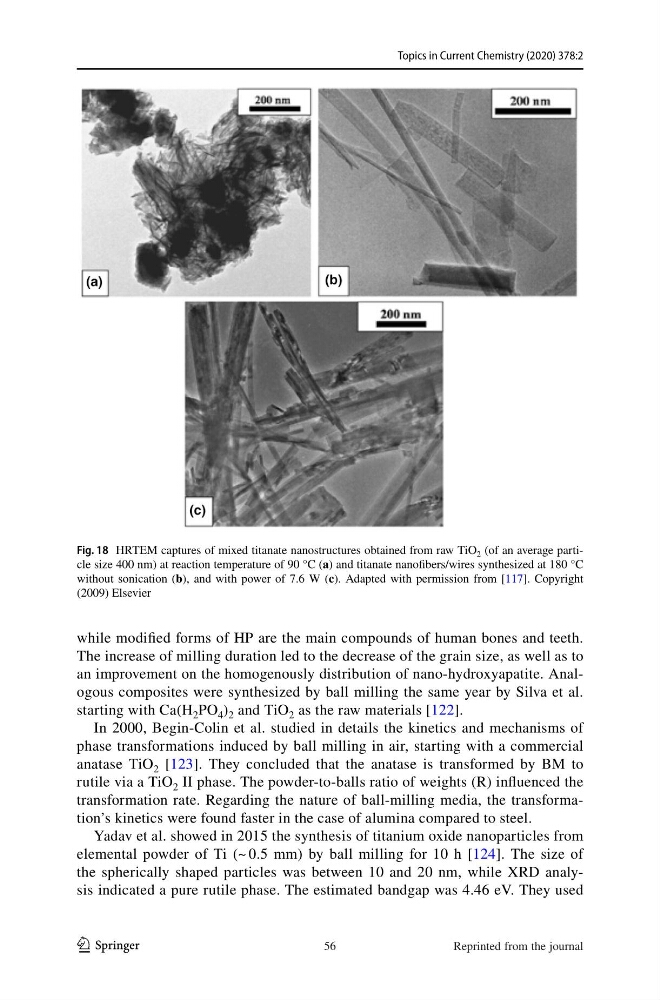
Fig. 18 HRTEM captures of mixed titanate nanostructures obtained from raw TiO 2 (of an average particle size 400 nm) at reaction temperature of 90 °C (a) and titanate nanofibers/wires synthesized at 180 °C
without sonication (b), and with power of 7.6 W (c). Adapted with permission from [117]. Copyright
(2009) Elsevier
56
Reprinted from the journal
1 3
while modified forms of HP are the main compounds of human bones and teeth.
The increase of milling duration led to the decrease of the grain size, as well as to
an improvement on the homogenously distribution of nano-hydroxyapatite. Analogous composites were synthesized by ball milling the same year by Silva et al.
starting with Ca(H 2 PO 4 ) 2 and TiO 2 as the raw materials [122].
In 2000, Begin-Colin et al. studied in details the kinetics and mechanisms of
phase transformations induced by ball milling in air, starting with a commercial
anatase TiO 2 [123]. They concluded that the anatase is transformed by BM to
rutile via a TiO 2 II phase. The powder-to-balls ratio of weights (R) influenced the
transformation rate. Regarding the nature of ball-milling media, the transformation’s kinetics were found faster in the case of alumina compared to steel.
Yadav et al. showed in 2015 the synthesis of titanium oxide nanoparticles from
elemental powder of Ti (~ 0.5 mm) by ball milling for 10 h [124]. The size of
the spherically shaped particles was between 10 and 20 nm, while XRD analysis indicated a pure rutile phase. The estimated bandgap was 4.46 eV. They used
Fig. 18 HRTEM captures of mixed titanate nanostructures obtained from raw TiO 2 (of an average particle size 400 nm) at reaction temperature of 90 °C (a) and titanate nanofibers/wires synthesized at 180 °C
without sonication (b), and with power of 7.6 W (c). Adapted with permission from [117]. Copyright
(2009) Elsevier
56
Reprinted from the journal