

Topics in Current Chemistry (2020) 378:2
1 3
capability against E. coli, a fact that was assigned by the authors to the increased
bandgap, surface area, and amount of surface hydroxyl groups. The improved and
faster inactivation performance for the nanorods was linked to the elevated hydroxyl
radical formation.
Since the morphological and structural features of TiNTBs (size and porosity) can be controlled, the application of US irradiation towards the increment of
these features gained more attention. Ma et al. [116] reported in 2006 the synthesis of longer NTBs with a smaller diameter by a combined sonication-hydrothermal approach and using as precursor the commercial TiO 2 P25. Their approach was
based on dispersing the commercial powder in a Teflon vessel filled with NaOH
aqueous solution (10 M). Using an immersed titanium horn (probably low-frequency, not specified), the suspension was sonicated at 70 °C under different sonication powers (100, 280, and 380 W elec. ) and varying also the duration (15, 30, and
60 min). The vessel was placed in a stainless-steel autoclave for hydrothermal treatment for 4 h at 110 °C. The obtained precipitate was washed with HCl (0.1 M) and
deionized water until an acidic pH, centrifuged, and dried under vacuum. The role
of the precursor on the size of the NTBs was determined by using different commercial TiO 2 precursors.
The hydrothermal treatment of the nanospherically shaped P25 particles of an
average size of ~ 30 nm without ultrasonicated pre-treatment led to minimal particle
shape alteration. Sonication for 1 h prior the hydrothermal treatment with powers of
100 and 280 W elec. resulted in sheet and fibrous morphologies, respectively. A typical tubular morphology was achieved (diameter: 9–14 nm and length: 100–600 nm)
by sonication at a higher power (380 W elec. ), revealing that the sonication, as well
its power, plays a key role in the desired transformation to TiNTBs. TEM images of
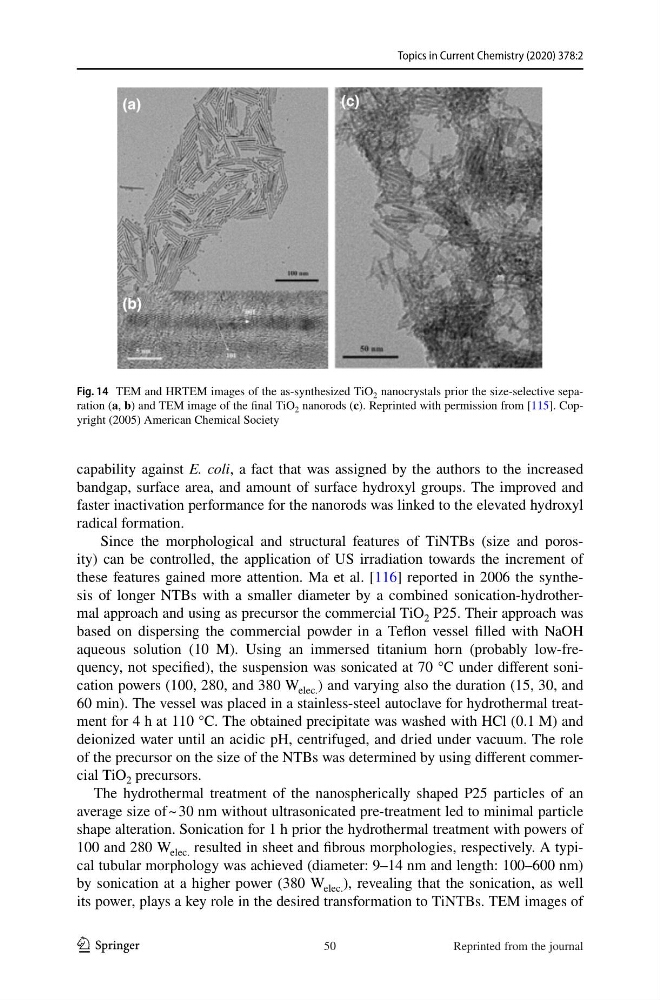
Fig. 14 TEM and HRTEM images of the as-synthesized TiO 2 nanocrystals prior the size-selective separation (a, b) and TEM image of the final TiO 2 nanorods (c). Reprinted with permission from [115]. Copyright (2005) American Chemical Society
50
Reprinted from the journal
1 3
capability against E. coli, a fact that was assigned by the authors to the increased
bandgap, surface area, and amount of surface hydroxyl groups. The improved and
faster inactivation performance for the nanorods was linked to the elevated hydroxyl
radical formation.
Since the morphological and structural features of TiNTBs (size and porosity) can be controlled, the application of US irradiation towards the increment of
these features gained more attention. Ma et al. [116] reported in 2006 the synthesis of longer NTBs with a smaller diameter by a combined sonication-hydrothermal approach and using as precursor the commercial TiO 2 P25. Their approach was
based on dispersing the commercial powder in a Teflon vessel filled with NaOH
aqueous solution (10 M). Using an immersed titanium horn (probably low-frequency, not specified), the suspension was sonicated at 70 °C under different sonication powers (100, 280, and 380 W elec. ) and varying also the duration (15, 30, and
60 min). The vessel was placed in a stainless-steel autoclave for hydrothermal treatment for 4 h at 110 °C. The obtained precipitate was washed with HCl (0.1 M) and
deionized water until an acidic pH, centrifuged, and dried under vacuum. The role
of the precursor on the size of the NTBs was determined by using different commercial TiO 2 precursors.
The hydrothermal treatment of the nanospherically shaped P25 particles of an
average size of ~ 30 nm without ultrasonicated pre-treatment led to minimal particle
shape alteration. Sonication for 1 h prior the hydrothermal treatment with powers of
100 and 280 W elec. resulted in sheet and fibrous morphologies, respectively. A typical tubular morphology was achieved (diameter: 9–14 nm and length: 100–600 nm)
by sonication at a higher power (380 W elec. ), revealing that the sonication, as well
its power, plays a key role in the desired transformation to TiNTBs. TEM images of
Fig. 14 TEM and HRTEM images of the as-synthesized TiO 2 nanocrystals prior the size-selective separation (a, b) and TEM image of the final TiO 2 nanorods (c). Reprinted with permission from [115]. Copyright (2005) American Chemical Society
50
Reprinted from the journal