

1 3
Topics in Current Chemistry (2020) 378:2
2.1.2 Controlling the Crystallinity
In 2000, Huang et al. studied the role of US irradiation in the selective synthesis
of anatase or rutile phases from different precursors and conditions [52]. The synthetic protocol was based on the addition of different precursors (TPT: tetraisopropyltitanate, TTC: titanium tetrachloride, or a mixture of TPT and TTC) in water
under sonication by a directly immersed horn (20 kHz, 100 W/cm
2
). The suspension
was ultrasonic-aged for 3 h, with the temperature reaching 80 °C. The precipitates
were obtained by centrifugation and subsequently washed with deionized water and
ethanol, following by overnight vacuum drying. Compared to the sol–gel-derived
materials that were amorphous prior to calcination, the samples obtained via US
irradiation showed a high degree of crystallinity. Rutile-phased nanoparticles (crystallographic size based on the application of Scherrer’s formula at the XRD: 8.2 nm)
were obtained when TTC was used, and anatase phase (3.5 nm) in the case of TPT.
The materials synthesized via US were also found to have relatively high surface
areas, 103 m
2
/g for the rutile phase and 201 m
2
/g for the anatase phase. The TPTderived sample (anatase) had a broad size distribution of mesopores (average of
5 nm), linked by the authors to the aggregation of nanoparticles. The rutile phase
TTC-derived sample had a non-mesoporous nature.
When a mixture of TPT and TTC were used in a molar ratio of 63.4:36.6, a
mixed anatase/rutile phase was determined. Analysis of the powder X-ray diffraction (PXRD) data revealed a crystallographic ratio of anatase to rutile phases of
47.6:52.4, suggesting that in the case of the mixture, part of the rutile phase formed
at the expense of TPT. It should be pointed out that without US irradiation, the
material obtained with the same mixture of precursors as above mixture was amorphous. The authors also studied the role of temperature. When the synthesis was
conducted at 30 °C instead of 80 °C and TPT as precursor, the result was mixed
brookite and anatase phases. On the contrary, when TTC was hydrolyzed under sonication at 10 °C, rutile phase was obtained. The role of pH was also studied, but not
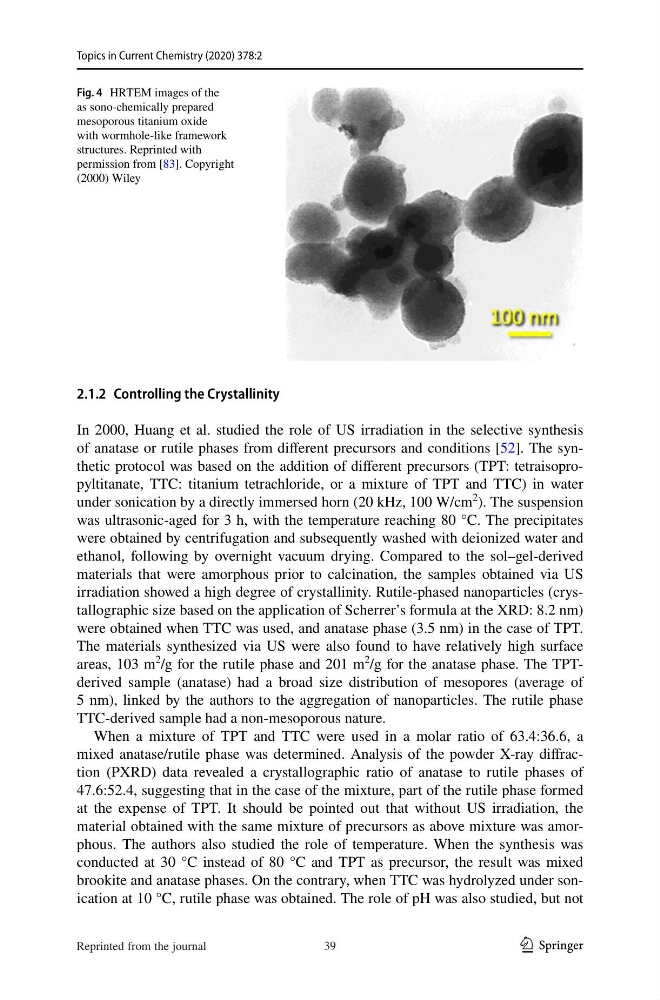
Fig. 4 HRTEM images of the
as sono-chemically prepared
mesoporous titanium oxide
with wormhole-like framework
structures. Reprinted with
permission from [83]. Copyright
(2000) Wiley
39
Reprinted from the journal
Topics in Current Chemistry (2020) 378:2
2.1.2 Controlling the Crystallinity
In 2000, Huang et al. studied the role of US irradiation in the selective synthesis
of anatase or rutile phases from different precursors and conditions [52]. The synthetic protocol was based on the addition of different precursors (TPT: tetraisopropyltitanate, TTC: titanium tetrachloride, or a mixture of TPT and TTC) in water
under sonication by a directly immersed horn (20 kHz, 100 W/cm
2
). The suspension
was ultrasonic-aged for 3 h, with the temperature reaching 80 °C. The precipitates
were obtained by centrifugation and subsequently washed with deionized water and
ethanol, following by overnight vacuum drying. Compared to the sol–gel-derived
materials that were amorphous prior to calcination, the samples obtained via US
irradiation showed a high degree of crystallinity. Rutile-phased nanoparticles (crystallographic size based on the application of Scherrer’s formula at the XRD: 8.2 nm)
were obtained when TTC was used, and anatase phase (3.5 nm) in the case of TPT.
The materials synthesized via US were also found to have relatively high surface
areas, 103 m
2
/g for the rutile phase and 201 m
2
/g for the anatase phase. The TPTderived sample (anatase) had a broad size distribution of mesopores (average of
5 nm), linked by the authors to the aggregation of nanoparticles. The rutile phase
TTC-derived sample had a non-mesoporous nature.
When a mixture of TPT and TTC were used in a molar ratio of 63.4:36.6, a
mixed anatase/rutile phase was determined. Analysis of the powder X-ray diffraction (PXRD) data revealed a crystallographic ratio of anatase to rutile phases of
47.6:52.4, suggesting that in the case of the mixture, part of the rutile phase formed
at the expense of TPT. It should be pointed out that without US irradiation, the
material obtained with the same mixture of precursors as above mixture was amorphous. The authors also studied the role of temperature. When the synthesis was
conducted at 30 °C instead of 80 °C and TPT as precursor, the result was mixed
brookite and anatase phases. On the contrary, when TTC was hydrolyzed under sonication at 10 °C, rutile phase was obtained. The role of pH was also studied, but not
Fig. 4 HRTEM images of the
as sono-chemically prepared
mesoporous titanium oxide
with wormhole-like framework
structures. Reprinted with
permission from [83]. Copyright
(2000) Wiley
39
Reprinted from the journal