

Topics in Current Chemistry (2020) 378:2
1 3
ranging from 3.1 to 3.7 eV, and UV light irradiation is required in order to trigger the photoreactivity. Considering that solar light consists predominately of visible and infrared light, with ultraviolet light less than 5% of the total solar light, a
persistent research effort is focused on narrowing of the bandgap and, as a result,
increase of light absorption and photoreactivity under sunlight. Even though several
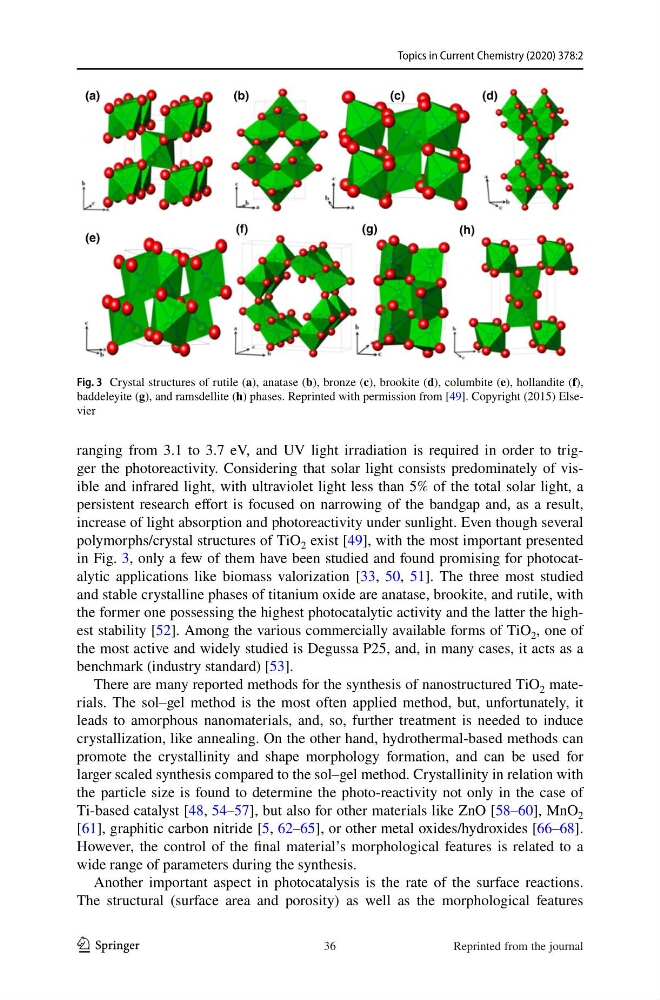
polymorphs/crystal structures of TiO 2 exist [49], with the most important presented
in Fig. 3, only a few of them have been studied and found promising for photocatalytic applications like biomass valorization [33, 50, 51]. The three most studied
and stable crystalline phases of titanium oxide are anatase, brookite, and rutile, with
the former one possessing the highest photocatalytic activity and the latter the highest stability [52]. Among the various commercially available forms of TiO 2 , one of
the most active and widely studied is Degussa P25, and, in many cases, it acts as a
benchmark (industry standard) [53].
There are many reported methods for the synthesis of nanostructured TiO 2 materials. The sol–gel method is the most often applied method, but, unfortunately, it
leads to amorphous nanomaterials, and, so, further treatment is needed to induce
crystallization, like annealing. On the other hand, hydrothermal-based methods can
promote the crystallinity and shape morphology formation, and can be used for
larger scaled synthesis compared to the sol–gel method. Crystallinity in relation with
the particle size is found to determine the photo-reactivity not only in the case of
Ti-based catalyst [48, 54–57], but also for other materials like ZnO [58–60], MnO 2
[61], graphitic carbon nitride [5, 62–65], or other metal oxides/hydroxides [66–68].
However, the control of the final material’s morphological features is related to a
wide range of parameters during the synthesis.
Another important aspect in photocatalysis is the rate of the surface reactions.
The structural (surface area and porosity) as well as the morphological features
Fig. 3 Crystal structures of rutile (a), anatase (b), bronze (c), brookite (d), columbite (e), hollandite (f),
baddeleyite (g), and ramsdellite (h) phases. Reprinted with permission from [49]. Copyright (2015) Elsevier
36
Reprinted from the journal
1 3
ranging from 3.1 to 3.7 eV, and UV light irradiation is required in order to trigger the photoreactivity. Considering that solar light consists predominately of visible and infrared light, with ultraviolet light less than 5% of the total solar light, a
persistent research effort is focused on narrowing of the bandgap and, as a result,
increase of light absorption and photoreactivity under sunlight. Even though several
polymorphs/crystal structures of TiO 2 exist [49], with the most important presented
in Fig. 3, only a few of them have been studied and found promising for photocatalytic applications like biomass valorization [33, 50, 51]. The three most studied
and stable crystalline phases of titanium oxide are anatase, brookite, and rutile, with
the former one possessing the highest photocatalytic activity and the latter the highest stability [52]. Among the various commercially available forms of TiO 2 , one of
the most active and widely studied is Degussa P25, and, in many cases, it acts as a
benchmark (industry standard) [53].
There are many reported methods for the synthesis of nanostructured TiO 2 materials. The sol–gel method is the most often applied method, but, unfortunately, it
leads to amorphous nanomaterials, and, so, further treatment is needed to induce
crystallization, like annealing. On the other hand, hydrothermal-based methods can
promote the crystallinity and shape morphology formation, and can be used for
larger scaled synthesis compared to the sol–gel method. Crystallinity in relation with
the particle size is found to determine the photo-reactivity not only in the case of
Ti-based catalyst [48, 54–57], but also for other materials like ZnO [58–60], MnO 2
[61], graphitic carbon nitride [5, 62–65], or other metal oxides/hydroxides [66–68].
However, the control of the final material’s morphological features is related to a
wide range of parameters during the synthesis.
Another important aspect in photocatalysis is the rate of the surface reactions.
The structural (surface area and porosity) as well as the morphological features
Fig. 3 Crystal structures of rutile (a), anatase (b), bronze (c), brookite (d), columbite (e), hollandite (f),
baddeleyite (g), and ramsdellite (h) phases. Reprinted with permission from [49]. Copyright (2015) Elsevier
36
Reprinted from the journal