

Topics in Current Chemistry (2020) 378:2
1 3
magnetism) who conducted displacement reactions between a metal and oxides of
less reactive metals [3, 7, 35]. In his first research published in 1820, which can be
assumed as the first systematic study of the mechanochemical process, he showed
the oxidation of Zn by the reduction of AgCl to Ag by simple mortar grinding [35,
38]. However, there was no specific evidence indicating if the grinding promoted the
reaction mechanochemically of just thermodynamically by heat generation through
friction.
The American chemist and pioneer of photographic chemistry, Mathew Carey
Lea (1823–1897), systematically studied and determined (between 1889 and 1894)
that the above kind of redox reactions were initiated/activated by mechanochemical
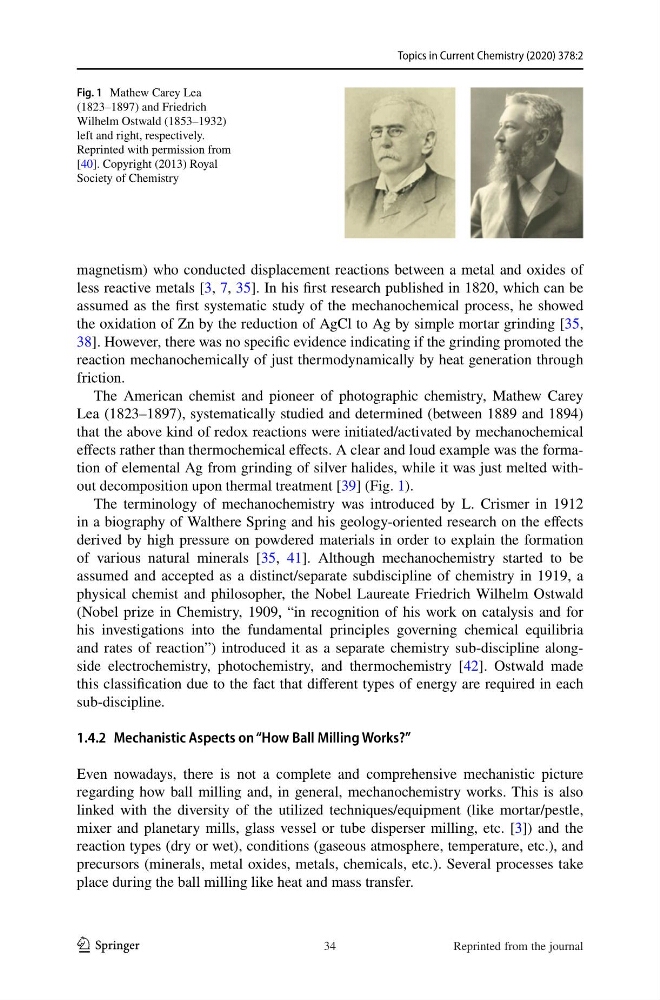
effects rather than thermochemical effects. A clear and loud example was the formation of elemental Ag from grinding of silver halides, while it was just melted without decomposition upon thermal treatment [39] (Fig. 1).
The terminology of mechanochemistry was introduced by L. Crismer in 1912
in a biography of Walthere Spring and his geology-oriented research on the effects
derived by high pressure on powdered materials in order to explain the formation
of various natural minerals [35, 41]. Although mechanochemistry started to be
assumed and accepted as a distinct/separate subdiscipline of chemistry in 1919, a
physical chemist and philosopher, the Nobel Laureate Friedrich Wilhelm Ostwald
(Nobel prize in Chemistry, 1909, “in recognition of his work on catalysis and for
his investigations into the fundamental principles governing chemical equilibria
and rates of reaction”) introduced it as a separate chemistry sub-discipline alongside electrochemistry, photochemistry, and thermochemistry [42]. Ostwald made
this classification due to the fact that different types of energy are required in each
sub-discipline.
1.4.2 Mechanistic Aspects on “How Ball Milling Works?”
Even nowadays, there is not a complete and comprehensive mechanistic picture
regarding how ball milling and, in general, mechanochemistry works. This is also
linked with the diversity of the utilized techniques/equipment (like mortar/pestle,
mixer and planetary mills, glass vessel or tube disperser milling, etc. [3]) and the
reaction types (dry or wet), conditions (gaseous atmosphere, temperature, etc.), and
precursors (minerals, metal oxides, metals, chemicals, etc.). Several processes take
place during the ball milling like heat and mass transfer.
Fig. 1 Mathew Carey Lea
(1823–1897) and Friedrich
Wilhelm Ostwald (1853–1932)
left and right, respectively.
Reprinted with permission from
[40]. Copyright (2013) Royal
Society of Chemistry
34
Reprinted from the journal
1 3
magnetism) who conducted displacement reactions between a metal and oxides of
less reactive metals [3, 7, 35]. In his first research published in 1820, which can be
assumed as the first systematic study of the mechanochemical process, he showed
the oxidation of Zn by the reduction of AgCl to Ag by simple mortar grinding [35,
38]. However, there was no specific evidence indicating if the grinding promoted the
reaction mechanochemically of just thermodynamically by heat generation through
friction.
The American chemist and pioneer of photographic chemistry, Mathew Carey
Lea (1823–1897), systematically studied and determined (between 1889 and 1894)
that the above kind of redox reactions were initiated/activated by mechanochemical
effects rather than thermochemical effects. A clear and loud example was the formation of elemental Ag from grinding of silver halides, while it was just melted without decomposition upon thermal treatment [39] (Fig. 1).
The terminology of mechanochemistry was introduced by L. Crismer in 1912
in a biography of Walthere Spring and his geology-oriented research on the effects
derived by high pressure on powdered materials in order to explain the formation
of various natural minerals [35, 41]. Although mechanochemistry started to be
assumed and accepted as a distinct/separate subdiscipline of chemistry in 1919, a
physical chemist and philosopher, the Nobel Laureate Friedrich Wilhelm Ostwald
(Nobel prize in Chemistry, 1909, “in recognition of his work on catalysis and for
his investigations into the fundamental principles governing chemical equilibria
and rates of reaction”) introduced it as a separate chemistry sub-discipline alongside electrochemistry, photochemistry, and thermochemistry [42]. Ostwald made
this classification due to the fact that different types of energy are required in each
sub-discipline.
1.4.2 Mechanistic Aspects on “How Ball Milling Works?”
Even nowadays, there is not a complete and comprehensive mechanistic picture
regarding how ball milling and, in general, mechanochemistry works. This is also
linked with the diversity of the utilized techniques/equipment (like mortar/pestle,
mixer and planetary mills, glass vessel or tube disperser milling, etc. [3]) and the
reaction types (dry or wet), conditions (gaseous atmosphere, temperature, etc.), and
precursors (minerals, metal oxides, metals, chemicals, etc.). Several processes take
place during the ball milling like heat and mass transfer.
Fig. 1 Mathew Carey Lea
(1823–1897) and Friedrich
Wilhelm Ostwald (1853–1932)
left and right, respectively.
Reprinted with permission from
[40]. Copyright (2013) Royal
Society of Chemistry
34
Reprinted from the journal