

1 3
Topics in Current Chemistry (2019) 377:22
the RTE can be numerically solved in the spectrophotometer sample cell by applying a nonlinear optimization program to adjust the RTE predictions to experimental
data. From the parameters estimation made with the optimization program, one can
obtain the scattering coefficient and the asymmetry factor g of the phase function
(Eq. 44). Figure 11 shows the specific optical properties (optical properties per catalyst mass concentration) as a function of wavelength for the Evonik Aeroxide P 25
TiO 2 catalyst. A similar method was applied by Marugán et al. [64] and TolosanaMoranchel et al. [65] to estimate the optical properties of different titanium dioxide
photocatalysts in aqueous suspension. Details on the spectrophotometric measurements and evaluation of the optical properties can be found elsewhere [63].
4.1.2 Local Volumetric Rate of Photon Absorption (LVRPA)
Rigorous and simplified numerical methods have been proposed to solve the RTE
in systems with absorption and scattering (Eqs. 41 and 42), and are summarized
in the classic books by Ozisik [61], Duderstadt and Martin [66], Modest [67], and
Howell et al. [68], among others. The numerical methods most frequently used to
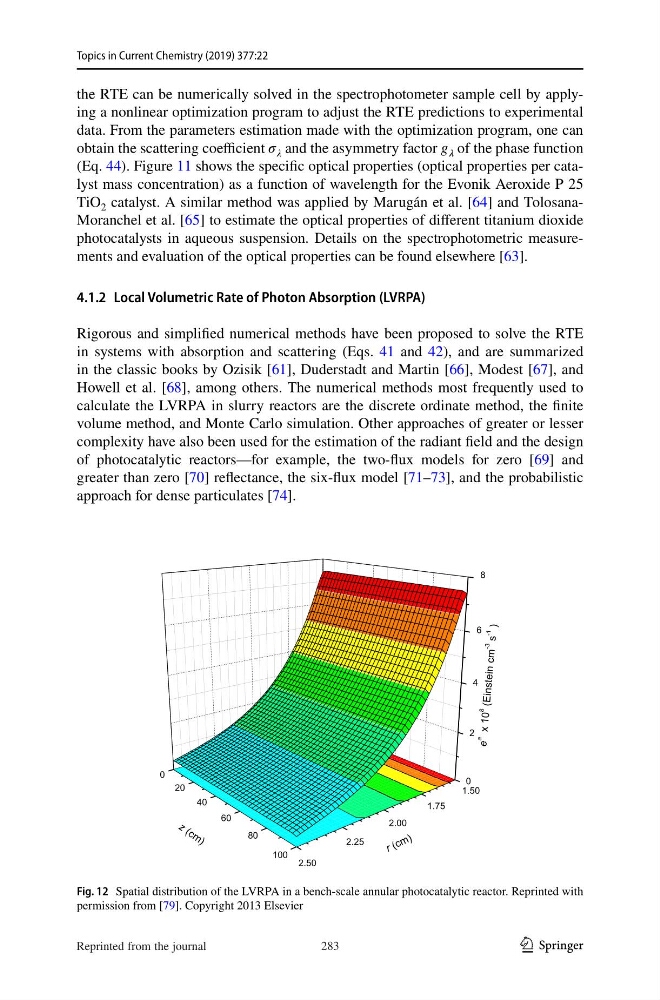
calculate the LVRPA in slurry reactors are the discrete ordinate method, the finite
volume method, and Monte Carlo simulation. Other approaches of greater or lesser
complexity have also been used for the estimation of the radiant field and the design
of photocatalytic reactors—for example, the two-flux models for zero [69] and
greater than zero [70] reflectance, the six-flux model [71–73], and the probabilistic
approach for dense particulates [74].
1.50
1.75
2.00
2.25
2.50
0
20
40
60
80
100
0
2
4
6
8
e
a
x 10
8
(Ein stein cm
-3
s
-1
)
r (c m )
z ( c m )
Fig. 12 Spatial distribution of the LVRPA in a bench-scale annular photocatalytic reactor. Reprinted with
permission from [79]. Copyright 2013 Elsevier
283
Reprinted from the journal
Topics in Current Chemistry (2019) 377:22
the RTE can be numerically solved in the spectrophotometer sample cell by applying a nonlinear optimization program to adjust the RTE predictions to experimental
data. From the parameters estimation made with the optimization program, one can
obtain the scattering coefficient and the asymmetry factor g of the phase function
(Eq. 44). Figure 11 shows the specific optical properties (optical properties per catalyst mass concentration) as a function of wavelength for the Evonik Aeroxide P 25
TiO 2 catalyst. A similar method was applied by Marugán et al. [64] and TolosanaMoranchel et al. [65] to estimate the optical properties of different titanium dioxide
photocatalysts in aqueous suspension. Details on the spectrophotometric measurements and evaluation of the optical properties can be found elsewhere [63].
4.1.2 Local Volumetric Rate of Photon Absorption (LVRPA)
Rigorous and simplified numerical methods have been proposed to solve the RTE
in systems with absorption and scattering (Eqs. 41 and 42), and are summarized
in the classic books by Ozisik [61], Duderstadt and Martin [66], Modest [67], and
Howell et al. [68], among others. The numerical methods most frequently used to
calculate the LVRPA in slurry reactors are the discrete ordinate method, the finite
volume method, and Monte Carlo simulation. Other approaches of greater or lesser
complexity have also been used for the estimation of the radiant field and the design
of photocatalytic reactors—for example, the two-flux models for zero [69] and
greater than zero [70] reflectance, the six-flux model [71–73], and the probabilistic
approach for dense particulates [74].
1.50
1.75
2.00
2.25
2.50
0
20
40
60
80
100
0
2
4
6
8
e
a
x 10
8
(Ein stein cm
-3
s
-1
)
r (c m )
z ( c m )
Fig. 12 Spatial distribution of the LVRPA in a bench-scale annular photocatalytic reactor. Reprinted with
permission from [79]. Copyright 2013 Elsevier
283
Reprinted from the journal