

Topics in Current Chemistry (2019) 377:22
1 3
1 Introduction
The modeling of conventional chemical reactors generally requires consideration
of the momentum, thermal energy, and multicomponent mass conservation equations. In the particular case of photoreactors, the radiant energy distribution within
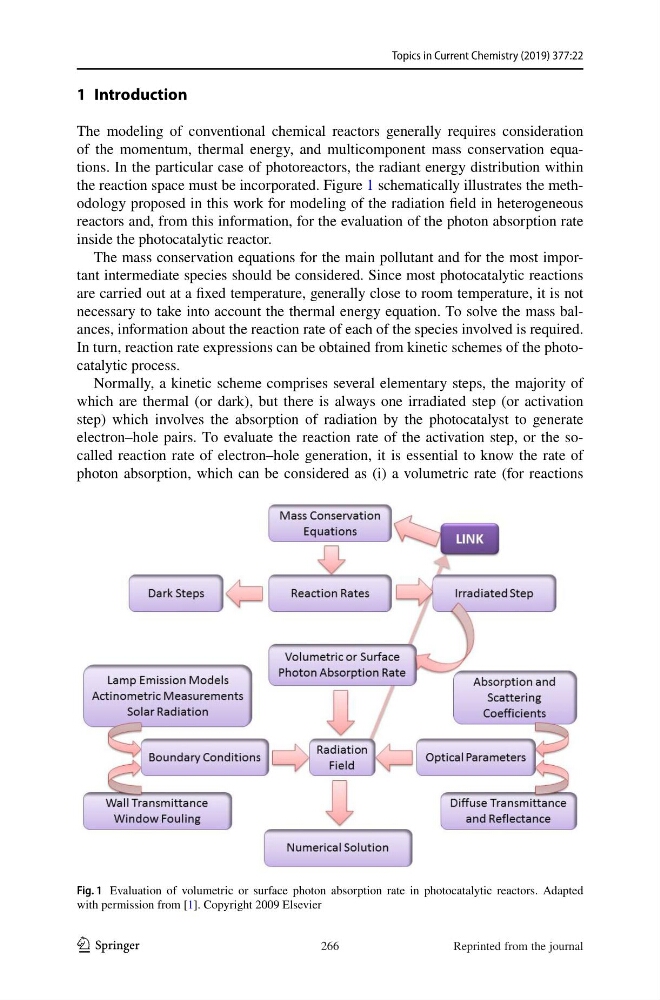
the reaction space must be incorporated. Figure 1 schematically illustrates the methodology proposed in this work for modeling of the radiation field in heterogeneous
reactors and, from this information, for the evaluation of the photon absorption rate
inside the photocatalytic reactor.
The mass conservation equations for the main pollutant and for the most important intermediate species should be considered. Since most photocatalytic reactions
are carried out at a fixed temperature, generally close to room temperature, it is not
necessary to take into account the thermal energy equation. To solve the mass balances, information about the reaction rate of each of the species involved is required.
In turn, reaction rate expressions can be obtained from kinetic schemes of the photocatalytic process.
Normally, a kinetic scheme comprises several elementary steps, the majority of
which are thermal (or dark), but there is always one irradiated step (or activation
step) which involves the absorption of radiation by the photocatalyst to generate
electron–hole pairs. To evaluate the reaction rate of the activation step, or the socalled reaction rate of electron–hole generation, it is essential to know the rate of
photon absorption, which can be considered as (i) a volumetric rate (for reactions
Fig. 1 Evaluation of volumetric or surface photon absorption rate in photocatalytic reactors. Adapted
with permission from [1]. Copyright 2009 Elsevier
266
Reprinted from the journal
1 3
1 Introduction
The modeling of conventional chemical reactors generally requires consideration
of the momentum, thermal energy, and multicomponent mass conservation equations. In the particular case of photoreactors, the radiant energy distribution within
the reaction space must be incorporated. Figure 1 schematically illustrates the methodology proposed in this work for modeling of the radiation field in heterogeneous
reactors and, from this information, for the evaluation of the photon absorption rate
inside the photocatalytic reactor.
The mass conservation equations for the main pollutant and for the most important intermediate species should be considered. Since most photocatalytic reactions
are carried out at a fixed temperature, generally close to room temperature, it is not
necessary to take into account the thermal energy equation. To solve the mass balances, information about the reaction rate of each of the species involved is required.
In turn, reaction rate expressions can be obtained from kinetic schemes of the photocatalytic process.
Normally, a kinetic scheme comprises several elementary steps, the majority of
which are thermal (or dark), but there is always one irradiated step (or activation
step) which involves the absorption of radiation by the photocatalyst to generate
electron–hole pairs. To evaluate the reaction rate of the activation step, or the socalled reaction rate of electron–hole generation, it is essential to know the rate of
photon absorption, which can be considered as (i) a volumetric rate (for reactions
Fig. 1 Evaluation of volumetric or surface photon absorption rate in photocatalytic reactors. Adapted
with permission from [1]. Copyright 2009 Elsevier
266
Reprinted from the journal