

1 3
Topics in Current Chemistry (2020) 378:7
An HPC technique using ZnO thin film as photocatalyst immobilized on a
metal plate (800 × 250 mm) was investigated as possible pretreatment (before
biological processing) of dairy wastewater [171]. The experiments were carried
out using a solar reactor with a fixed dairy wastewater volume (3 L) and a liquid flow rate of 13 L/min. According to the Taguchi L8 orthogonal array used
in the experimental design, an effective TOC percentage degradation as low as
14.23% for all conditions at an optimal level was recorded (max degradation
percentage of 31.42%). Although the authors recommend the process as a possible pre-oxidation step to improve dairy wastewater biodegradability, taking into
account wastewater characteristics (turbidity 2786 NTU, COD 6032 mg/L, total
solids 10,720 mg/L, oil and grease 2002 mg/L) as well as initial biodegradability
(as BOD 5 /COD = 0.368), it appears to be more appropriate as a post-treatment
method after biological processes, assuming that the reactor can be scaled up.
The possibility of energy recovery from agrifood wastewater has attracted
increasing interest among the scientific community due to the potential for
organic pollutants to be transformed into useful fuels such as methane and hydrogen. The purification of wastewater with simultaneous energy conversion is an
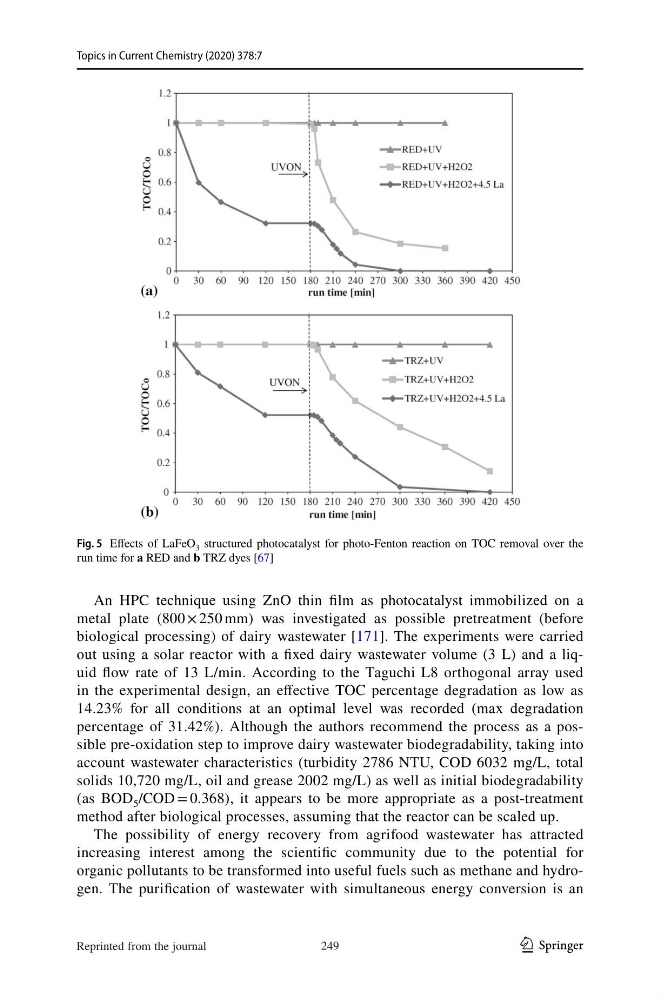
Fig. 5 Effects of LaFeO 3 structured photocatalyst for photo-Fenton reaction on TOC removal over the
run time for a RED and b TRZ dyes [67]
249
Reprinted from the journal
Topics in Current Chemistry (2020) 378:7
An HPC technique using ZnO thin film as photocatalyst immobilized on a
metal plate (800 × 250 mm) was investigated as possible pretreatment (before
biological processing) of dairy wastewater [171]. The experiments were carried
out using a solar reactor with a fixed dairy wastewater volume (3 L) and a liquid flow rate of 13 L/min. According to the Taguchi L8 orthogonal array used
in the experimental design, an effective TOC percentage degradation as low as
14.23% for all conditions at an optimal level was recorded (max degradation
percentage of 31.42%). Although the authors recommend the process as a possible pre-oxidation step to improve dairy wastewater biodegradability, taking into
account wastewater characteristics (turbidity 2786 NTU, COD 6032 mg/L, total
solids 10,720 mg/L, oil and grease 2002 mg/L) as well as initial biodegradability
(as BOD 5 /COD = 0.368), it appears to be more appropriate as a post-treatment
method after biological processes, assuming that the reactor can be scaled up.
The possibility of energy recovery from agrifood wastewater has attracted
increasing interest among the scientific community due to the potential for
organic pollutants to be transformed into useful fuels such as methane and hydrogen. The purification of wastewater with simultaneous energy conversion is an
Fig. 5 Effects of LaFeO 3 structured photocatalyst for photo-Fenton reaction on TOC removal over the
run time for a RED and b TRZ dyes [67]
249
Reprinted from the journal