

1 3
Topics in Current Chemistry (2020) 378:7
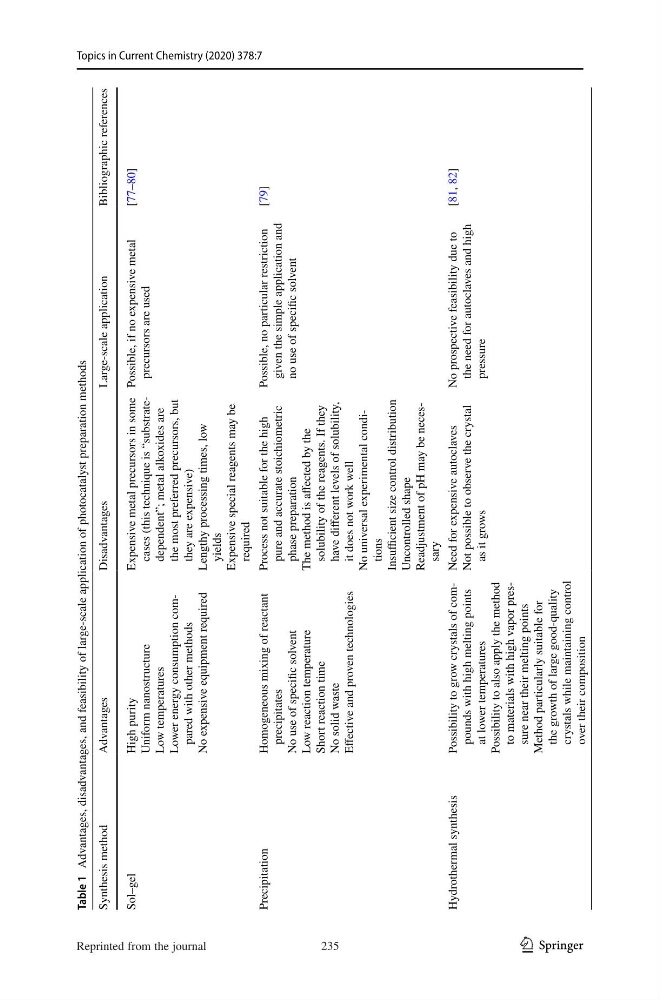
Table 1
Advantages, disadvantages, and feasibility of large-scale application of photocatalyst preparation methods
Synthesis method
Advantages
Disadvantages
Large-scale application
Bibliographic references
Sol–gel
High purity
Uniform nanostructure
Low temperatures
Lower energy consumption compared with other methods
No expensive equipment required
Expensive metal precursors in some
cases (this technique is “substratedependent”; metal alkoxides are
the most preferred precursors, but
they are expensive)
Lengthy processing times, low
yields
Expensive special reagents may be
required
Possible, if no expensive metal
precursors are used
[77–80]
Precipitation
Homogeneous mixing of reactant
precipitates
No use of specific solvent
Low reaction temperature
Short reaction time
No solid waste
Effective and proven technologies
Process not suitable for the high
pure and accurate stoichiometric
phase preparation
The method is affected by the
solubility of the reagents. If they
have different levels of solubility,
it does not work well
No universal experimental conditions
Insufficient size control distribution
Uncontrolled shape
Readjustment of pH may be necessary
Possible, no particular restriction
given the simple application and
no use of specific solvent
[79]
Hydrothermal synthesis
Possibility to grow crystals of compounds with high melting points
at lower temperatures
Possibility to also apply the method
to materials with high vapor pressure near their melting points
Method particularly suitable for
the growth of large good-quality
crystals while maintaining control
over their composition
Need for expensive autoclaves
Not possible to observe the crystal
as it grows
No prospective feasibility due to
the need for autoclaves and high
pressure
[81, 82]
235
Reprinted from the journal
Topics in Current Chemistry (2020) 378:7
Table 1
Advantages, disadvantages, and feasibility of large-scale application of photocatalyst preparation methods
Synthesis method
Advantages
Disadvantages
Large-scale application
Bibliographic references
Sol–gel
High purity
Uniform nanostructure
Low temperatures
Lower energy consumption compared with other methods
No expensive equipment required
Expensive metal precursors in some
cases (this technique is “substratedependent”; metal alkoxides are
the most preferred precursors, but
they are expensive)
Lengthy processing times, low
yields
Expensive special reagents may be
required
Possible, if no expensive metal
precursors are used
[77–80]
Precipitation
Homogeneous mixing of reactant
precipitates
No use of specific solvent
Low reaction temperature
Short reaction time
No solid waste
Effective and proven technologies
Process not suitable for the high
pure and accurate stoichiometric
phase preparation
The method is affected by the
solubility of the reagents. If they
have different levels of solubility,
it does not work well
No universal experimental conditions
Insufficient size control distribution
Uncontrolled shape
Readjustment of pH may be necessary
Possible, no particular restriction
given the simple application and
no use of specific solvent
[79]
Hydrothermal synthesis
Possibility to grow crystals of compounds with high melting points
at lower temperatures
Possibility to also apply the method
to materials with high vapor pressure near their melting points
Method particularly suitable for
the growth of large good-quality
crystals while maintaining control
over their composition
Need for expensive autoclaves
Not possible to observe the crystal
as it grows
No prospective feasibility due to
the need for autoclaves and high
pressure
[81, 82]
235
Reprinted from the journal