

Topics in Current Chemistry (2020) 378:7
1 3
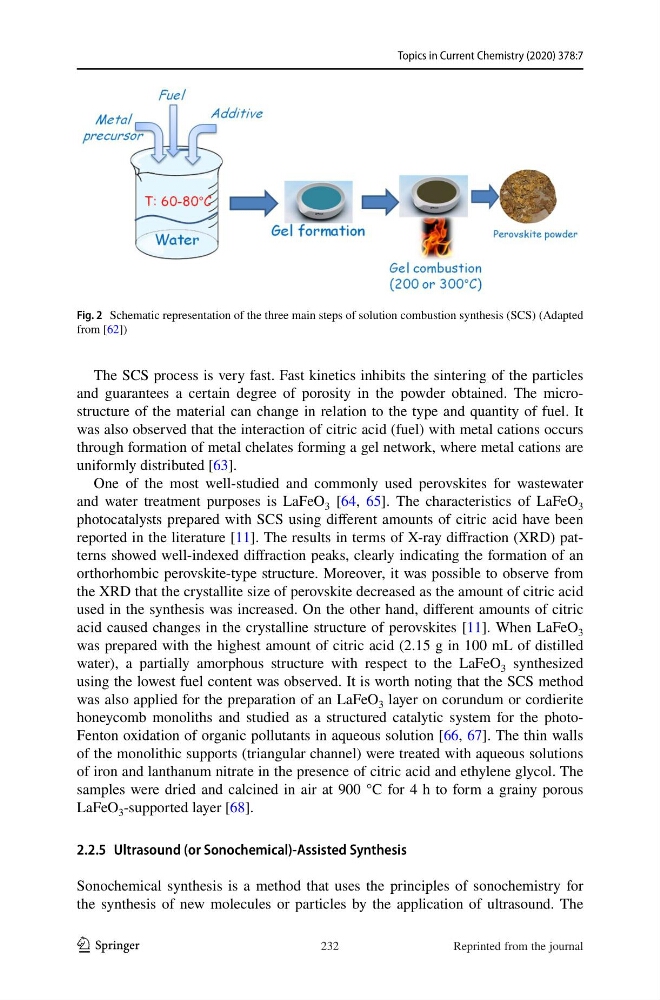
The SCS process is very fast. Fast kinetics inhibits the sintering of the particles
and guarantees a certain degree of porosity in the powder obtained. The microstructure of the material can change in relation to the type and quantity of fuel. It
was also observed that the interaction of citric acid (fuel) with metal cations occurs
through formation of metal chelates forming a gel network, where metal cations are
uniformly distributed [63].
One of the most well-studied and commonly used perovskites for wastewater
and water treatment purposes is LaFeO 3 [64, 65]. The characteristics of LaFeO 3
photocatalysts prepared with SCS using different amounts of citric acid have been
reported in the literature [11]. The results in terms of X-ray diffraction (XRD) patterns showed well-indexed diffraction peaks, clearly indicating the formation of an
orthorhombic perovskite-type structure. Moreover, it was possible to observe from
the XRD that the crystallite size of perovskite decreased as the amount of citric acid
used in the synthesis was increased. On the other hand, different amounts of citric
acid caused changes in the crystalline structure of perovskites [11]. When LaFeO 3
was prepared with the highest amount of citric acid (2.15 g in 100 mL of distilled
water), a partially amorphous structure with respect to the LaFeO 3 synthesized
using the lowest fuel content was observed. It is worth noting that the SCS method
was also applied for the preparation of an LaFeO 3 layer on corundum or cordierite
honeycomb monoliths and studied as a structured catalytic system for the photoFenton oxidation of organic pollutants in aqueous solution [66, 67]. The thin walls
of the monolithic supports (triangular channel) were treated with aqueous solutions
of iron and lanthanum nitrate in the presence of citric acid and ethylene glycol. The
samples were dried and calcined in air at 900 °C for 4 h to form a grainy porous
LaFeO 3 -supported layer [68].
2.2.5 Ultrasound (or Sonochemical)‑Assisted Synthesis
Sonochemical synthesis is a method that uses the principles of sonochemistry for
the synthesis of new molecules or particles by the application of ultrasound. The
Fig. 2 Schematic representation of the three main steps of solution combustion synthesis (SCS) (Adapted
from [62])
232
Reprinted from the journal
1 3
The SCS process is very fast. Fast kinetics inhibits the sintering of the particles
and guarantees a certain degree of porosity in the powder obtained. The microstructure of the material can change in relation to the type and quantity of fuel. It
was also observed that the interaction of citric acid (fuel) with metal cations occurs
through formation of metal chelates forming a gel network, where metal cations are
uniformly distributed [63].
One of the most well-studied and commonly used perovskites for wastewater
and water treatment purposes is LaFeO 3 [64, 65]. The characteristics of LaFeO 3
photocatalysts prepared with SCS using different amounts of citric acid have been
reported in the literature [11]. The results in terms of X-ray diffraction (XRD) patterns showed well-indexed diffraction peaks, clearly indicating the formation of an
orthorhombic perovskite-type structure. Moreover, it was possible to observe from
the XRD that the crystallite size of perovskite decreased as the amount of citric acid
used in the synthesis was increased. On the other hand, different amounts of citric
acid caused changes in the crystalline structure of perovskites [11]. When LaFeO 3
was prepared with the highest amount of citric acid (2.15 g in 100 mL of distilled
water), a partially amorphous structure with respect to the LaFeO 3 synthesized
using the lowest fuel content was observed. It is worth noting that the SCS method
was also applied for the preparation of an LaFeO 3 layer on corundum or cordierite
honeycomb monoliths and studied as a structured catalytic system for the photoFenton oxidation of organic pollutants in aqueous solution [66, 67]. The thin walls
of the monolithic supports (triangular channel) were treated with aqueous solutions
of iron and lanthanum nitrate in the presence of citric acid and ethylene glycol. The
samples were dried and calcined in air at 900 °C for 4 h to form a grainy porous
LaFeO 3 -supported layer [68].
2.2.5 Ultrasound (or Sonochemical)‑Assisted Synthesis
Sonochemical synthesis is a method that uses the principles of sonochemistry for
the synthesis of new molecules or particles by the application of ultrasound. The
Fig. 2 Schematic representation of the three main steps of solution combustion synthesis (SCS) (Adapted
from [62])
232
Reprinted from the journal