

Topics in Current Chemistry (2020) 378:7
1 3
reactions of the precursors (usually metal alkoxides). Briefly, the sol–gel method
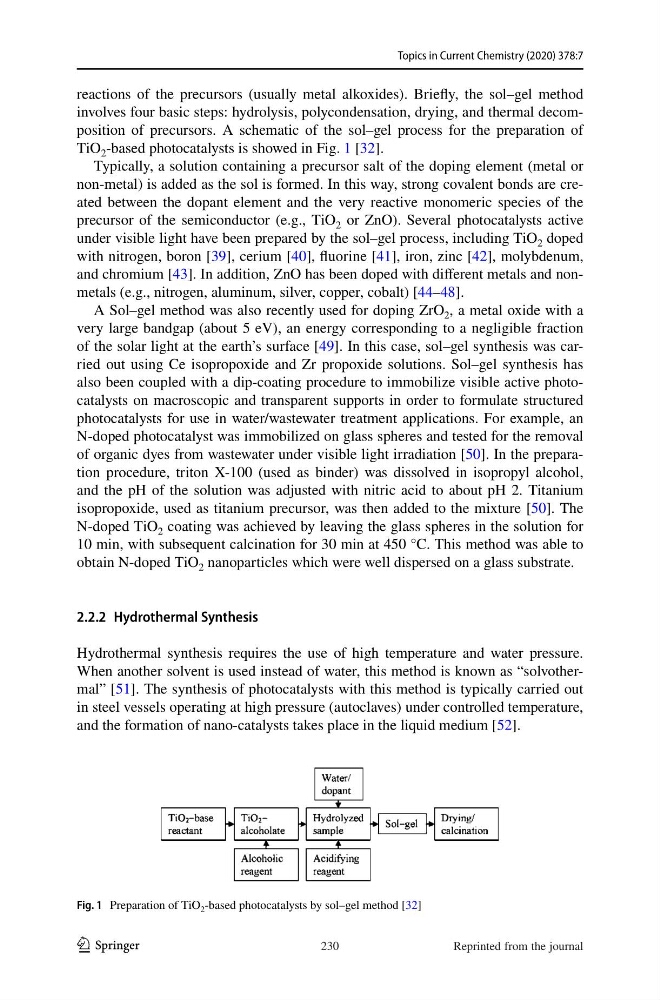
involves four basic steps: hydrolysis, polycondensation, drying, and thermal decomposition of precursors. A schematic of the sol–gel process for the preparation of
TiO 2 -based photocatalysts is showed in Fig. 1 [32].
Typically, a solution containing a precursor salt of the doping element (metal or
non-metal) is added as the sol is formed. In this way, strong covalent bonds are created between the dopant element and the very reactive monomeric species of the
precursor of the semiconductor (e.g., TiO 2 or ZnO). Several photocatalysts active
under visible light have been prepared by the sol–gel process, including TiO 2 doped
with nitrogen, boron [39], cerium [40], fluorine [41], iron, zinc [42], molybdenum,
and chromium [43]. In addition, ZnO has been doped with different metals and nonmetals (e.g., nitrogen, aluminum, silver, copper, cobalt) [44–48].
A Sol–gel method was also recently used for doping ZrO 2 , a metal oxide with a
very large bandgap (about 5 eV), an energy corresponding to a negligible fraction
of the solar light at the earth’s surface [49]. In this case, sol–gel synthesis was carried out using Ce isopropoxide and Zr propoxide solutions. Sol–gel synthesis has
also been coupled with a dip-coating procedure to immobilize visible active photocatalysts on macroscopic and transparent supports in order to formulate structured
photocatalysts for use in water/wastewater treatment applications. For example, an
N-doped photocatalyst was immobilized on glass spheres and tested for the removal
of organic dyes from wastewater under visible light irradiation [50]. In the preparation procedure, triton X-100 (used as binder) was dissolved in isopropyl alcohol,
and the pH of the solution was adjusted with nitric acid to about pH 2. Titanium
isopropoxide, used as titanium precursor, was then added to the mixture [50]. The
N-doped TiO 2 coating was achieved by leaving the glass spheres in the solution for
10 min, with subsequent calcination for 30 min at 450 °C. This method was able to
obtain N-doped TiO 2 nanoparticles which were well dispersed on a glass substrate.
2.2.2 Hydrothermal Synthesis
Hydrothermal synthesis requires the use of high temperature and water pressure.
When another solvent is used instead of water, this method is known as “solvothermal” [51]. The synthesis of photocatalysts with this method is typically carried out
in steel vessels operating at high pressure (autoclaves) under controlled temperature,
and the formation of nano-catalysts takes place in the liquid medium [52].
Fig. 1 Preparation of TiO 2 -based photocatalysts by sol–gel method [32]
230
Reprinted from the journal
1 3
reactions of the precursors (usually metal alkoxides). Briefly, the sol–gel method
involves four basic steps: hydrolysis, polycondensation, drying, and thermal decomposition of precursors. A schematic of the sol–gel process for the preparation of
TiO 2 -based photocatalysts is showed in Fig. 1 [32].
Typically, a solution containing a precursor salt of the doping element (metal or
non-metal) is added as the sol is formed. In this way, strong covalent bonds are created between the dopant element and the very reactive monomeric species of the
precursor of the semiconductor (e.g., TiO 2 or ZnO). Several photocatalysts active
under visible light have been prepared by the sol–gel process, including TiO 2 doped
with nitrogen, boron [39], cerium [40], fluorine [41], iron, zinc [42], molybdenum,
and chromium [43]. In addition, ZnO has been doped with different metals and nonmetals (e.g., nitrogen, aluminum, silver, copper, cobalt) [44–48].
A Sol–gel method was also recently used for doping ZrO 2 , a metal oxide with a
very large bandgap (about 5 eV), an energy corresponding to a negligible fraction
of the solar light at the earth’s surface [49]. In this case, sol–gel synthesis was carried out using Ce isopropoxide and Zr propoxide solutions. Sol–gel synthesis has
also been coupled with a dip-coating procedure to immobilize visible active photocatalysts on macroscopic and transparent supports in order to formulate structured
photocatalysts for use in water/wastewater treatment applications. For example, an
N-doped photocatalyst was immobilized on glass spheres and tested for the removal
of organic dyes from wastewater under visible light irradiation [50]. In the preparation procedure, triton X-100 (used as binder) was dissolved in isopropyl alcohol,
and the pH of the solution was adjusted with nitric acid to about pH 2. Titanium
isopropoxide, used as titanium precursor, was then added to the mixture [50]. The
N-doped TiO 2 coating was achieved by leaving the glass spheres in the solution for
10 min, with subsequent calcination for 30 min at 450 °C. This method was able to
obtain N-doped TiO 2 nanoparticles which were well dispersed on a glass substrate.
2.2.2 Hydrothermal Synthesis
Hydrothermal synthesis requires the use of high temperature and water pressure.
When another solvent is used instead of water, this method is known as “solvothermal” [51]. The synthesis of photocatalysts with this method is typically carried out
in steel vessels operating at high pressure (autoclaves) under controlled temperature,
and the formation of nano-catalysts takes place in the liquid medium [52].
Fig. 1 Preparation of TiO 2 -based photocatalysts by sol–gel method [32]
230
Reprinted from the journal