

Topics in Current Chemistry (2019) 377:27
1 3
Triton X-100/1-butanol/n-hexane, and using Cd(NO 3 ) 2 , Zn(NO 3 ) 2 , and Na 2 S·xH 2 O, as
precursors of Cd, Zn and S
2−
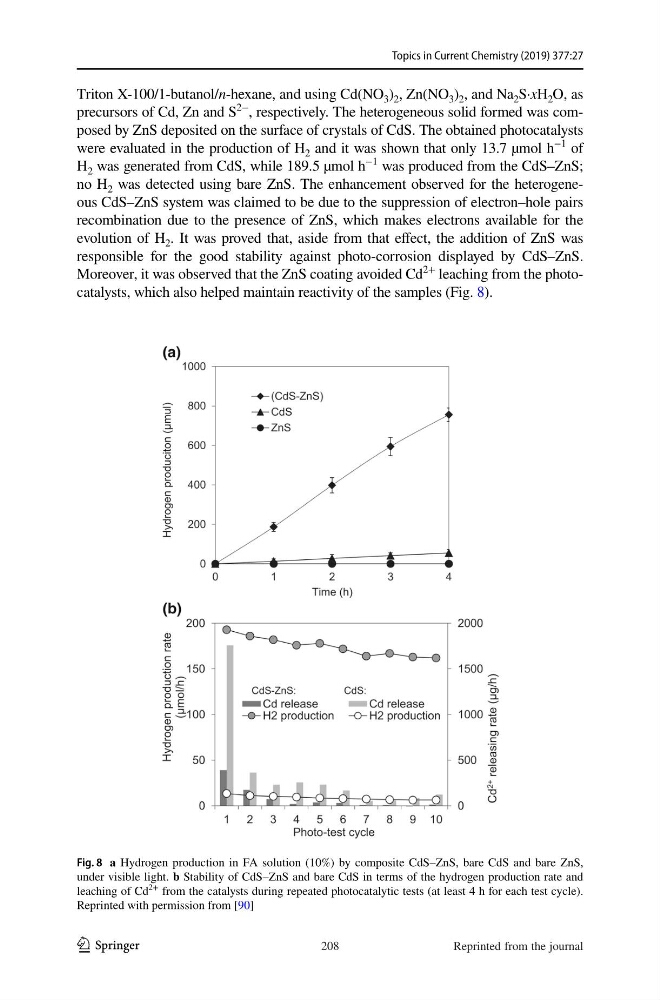
, respectively. The heterogeneous solid formed was composed by ZnS deposited on the surface of crystals of CdS. The obtained photocatalysts
were evaluated in the production of H 2 and it was shown that only 13.7 µmol h
−1
of
H 2 was generated from CdS, while 189.5 µmol h
−1
was produced from the CdS–ZnS;
no H 2 was detected using bare ZnS. The enhancement observed for the heterogeneous CdS–ZnS system was claimed to be due to the suppression of electron–hole pairs
recombination due to the presence of ZnS, which makes electrons available for the
evolution of H 2 . It was proved that, aside from that effect, the addition of ZnS was
responsible for the good stability against photo-corrosion displayed by CdS–ZnS.
Moreover, it was observed that the ZnS coating avoided Cd
2+
leaching from the photocatalysts, which also helped maintain reactivity of the samples (Fig. 8).
Fig. 8 a Hydrogen production in FA solution (10%) by composite CdS–ZnS, bare CdS and bare ZnS,
under visible light. b Stability of CdS–ZnS and bare CdS in terms of the hydrogen production rate and
leaching of Cd
2+ from the catalysts during repeated photocatalytic tests (at least 4 h for each test cycle).
Reprinted with permission from [90]
208
Reprinted from the journal
1 3
Triton X-100/1-butanol/n-hexane, and using Cd(NO 3 ) 2 , Zn(NO 3 ) 2 , and Na 2 S·xH 2 O, as
precursors of Cd, Zn and S
2−
, respectively. The heterogeneous solid formed was composed by ZnS deposited on the surface of crystals of CdS. The obtained photocatalysts
were evaluated in the production of H 2 and it was shown that only 13.7 µmol h
−1
of
H 2 was generated from CdS, while 189.5 µmol h
−1
was produced from the CdS–ZnS;
no H 2 was detected using bare ZnS. The enhancement observed for the heterogeneous CdS–ZnS system was claimed to be due to the suppression of electron–hole pairs
recombination due to the presence of ZnS, which makes electrons available for the
evolution of H 2 . It was proved that, aside from that effect, the addition of ZnS was
responsible for the good stability against photo-corrosion displayed by CdS–ZnS.
Moreover, it was observed that the ZnS coating avoided Cd
2+
leaching from the photocatalysts, which also helped maintain reactivity of the samples (Fig. 8).
Fig. 8 a Hydrogen production in FA solution (10%) by composite CdS–ZnS, bare CdS and bare ZnS,
under visible light. b Stability of CdS–ZnS and bare CdS in terms of the hydrogen production rate and
leaching of Cd
2+ from the catalysts during repeated photocatalytic tests (at least 4 h for each test cycle).
Reprinted with permission from [90]
208
Reprinted from the journal