

1 3
Topics in Current Chemistry (2019) 377:27
3 Photocatalytic Systems Based on CdS
The previous section mentioned some benefits of TiO 2 in photocatalytic reactions, and summarized some examples of TiO 2 -based catalysts for FA decomposition. However, their limitation in the visible-light range makes it necessary to
search for photocatalysts with a wider light responsive range. In this sense, metal
sulphides have been studied extensively because they exhibit an important visible-light response although their efficiency is poor. As mentioned before, recombination between electron and hole is related to efficiency. An approach to limit
such recombination is the use of photocatalysts with a high CB position, which
present an interesting reduction capability. At this point, CdS (with a band gap
of ~ 2.5 eV) is an interesting option that has attracted much attention due to its
wide visible-light range together with its simple synthesis and low cost. Furthermore, it fulfils the thermodynamic aspects of some of the most studied photocatalytic reactions [84, 85]. Regarding the photocatalytic decomposition of FA,
a few studies on CdS-based photocatalysts have also been reported to date. In
1968, Willner and Goren [86] reported on semiconductor CdS particles for the
generation of H 2 from the FA decomposition. In this particular case, they used
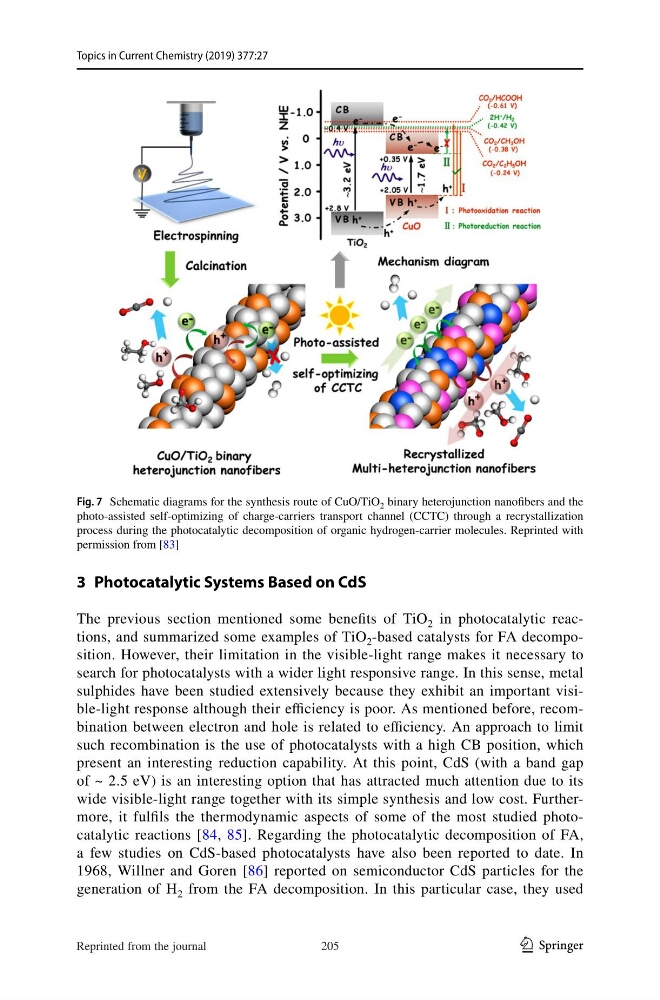
Fig. 7 Schematic diagrams for the synthesis route of CuO/TiO 2 binary heterojunction nanofibers and the
photo-assisted self-optimizing of charge-carriers transport channel (CCTC) through a recrystallization
process during the photocatalytic decomposition of organic hydrogen-carrier molecules. Reprinted with
permission from [83]
205
Reprinted from the journal
Topics in Current Chemistry (2019) 377:27
3 Photocatalytic Systems Based on CdS
The previous section mentioned some benefits of TiO 2 in photocatalytic reactions, and summarized some examples of TiO 2 -based catalysts for FA decomposition. However, their limitation in the visible-light range makes it necessary to
search for photocatalysts with a wider light responsive range. In this sense, metal
sulphides have been studied extensively because they exhibit an important visible-light response although their efficiency is poor. As mentioned before, recombination between electron and hole is related to efficiency. An approach to limit
such recombination is the use of photocatalysts with a high CB position, which
present an interesting reduction capability. At this point, CdS (with a band gap
of ~ 2.5 eV) is an interesting option that has attracted much attention due to its
wide visible-light range together with its simple synthesis and low cost. Furthermore, it fulfils the thermodynamic aspects of some of the most studied photocatalytic reactions [84, 85]. Regarding the photocatalytic decomposition of FA,
a few studies on CdS-based photocatalysts have also been reported to date. In
1968, Willner and Goren [86] reported on semiconductor CdS particles for the
generation of H 2 from the FA decomposition. In this particular case, they used
Fig. 7 Schematic diagrams for the synthesis route of CuO/TiO 2 binary heterojunction nanofibers and the
photo-assisted self-optimizing of charge-carriers transport channel (CCTC) through a recrystallization
process during the photocatalytic decomposition of organic hydrogen-carrier molecules. Reprinted with
permission from [83]
205
Reprinted from the journal