

Topics in Current Chemistry (2019) 377:24
1 3
3.2 Spectro‑Kinetic Studies
A well-described experimental methodology in catalysis is related to the study
of the mechanism and kinetics of a reaction using spectroscopic tools. In photocatalysis, such a task has complications coming from the necessity of including
light into the mechanistic framework, leading to what is called light-triggered
intrinsic kinetic formalisms [6, 83–85]. Spectro-kinetic schemes have been
utilized in photo-catalysis to answer two main questions; first the study of the
kinetic significance of radical species, and second to detail or analyze the potential mechanism of different photo-reactions.
Photo-catalytic reactions are initiated by radical species produced after light
absorption but the analysis of their kinetic relevance is relatively complex. Some
simple kinetic analysis worked out relationships between the amount of radical
species, typically measured with electron spin resonance (EPR) or optical spectroscopies with the help of probe molecules, and the reaction rate. More concretely, the hydroxyl radical species was found kinetically significant through
this methodology for a series of reactions. This is the case of Fe(III)-deposited
Ru-doped TiO 2 photo-catalysts used for the liquid-phase photo-degradation
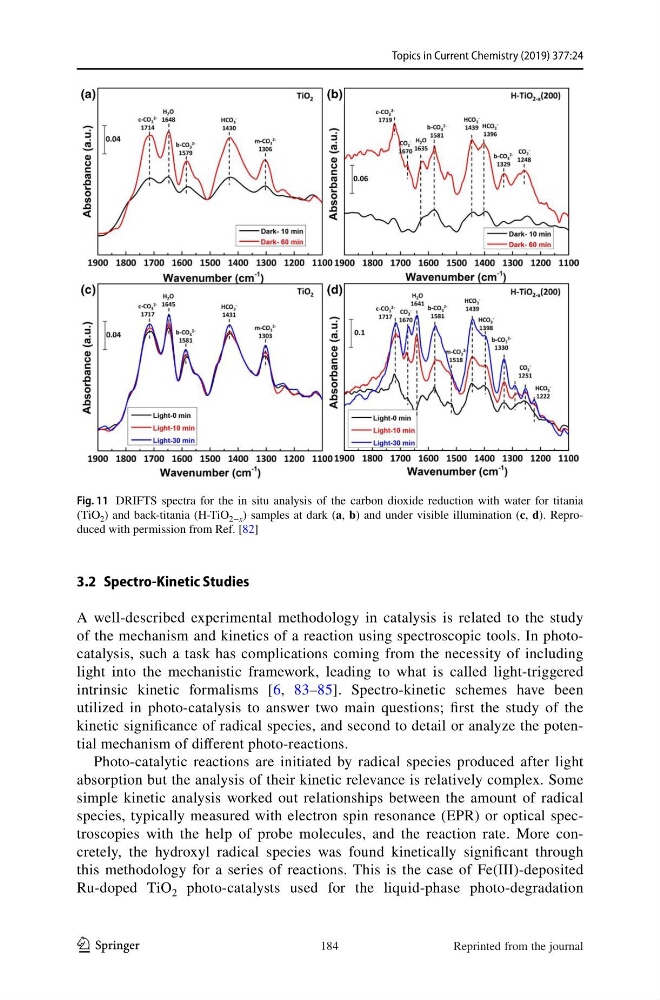
Fig. 11 DRIFTS spectra for the in situ analysis of the carbon dioxide reduction with water for titania
(TiO 2 ) and back-titania (H-TiO 2−x ) samples at dark (a, b) and under visible illumination (c, d). Reproduced with permission from Ref. [82]
184
Reprinted from the journal
1 3
3.2 Spectro‑Kinetic Studies
A well-described experimental methodology in catalysis is related to the study
of the mechanism and kinetics of a reaction using spectroscopic tools. In photocatalysis, such a task has complications coming from the necessity of including
light into the mechanistic framework, leading to what is called light-triggered
intrinsic kinetic formalisms [6, 83–85]. Spectro-kinetic schemes have been
utilized in photo-catalysis to answer two main questions; first the study of the
kinetic significance of radical species, and second to detail or analyze the potential mechanism of different photo-reactions.
Photo-catalytic reactions are initiated by radical species produced after light
absorption but the analysis of their kinetic relevance is relatively complex. Some
simple kinetic analysis worked out relationships between the amount of radical
species, typically measured with electron spin resonance (EPR) or optical spectroscopies with the help of probe molecules, and the reaction rate. More concretely, the hydroxyl radical species was found kinetically significant through
this methodology for a series of reactions. This is the case of Fe(III)-deposited
Ru-doped TiO 2 photo-catalysts used for the liquid-phase photo-degradation
Fig. 11 DRIFTS spectra for the in situ analysis of the carbon dioxide reduction with water for titania
(TiO 2 ) and back-titania (H-TiO 2−x ) samples at dark (a, b) and under visible illumination (c, d). Reproduced with permission from Ref. [82]
184
Reprinted from the journal