

1 3
Topics in Current Chemistry (2019) 377:24
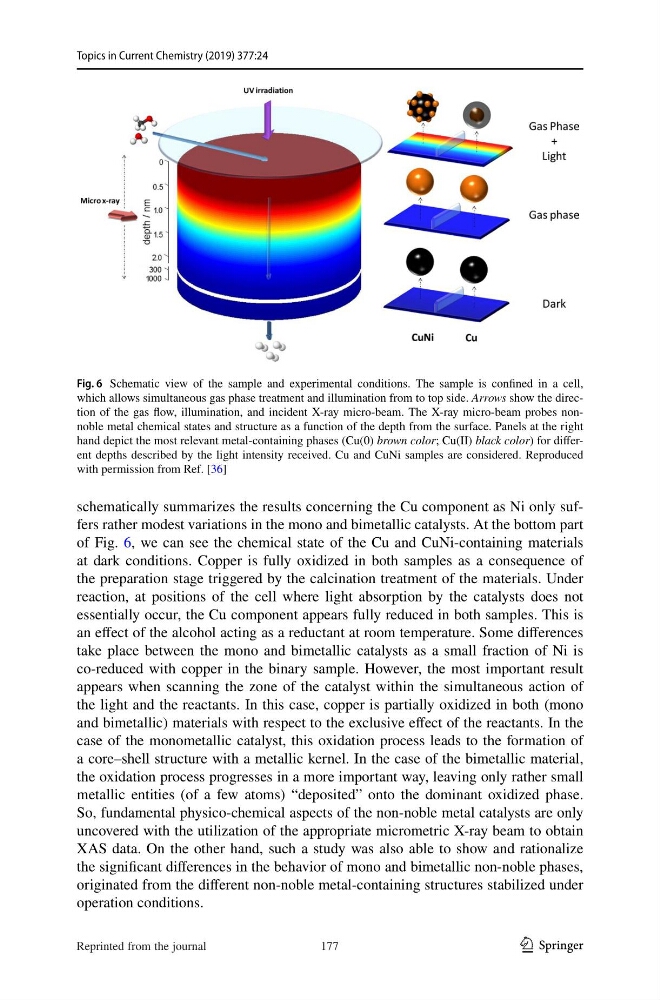
schematically summarizes the results concerning the Cu component as Ni only suffers rather modest variations in the mono and bimetallic catalysts. At the bottom part
of Fig. 6, we can see the chemical state of the Cu and CuNi-containing materials
at dark conditions. Copper is fully oxidized in both samples as a consequence of
the preparation stage triggered by the calcination treatment of the materials. Under
reaction, at positions of the cell where light absorption by the catalysts does not
essentially occur, the Cu component appears fully reduced in both samples. This is
an effect of the alcohol acting as a reductant at room temperature. Some differences
take place between the mono and bimetallic catalysts as a small fraction of Ni is
co-reduced with copper in the binary sample. However, the most important result
appears when scanning the zone of the catalyst within the simultaneous action of
the light and the reactants. In this case, copper is partially oxidized in both (mono
and bimetallic) materials with respect to the exclusive effect of the reactants. In the
case of the monometallic catalyst, this oxidation process leads to the formation of
a core–shell structure with a metallic kernel. In the case of the bimetallic material,
the oxidation process progresses in a more important way, leaving only rather small
metallic entities (of a few atoms) “deposited” onto the dominant oxidized phase.
So, fundamental physico-chemical aspects of the non-noble metal catalysts are only
uncovered with the utilization of the appropriate micrometric X-ray beam to obtain
XAS data. On the other hand, such a study was also able to show and rationalize
the significant differences in the behavior of mono and bimetallic non-noble phases,
originated from the different non-noble metal-containing structures stabilized under
operation conditions.
Fig. 6 Schematic view of the sample and experimental conditions. The sample is confined in a cell,
which allows simultaneous gas phase treatment and illumination from to top side. Arrows show the direction of the gas flow, illumination, and incident X-ray micro-beam. The X-ray micro-beam probes nonnoble metal chemical states and structure as a function of the depth from the surface. Panels at the right
hand depict the most relevant metal-containing phases (Cu(0) brown color; Cu(II) black color) for different depths described by the light intensity received. Cu and CuNi samples are considered. Reproduced
with permission from Ref. [36]
177
Reprinted from the journal
Topics in Current Chemistry (2019) 377:24
schematically summarizes the results concerning the Cu component as Ni only suffers rather modest variations in the mono and bimetallic catalysts. At the bottom part
of Fig. 6, we can see the chemical state of the Cu and CuNi-containing materials
at dark conditions. Copper is fully oxidized in both samples as a consequence of
the preparation stage triggered by the calcination treatment of the materials. Under
reaction, at positions of the cell where light absorption by the catalysts does not
essentially occur, the Cu component appears fully reduced in both samples. This is
an effect of the alcohol acting as a reductant at room temperature. Some differences
take place between the mono and bimetallic catalysts as a small fraction of Ni is
co-reduced with copper in the binary sample. However, the most important result
appears when scanning the zone of the catalyst within the simultaneous action of
the light and the reactants. In this case, copper is partially oxidized in both (mono
and bimetallic) materials with respect to the exclusive effect of the reactants. In the
case of the monometallic catalyst, this oxidation process leads to the formation of
a core–shell structure with a metallic kernel. In the case of the bimetallic material,
the oxidation process progresses in a more important way, leaving only rather small
metallic entities (of a few atoms) “deposited” onto the dominant oxidized phase.
So, fundamental physico-chemical aspects of the non-noble metal catalysts are only
uncovered with the utilization of the appropriate micrometric X-ray beam to obtain
XAS data. On the other hand, such a study was also able to show and rationalize
the significant differences in the behavior of mono and bimetallic non-noble phases,
originated from the different non-noble metal-containing structures stabilized under
operation conditions.
Fig. 6 Schematic view of the sample and experimental conditions. The sample is confined in a cell,
which allows simultaneous gas phase treatment and illumination from to top side. Arrows show the direction of the gas flow, illumination, and incident X-ray micro-beam. The X-ray micro-beam probes nonnoble metal chemical states and structure as a function of the depth from the surface. Panels at the right
hand depict the most relevant metal-containing phases (Cu(0) brown color; Cu(II) black color) for different depths described by the light intensity received. Cu and CuNi samples are considered. Reproduced
with permission from Ref. [36]
177
Reprinted from the journal