

1 3
Topics in Current Chemistry (2019) 377:24
and handle (electron and hole) charge carriers after excitation. In the case of Ti–W
mixed oxides, the presence of W mostly affects the band gap energy (as mentioned
in non-linear way with tungsten content) and the conduction band edge, detecting
minor effects in the valence band and relatively minor localized gap states mostly
related to surface defects. When tungsten exceeds the solubility limit at the anatase
structure, the presence of W–O–W bonds are behind electronic properties, triggering changes in the surface redox and acid–base properties of the solids [9, 12, 13,
22, 23].
3 Advanced Characterization
Recently, the need for obtaining information on interpreting photo-catalyst behavior
under reaction conditions has lead to the development of operando studies as well
as spectro-kinetic approaches. Although both types of experiments are closely connected, contributions in the literature can be ascribed usually to one of these categories. Therefore, and for practical reasons, we will analyze both in separate sections.
A first (and common to all novel or advanced approaches) point to study active
materials under the effect of light and the reactive mixture is to define adequately
the experimental conditions to measure the catalyst portion illuminated. If this is not
the case, misleading results are likely to come for the corresponding experimental
observations. This constrain adds to the normal ones in any operando or kinetic catalytic study, e.g., efficient reactant–catalyst contact to avoid internal/external mass
transfer and near-zero dead volume. Analysis of the light–matter interaction is thus
mandatory for gas and liquid phase photo-catalytic processes if advanced methodologies are to be used. A primary result from that would be the catalyst volume under
illumination and, consequently, the mean free path of light across the sample.
Analysis of the mean free path in a gas phase catalyst (or if a film is used in liquid
phase) requires calculating the intensity decay through the solid. For a uniform ontop illumination of an in situ (spectroscopic) cell, we first calculated the value of the
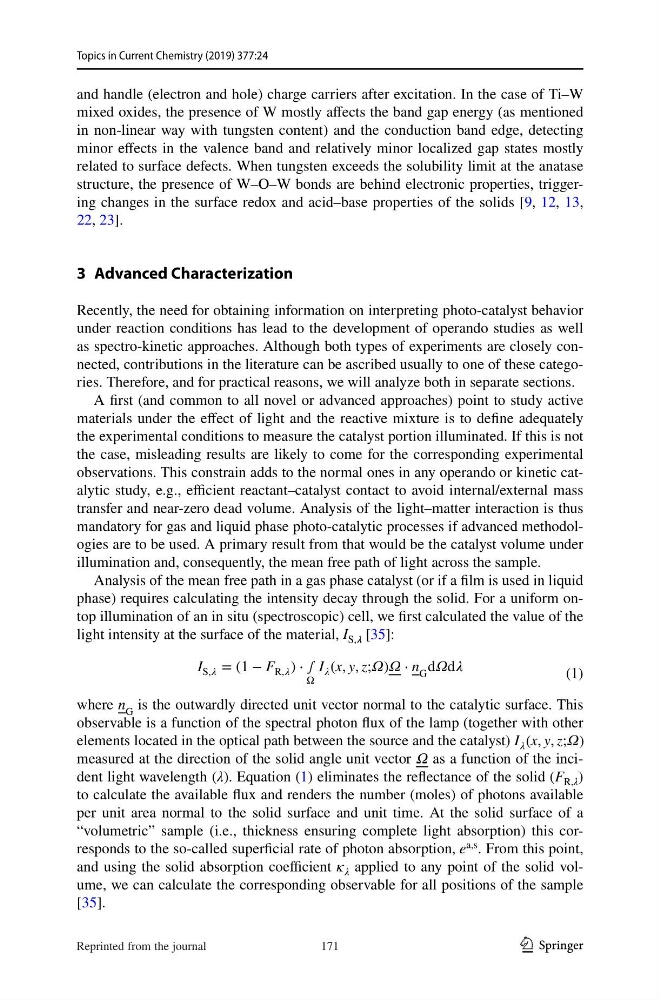
light intensity at the surface of the material, I S, [35]:
where n G is the outwardly directed unit vector normal to the catalytic surface. This
observable is a function of the spectral photon flux of the lamp (together with other
elements located in the optical path between the source and the catalyst) I (x, y, z;)
measured at the direction of the solid angle unit vector as a function of the incident light wavelength (λ). Equation (1) eliminates the reflectance of the solid (F R,λ )
to calculate the available flux and renders the number (moles) of photons available
per unit area normal to the solid surface and unit time. At the solid surface of a
“volumetric” sample (i.e., thickness ensuring complete light absorption) this corresponds to the so-called superficial rate of photon absorption, e
a,s
. From this point,
and using the solid absorption coefficient applied to any point of the solid volume, we can calculate the corresponding observable for all positions of the sample
[35].
(1)
I S, = (1 − F R, ) ⋅ ∫
Ω
I (x, y, z;) ⋅ n G dd
171
Reprinted from the journal
Topics in Current Chemistry (2019) 377:24
and handle (electron and hole) charge carriers after excitation. In the case of Ti–W
mixed oxides, the presence of W mostly affects the band gap energy (as mentioned
in non-linear way with tungsten content) and the conduction band edge, detecting
minor effects in the valence band and relatively minor localized gap states mostly
related to surface defects. When tungsten exceeds the solubility limit at the anatase
structure, the presence of W–O–W bonds are behind electronic properties, triggering changes in the surface redox and acid–base properties of the solids [9, 12, 13,
22, 23].
3 Advanced Characterization
Recently, the need for obtaining information on interpreting photo-catalyst behavior
under reaction conditions has lead to the development of operando studies as well
as spectro-kinetic approaches. Although both types of experiments are closely connected, contributions in the literature can be ascribed usually to one of these categories. Therefore, and for practical reasons, we will analyze both in separate sections.
A first (and common to all novel or advanced approaches) point to study active
materials under the effect of light and the reactive mixture is to define adequately
the experimental conditions to measure the catalyst portion illuminated. If this is not
the case, misleading results are likely to come for the corresponding experimental
observations. This constrain adds to the normal ones in any operando or kinetic catalytic study, e.g., efficient reactant–catalyst contact to avoid internal/external mass
transfer and near-zero dead volume. Analysis of the light–matter interaction is thus
mandatory for gas and liquid phase photo-catalytic processes if advanced methodologies are to be used. A primary result from that would be the catalyst volume under
illumination and, consequently, the mean free path of light across the sample.
Analysis of the mean free path in a gas phase catalyst (or if a film is used in liquid
phase) requires calculating the intensity decay through the solid. For a uniform ontop illumination of an in situ (spectroscopic) cell, we first calculated the value of the
light intensity at the surface of the material, I S, [35]:
where n G is the outwardly directed unit vector normal to the catalytic surface. This
observable is a function of the spectral photon flux of the lamp (together with other
elements located in the optical path between the source and the catalyst) I (x, y, z;)
measured at the direction of the solid angle unit vector as a function of the incident light wavelength (λ). Equation (1) eliminates the reflectance of the solid (F R,λ )
to calculate the available flux and renders the number (moles) of photons available
per unit area normal to the solid surface and unit time. At the solid surface of a
“volumetric” sample (i.e., thickness ensuring complete light absorption) this corresponds to the so-called superficial rate of photon absorption, e
a,s
. From this point,
and using the solid absorption coefficient applied to any point of the solid volume, we can calculate the corresponding observable for all positions of the sample
[35].
(1)
I S, = (1 − F R, ) ⋅ ∫
Ω
I (x, y, z;) ⋅ n G dd
171
Reprinted from the journal